E-Paper



Paucity of space leads to inbreeding among rhinos of Assam’s Pobitora wildlife sanctuary
According to information obtained by wildlife activist Rohit Choudhury under RTI, rhinos in Pobitora wildlife sanctuary, located in Morigaon district (nearly 50 km from Guwahati), are suffering as a large area belonging to the sanctuary has not been demarcated and given to the forest department.

 Prefer HTon Google


Paucity of space and inability to move from one area to another has led to inbreeding among nearly 100 rhinos of Pobitora wildlife sanctuary (WLS) in Assam, a RTI query has revealed.
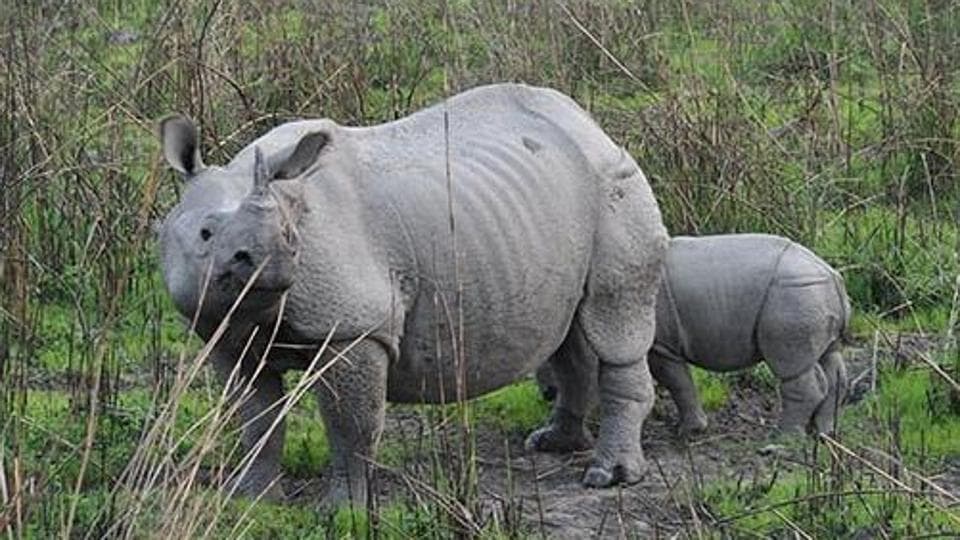
According to information obtained by wildlife activist Rohit Choudhury under RTI, rhinos in Pobitora wildlife sanctuary, located in Morigaon district (nearly 50 km from Guwahati), are suffering as a large area belonging to the sanctuary has not been demarcated and given to the forest department.
“Recent scientific investigation has revealed that the rhino population of Pobitora WLS is showing signs of inbreeding due to the presence of nearly 100 rhinos in a small area of 16 sq km thus resulting in a limited movement of gene flow,” said a letter written by Jitendra Kumar, divisional forest officer (Guwahati wildlife division) to Morigaon deputy commissioner in April this year.
The letter obtained by Choudhury, showed that the Assam government had notified a total area 38.81 sq km (comprising nearly 16 sq km of Pobitora reserve forest, 12 sq km of Raja Mayang Hill reserve forest and nearly 11 sq km of revenue land) as Pobitora WLS in 1998.
But 22 years later, while nearly 28 sq km area of Pobitora RF and Raja Mayang Hill RF are with the Pobitora WLS, the 11 sq km of revenue land is yet to be handed by the district authorities to the forest department.
According to a 2018 census, there are 102 rhinos in Pobitora WLS. Almost all of them are restricted to the 16 sq km area of Pobitora RF as the 11 km revenue land which connects both the reserve forests is still not under control of the forest department.
“It is a cause of great concern that even after 20 years of sanctuary notification, a large chunk of land has not been demarcated on ground by district revenue authority and not handed over to the authorities concerned thereby violating provisions of Wildlife (Protection) Act, 1972 and Forest (Conservation) Act, 1980,” the letter stated.
The delay in handing over revenue land to the forest department has also affected implementation of a 2018 Supreme Court order declaring 10-km area around 21 national parks and wildlife sanctuaries in 8 states (including Pobitora WLS) as eco-sensitive zones (ESZs).
“Rhinos and other wildlife are facing acute space problems because of rampant encroachment within and outside Pobitora WLS in the buffer zone immediately adjoining the sanctuary,” wildlife activist Rohit Choudhury said.
“Most of the attention regarding rhino conservation is focused on Kaziranga National Park, which has over 2,400 members of the species. But are the 102 rhinos of Pobitora WLS less important? Why is the sanctuary yet to be encroachment free even after 22 years after it was notified?” he questioned.
The Morigaon district administration failed to give a proper reason why the 11 sq km of revenue land was yet to be given to the Pobitora WLS.
“I have joined duty in Morigaon last month and am not yet aware of this. Since you’ve brought it to my notice, I’ll talk to departments concerned and see what can be done,” Morigaon deputy commissioner Leena Das said.