


 Live Score
 Cricket Teams
 Cricket Players
Abhishek Sharma is forcing T20 cricket to rethink its oldest trade-off, and his rivals are nowhere near the answer
Abhishek Sharma's latest T20I century underlines a rare mix of extreme scoring and strong average, setting him apart from modern attacking openers.

 Prefer HTon Google


Abhishek Sharma’s 108 off 34 balls against Afghanistan in New Delhi was remarkable even by the standards he has begun to set for himself. He reached his hundred in 30 deliveries, struck nine fours and 11 sixes, and finished with a strike rate of 317.64. It was the fastest T20I hundred by a batter from a Full Member nation, and only two hundreds in the format have been quicker overall.
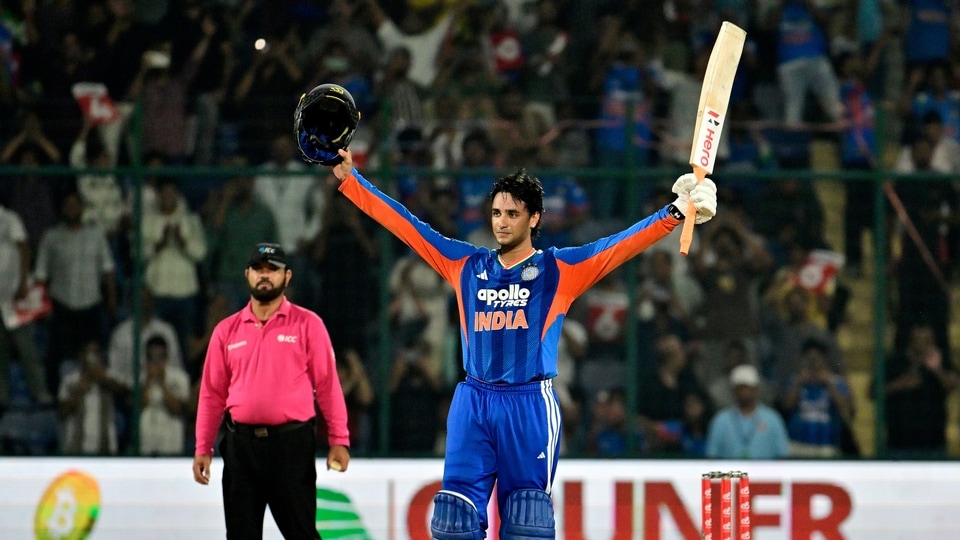
The innings also completed an extraordinary series. Abhishek had already made 82 off 32 balls in the opener and 39 off 19 in the second match. Across three games, he amassed 229 runs off only 85 deliveries, scoring at a strike rate of 269.41. Those numbers alone would be enough to describe a devastating series, but the larger significance lies in what they have done to his career record.
After 58 T20I innings, Abhishek has 1,858 runs at an average of 33.18 and a strike rate of 194.55. That combination is far more revealing than the speed of one century. Modern T20 cricket has produced several openers capable of extreme aggression, but very few have maintained such an average while scoring at anything close to this rate.
The trade-off Abhishek has largely avoided
Deep Dive

Aggressive opening carries an obvious cost. The more frequently a batter attacks high-risk balls, the greater the chance of an early dismissal. Over a long enough sample, that tendency usually reveals itself in the average.
Abhishek’s numbers so far resist that pattern. Phil Salt offers one of the cleanest comparisons because the two have played almost the same number of T20I innings. Salt has 1,717 runs from 56 innings at an average of 34.34 and a strike rate of 165.89. Abhishek’s average is only 1.16 runs lower, yet he scores 28.66 runs more per 100 balls. Finn Allen provides an even closer stylistic comparison. Allen has 1,663 runs from 61 innings, averaging 28.67 at a strike rate of 170.74. Abhishek, therefore, scores almost 24 runs more per 100 balls while averaging 4.51 runs more every time he is dismissed.
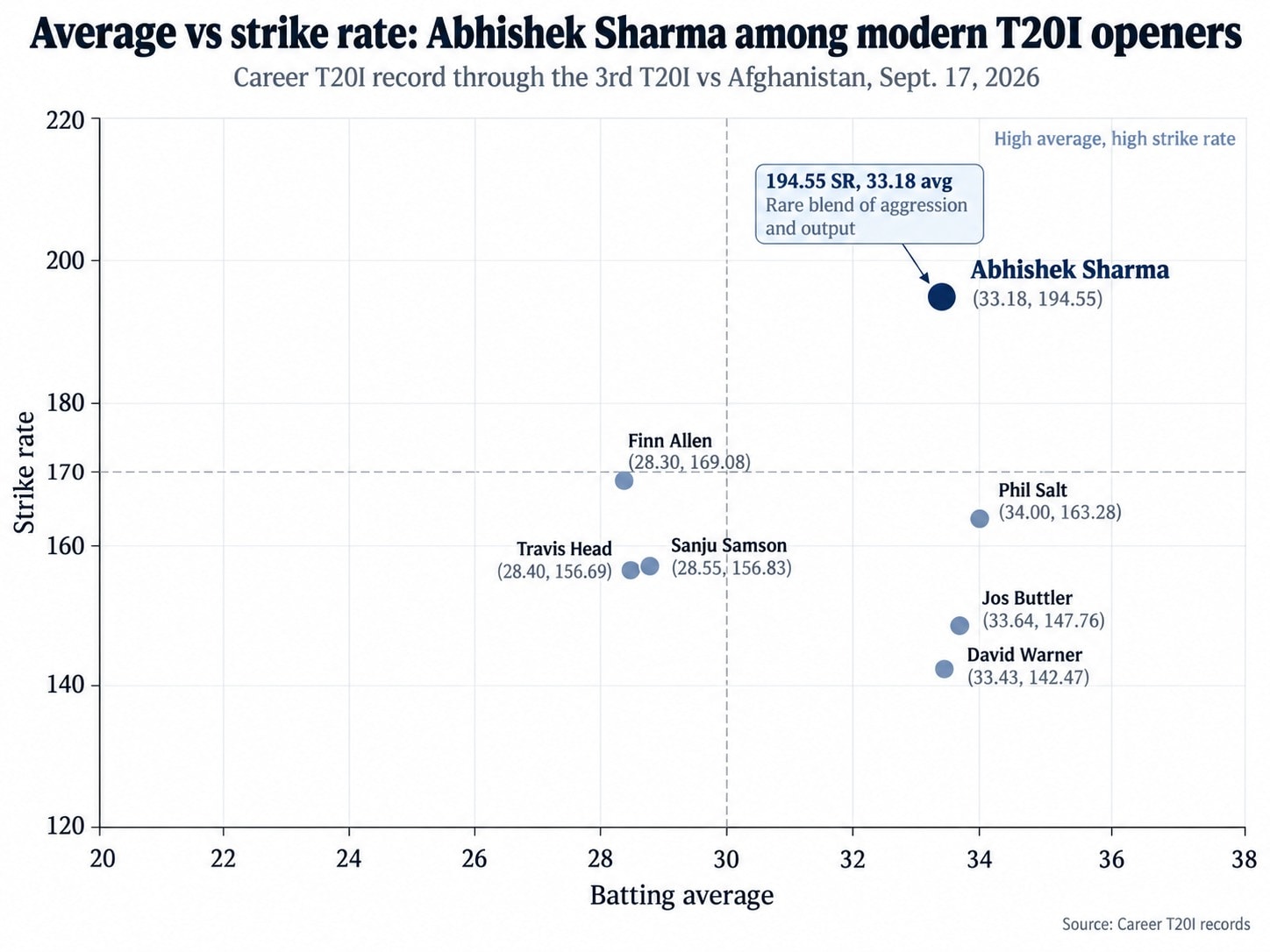
Travis Head’s figures make the contrast even broader. He has 1,335 T20I runs from 51 innings at 28.40 and a strike rate of 156.69. Abhishek scores nearly 38 runs more per 100 deliveries and still averages close to five runs more per dismissal. That is where his record becomes unusual. The strike rate is not merely higher than those of other elite attacking openers; it is higher without the corresponding decline in average that would normally accompany such an extreme scoring rate.
A metric for scoring speed and survival
One simple way of expressing that relationship is through what can be called a Tempo-Return Index. The calculation is straightforward: batting average multiplied by strike rate, divided by 100. The purpose of this metric is to capture how efficiently a batter combines scoring speed with runs per dismissal.
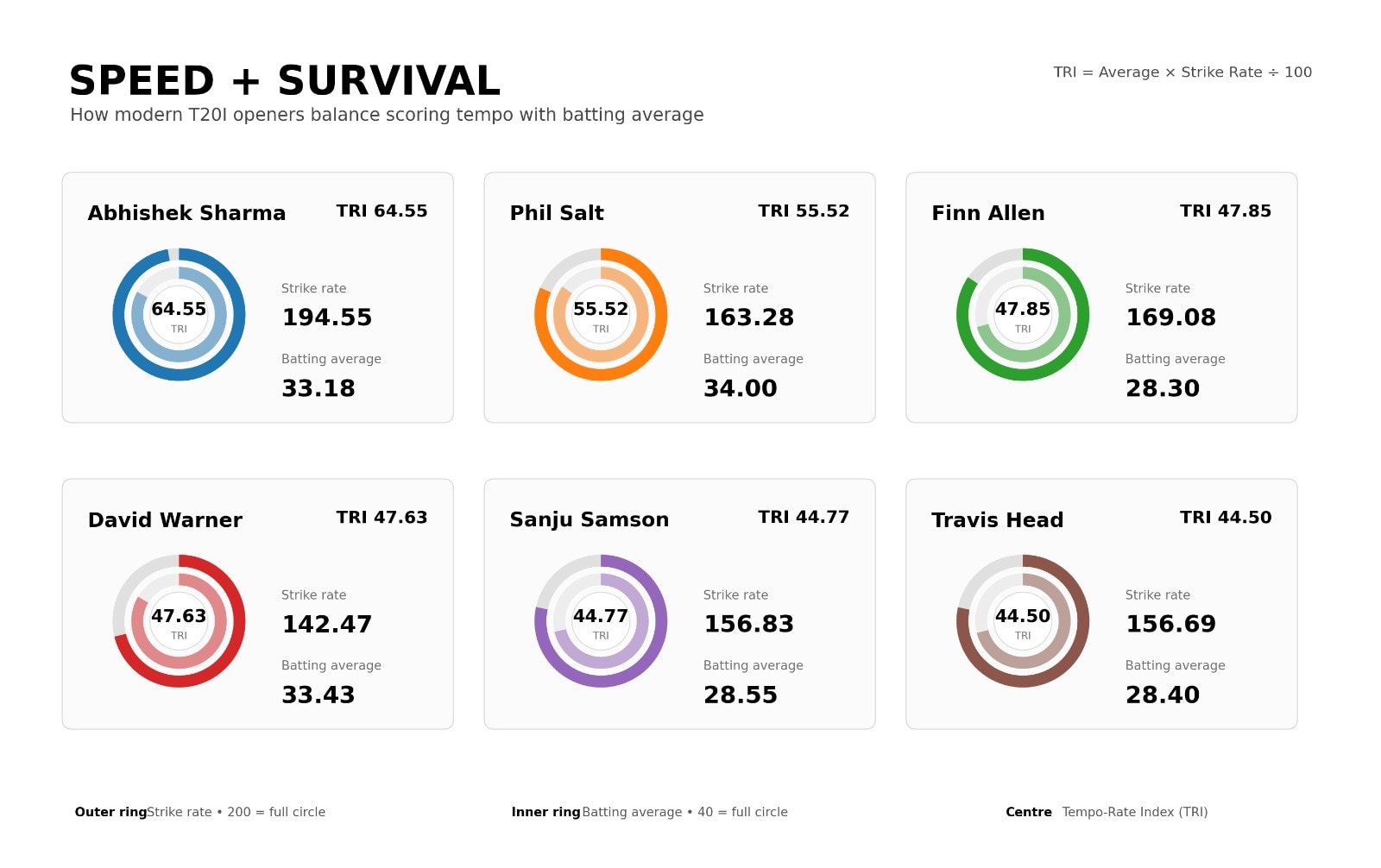
Abhishek’s current Tempo-Return Index is 64.55; Salt stands at 56.97, Allen at 48.95 and Head at 44.50. The gap is substantial, but the metric merely formalises what the raw figures already show. A batter with a very high average compensates for a more conservative strike rate. Another can make up ground through extreme scoring speed while accepting frequent dismissals. Abhishek is an anomaly because he has remained scoring on both axes at once.
That balance becomes clearer when the method behind his runs is examined. Abhishek has faced 955 balls in T20Is and struck 182 fours and 126 sixes. Boundaries account for 1,484 of his 1,858 runs, or 79.9 per cent of his total output. He has hit a six every 7.58 balls. Allen, another of international cricket’s most aggressive boundary hitters, has struck a six roughly once every 8.47 balls. Salt’s corresponding figure is approximately 12.47, while Head’s is around 14.20. Abhishek is therefore not maintaining his average by regularly slowing down after the powerplay or relying heavily on accumulation between boundaries.
The volatility remains part of the model
His approach still produces severe troughs. Abhishek made three successive ducks during the 2026 T20 World Cup, and a later series in Zimbabwe yielded only 11 runs across three innings. Those failures are not separate from his method; they are part of its cost. The Afghanistan series illustrated the other extreme. After those lean periods, he produced scores of 82 from 32, 39 from 19 and 108 from 34. That sequence underlines how India appear willing to judge his role. They are accepting a wider distribution of outcomes because the upper end of that distribution can dismantle a bowling attack before the innings has properly settled.
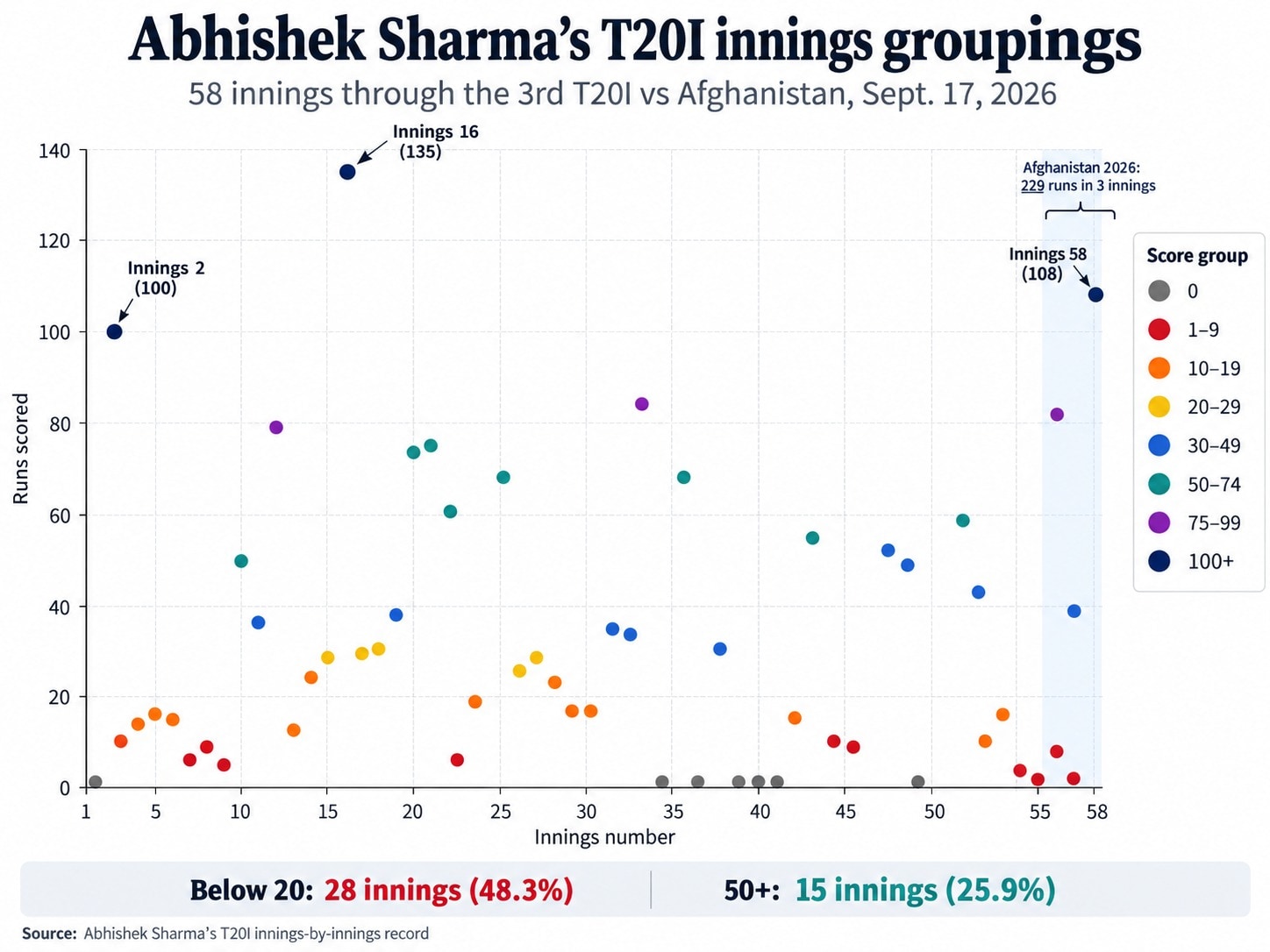
This is also why average matters so much. A strike rate close to 195 could be explained away if it belonged to a batter who averaged in the mid 20s. At 33.18, it becomes something more difficult to dismiss as merely reckless. Abhishek Sharma’s 30-ball hundred against Afghanistan was a spectacular expression of his method. The more important number, however, may be the one sitting beside his strike rate. He is not simply scoring faster than most modern T20I openers. He is doing so while preserving enough batting value to make the traditional trade-off between aggression and survival look far less rigid than it once did.


