E-Paper



G7 Summit: Modi holds talks with Zelenskyy, assures solution to Ukraine war
, Modi noted that he had spoken on the telephone with Zelenskyy over the past one-and-half years but that they were meeting in person after the COP26 conference in Glasgow in late 2021

 Prefer HTon Google


Prime Minister Narendra Modi on Saturday assured Ukrainian President Volodymyr Zelenskyy that India will do whatever is possible to find a solution to the Ukraine war, which he described as an “issue of human values”.
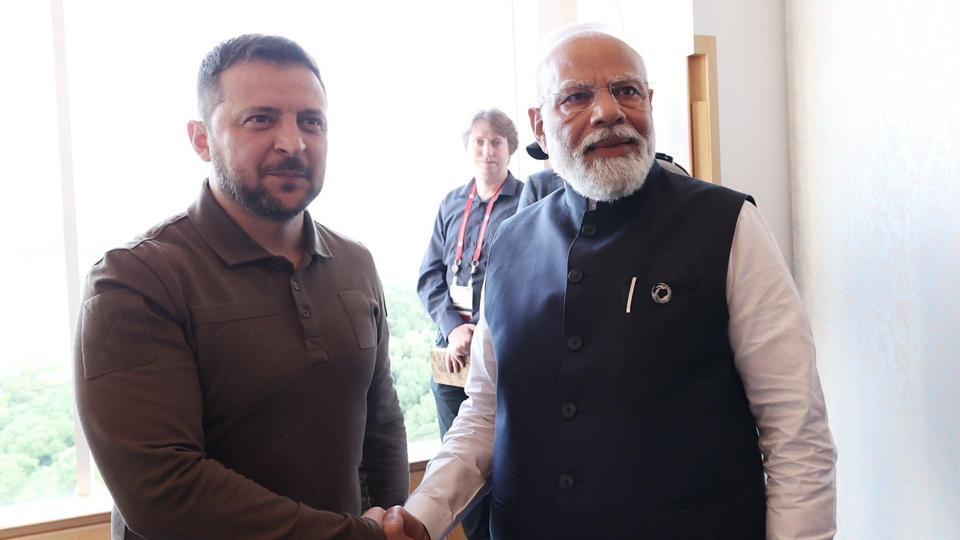
Modi made the remarks during his first in-person meeting with Zelenskyy on the margins of the G7 Summit in the Japanese city of Hiroshima. Flanked by external affairs minister S Jaishankar and National Security Adviser Ajit Doval, Modi sat opposite Zelenskyy, who was clad in his trademark military uniform during the meeting.
In his televised opening remarks at the meeting, Modi noted that he had spoken on the telephone with Zelenskyy over the past one-and-half years but that they were meeting in person after the COP26 conference in Glasgow in late 2021.
Also Read: ‘Democratise technology, build inclusive food system’: PM Modi at G7 summit
“The war in Ukraine is a very big issue for the whole world. It has had many different impacts on the whole world. But I don’t see this as a political or economic issue. For me, this is an issue of humanity, an issue of human values,” Modi said, speaking in Hindi.
“You know more than any of us the suffering caused by war, but when our students came back from Ukraine last year. I could understand the pain felt by you and Ukrainian citizens from the description of the circumstances they gave then,” he said.
Modi added: “I wish to assure you that India and me, in my personal capacity, will do whatever is possible to find a solution to this.”
The Indian leader has spoken to Zelenskyy and Russian President Vladimir Putin several times since the start of the conflict, pushing New Delhi’s position that the sovereignty and territorial integrity of all states must be respected and that there should be a return to diplomacy and dialogue.
At a meeting with Putin on the margins of the Shanghai Cooperation Organisation (SCO) Summit in Uzbekistan last September, Modi nudged Putin to end the conflict by telling him this is “not the era of war” – a call that found mention in the joint communique issued after the G20 Summit in Indonesia.
In April, Zelenskyy sent Ukrainian first deputy foreign minister Emine Dzhaparova to New Delhi with a message for Modi, seeking a greater role for India in efforts to end the war and inviting the Indian premier to visit Kyiv.
Also Read: PM Modi meets Zelensky in Japan, calls Russia-Ukraine war ‘issue of humanity’
India has not publicly criticised Russia’s actions despite considerable pressure from the US and European countries. It has also ramped up its purchase of discounted Russian crude, a move criticised by some Ukrainian leaders.
India, along with China and Myanmar, provided clearance for overflight for the French military aircraft that brought Zelenskyy to Hiroshima from Jeddah, where the Ukrainian leader addressed the Arab League Summit hosted by Saudi Arabia on Friday as part of a fresh push for his 10-point peace plan. Zelenskyy told the heads of Arab states that Ukraine will continue fighting and not submit to any “colonisers”.
The G7 strongly denounced Moscow’s actions on Friday and announced new sanctions to “starve Russia of G7 technology, industrial equipment and services that support its war machine”. A joint statement issued by G7 leaders urged Russia to stop its aggression and “immediately, completely and unconditionally withdraw its troops” from Ukraine, and described Russia’s “irresponsible nuclear rhetoric...and stated intent to deploy nuclear weapons in Belarus” as dangerous and unacceptable.