
 E-Paper



PM Modi at G20 summit: 6-point agenda, AI safeguards, UNSC reforms | Key highlights
During the G20 Summit in Johannesburg, PM Modi presented vital proposals on AI ethics and UN reforms. Read on for a comprehensive gist of his address.

 Prefer HTon Google


World leaders gathered in Johannesburg on Saturday for the G20 Leaders’ Summit, hosted by South African President Cyril Ramaphosa. Prime Minister Narendra Modi arrived in Johannesburg a day earlier and held a series of bilateral meetings, including talks with Australian Prime Minister Anthony Albanese.
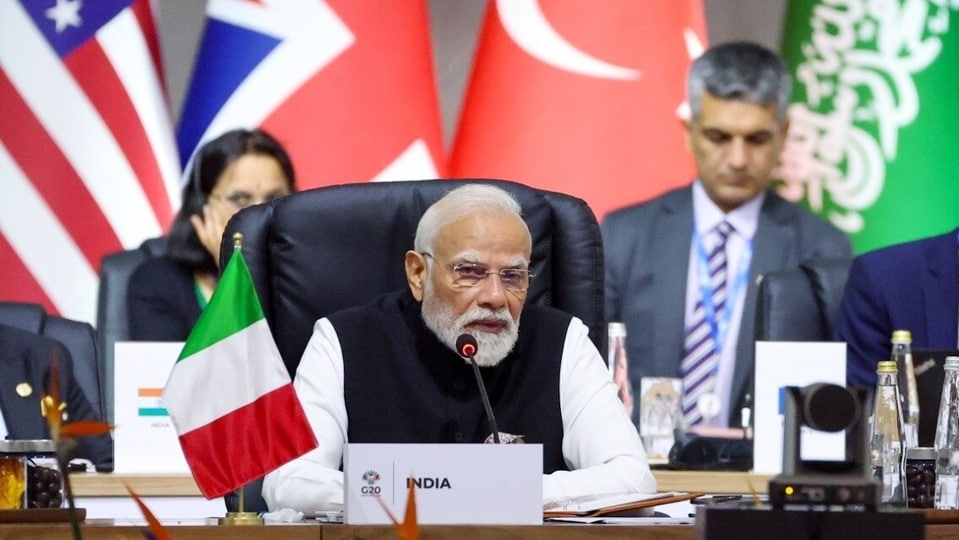
Here is a full overview of the PM’s statements at the G20 summit:
PM Modi’s six-point agenda
During the sessions, PM Modi presented India’s six major proposals for new G20-led initiatives.
- His first point called for urgent action against drug trafficking through a G20 Initiative on Countering the Drug-Terror Nexus.
- Secondly, he proposed creating a G20 Global Healthcare Response Team, comprising trained medical professionals from member countries ready for deployment during crises.
- In support of Africa’s development, Modi suggested a G20 Africa-Skills Multiplier Initiative to build a stronger, future-ready workforce.
- Modi’s other proposals included establishing a Global Traditional Knowledge Repository.
- A G20 Open Satellite Data Partnership, and
- A G20 Critical Minerals Circularity Initiative to improve sustainability and value addition in the minerals sector.
ALSO READ | PM Modi's 6-point agenda, climate deal, US boycott: Five key takeaways from G20 summit
Modi’s call for a global compact on AI
Speaking at the session titled “A Fair and Just Future for All - Critical Minerals; Decent Work; Artificial Intelligence”, PM Modi urged nations to work toward a global compact on AI to prevent misuse. He emphasised that AI technology must remain human-centric, transparent, responsible, and free from abuse in areas like deepfakes, crime, and terrorism, said a report by news agency PTI.
ALSO READ | 'Long live the friendship...': Macron's message for 'dear friend' Modi at G20 Summit
Modi stressed that AI systems affecting public trust should be auditable and accountable, and that final decision-making must rest with humans. He also pushed for a global framework on talent mobility to prepare for the “Capabilities of Tomorrow”.
UNSC reform is a necessity, not an option: Modi at IBSA
On the sidelines, PM Modi addressed the India-Brazil-South Africa (IBSA) Leaders’ Summit. He said reforming the UN Security Council was no longer optional but essential, urging the IBSA grouping to send a strong message for fairer global governance, according to a separate report by PTI.
ALSO READ | G20 to focus on debt sustainability, just energy transition: Top official
Modi proposed institutionalising an IBSA-level NSA meet, creating an IBSA Digital Innovation Alliance, and forming an IBSA Fund for Climate-Resilient Agriculture. He highlighted opportunities for cooperation in digital public infrastructure, green energy, natural farming, disaster resilience and traditional medicine.
Calling IBSA a bridge across three continents and major democracies, Modi invited leaders to India’s AI Impact Summit next year, saying the group could help shape norms for safe and trustworthy AI.
(With inputs from PTI)


