
 E-Paper



PM Modi, Rishi Sunak hold first bilateral talks
India and the UK on Wednesday unveiled a new reciprocal arrangement whereby 3,000 degree educated Indian nationals can come to Britain every year to live and work.


India and the UK on Wednesday unveiled a new reciprocal arrangement whereby 3,000 degree educated Indian nationals can come to Britain every year to live and work, and expressed their commitment to a free trade agreement (FTA) as Prime Minister Narendra Modi and his British counterpart Rishi Sunak reviewed progress in the Roadmap 2030 for bilateral ties.
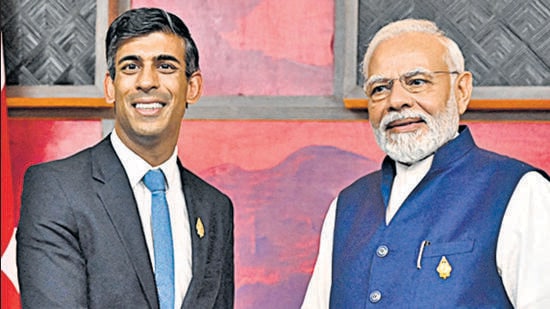
Modi and Sunak, who met for the first time on the sidelines of the G20 Summit in Bali, held talks on collaboration in areas such as trade, mobility, defence and security at a time when the conclusion of an FTA, earlier slated to be finalised by Diwali, has slowed down amid political turmoil in the UK in recent months.
Modi congratulated Sunak, the first person of Asian descent to become UK Prime Minister, on assuming office and the British premier conveyed his thanks for the Indian people’s “overwhelming response” to his appointment.
Modi also held bilateral meetings with French President Emmanuel Macron, Australian Prime Minister Anthony Albanese, Italian Prime Minister Giorgia Meloni, German Chancellor Olaf Scholz, and Singapore Prime Minister Lee Hsien Loong. Regional and global issues, such as the situation in the Indo-Pacific and the Ukraine war, figured in these meetings.
Moidi and Sunak agreed to work together in bilateral and multilateral forums such as G20 and Commonwealth. “They looked forward to the agreement of a UK-India free trade deal, which has the potential to unlock investment and increase jobs in both our countries, as well as expanding our deep cultural links,” said a readout from the UK Prime Minister’s Office.
Sunak welcomed the opportunity to jointly work on challenges such as “ending the war in Ukraine and tackling climate change” under India’s G20 presidency in 2023, the readout said.
The UK-India Young Professionals Scheme, which will be reciprocal and open in early 2023, was confirmed during the meeting and will give young professionals from both countries to participate in professional and cultural exchanges. India is the first country to benefit from such a scheme, which is an outcome of the UK-India Migration and Mobility Partnership signed in May 2021.
The UK will offer 3,000 places annually to 18-30-year-old degree educated Indian nationals to come to Britain to live and work for up to two years.
Sunak said: “I know first-hand the incredible value of the deep cultural and historic ties we have with India. I am pleased that even more of India’s brightest young people will now have the opportunity to experience all that life in the UK has to offer – and vice-versa – making our economies and societies richer.”
The British side described the new scheme as part of Sunak’s emphasis on the importance of the Indo-Pacific to global security and prosperity. India and the UK are currently negotiating the proposed FTA, and New Delhi has made the mobility of students and professionals a key part of discussions. The two sides have missed the Diwali deadline for concluding negotiations, and are now expected to ink the deal next year.
Modi and Macron reviewed collaboration in areas such as defence, civil nuclear, trade and investment during a working lunch. They welcomed the deepening of cooperation in new areas of economic engagement. Macron said in a tweet the two sides “share the same agenda for peace” and will work on this under India’s G20 presidency.
The Prime Minister and German Chancellor Scholz reviewed bilateral cooperation and agreed to deepen trade and investment ties and cooperation in defence and security, migration and mobility, and infrastructure. They also agreed to enhance cooperation in multilateral forums including G20 and the UN.
Modi and Albanese reviewed progress in deepening cooperation in defence, trade, education, clean energy and critical minerals. They also discussed the institutional partnership in education, especially higher and vocational education. They exchanged views on regional issues, including a shared vision for a stable and peaceful Indo-Pacific and climate-related matters.
Lee Hsien Loong and Modi reiterated their commitment to expand trade and investment links between India and Singapore, especially in the fintech, renewable energy, skill development, health and pharmaceutical sectors. Modi invited Singapore to invest in various sectors, including green economy, infrastructure, and digitalisation and to take advantage of the National Infrastructure Pipeline.
Modi appreciated Singapore’s role in India’s Act East policy and both leaders said they will work together to further India-Asean cooperation.
During the meeting with Meloni, who is Italy’s first woman premier, Modi congratulated her on assuming office and discussed the deepening of cooperation in trade and investment and counterterrorism. Modi said he looks forward to welcoming Meloni to India for the G20 Summit next year


