
 E-Paper



‘Political vultures’ vs ‘PM run by Trump’: Modi, Rahul exchange fire over West Asia war impact on India
“You know better than me what is happening” Rahul Gandhi told gathering in Kerala, a state that sends a large number of workers to the Gulf region.


The West Asia conflict figured at the centre of political speeches of Prime Minister Narendra Modi and Opposition leader Rahul Gandhi on Tuesday as both blamed the other for the domino effects on India.
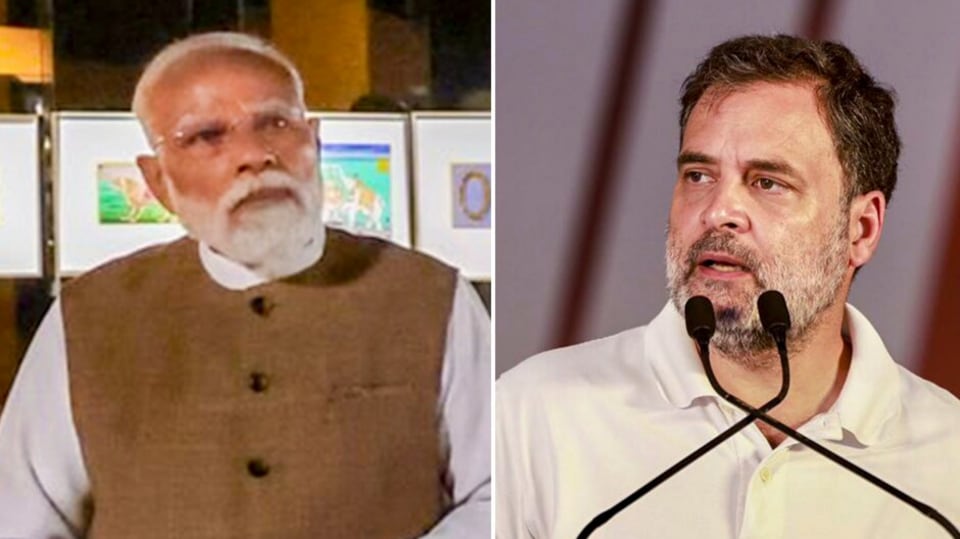
Speaking in Vav-Tharad, Gujarat, PM Modi said India's “effective” foreign policy and the "unwavering unity" of citizens have kept the "situation under control" despite global difficulties regarding oil and related energy requirements.
Addressing a public gathering in his home state after inaugurating development projects, PM Modi said, “The situation unfolding in West Asia is having repercussions across the entire world. Difficulties regarding energy requirements — specifically diesel, petrol, and gas – have escalated globally. Yet, even amidst such a crisis, India has successfully kept the situation under control.”
He alleged that the Congress wishes for the West Asia conflict to escalate so they can "gain political advantage".
"Congress is busy spreading fear and rumours. Congress is actively inciting the public. Like political vultures, Congress is waiting, hoping that troubles will escalate so that it can exploit the situation to gain political advantage," the PM alleged, as per news agency ANI.
Earlier in the day, Lok Sabha Leader of Opposition and Congress MP Rahul Gandhi, at a rally in Kozhikode district in poll-bound Kerala, warned that a “financial earthquake is coming”.
“You know better than me what is happening in the Middle East (West Asia),” he told the gathering, as Kerala sends a large number of workers to the Gulf region.
"You know the drama that is unfolding there. A tragedy is taking place. And nobody knows where it will end, where it will go. And the people of Kerala, the people of India, are going to be directly affected. Fuel prices are going to rise. Inflation is going to go up. An earthquake, a financial earthquake, is coming," he said.
He questioned the BJP-led NDA government at the Centre, as well as the Left front Kerala government, over their efforts.
"Modi cannot do anything. He is run by (US President) Donald Trump. But what is the Kerala government doing to protect you?" he said.
The situation escalated in West Asia after a joint US-Israel military strike on February 28 on Iranian territory resulted in the death of its Supreme Leader, Ayatollah Ali Khamenei, and other senior figures, prompting a fierce response from Tehran.
As of now, reports suggest that the US is preparing plans for the possibility of extended ground operations in Iran for several weeks, as per The Washington Post. But mixed signals continue to come from Trump, while Iran has threatened to hit American companies, including Google and Apple, in the Gulf region.


