
 E-Paper



Post-Covid, Telangana private schools grapple with acute teacher shortage
A trained graduate teacher in mathematics and a post-graduate in sociology, Nagaraju was being paid a paltry salary of ₹10,000 per month at a private school in Huzurnagar in the pre-Covid days. Following a nationwide lockdown in March 2020, the school was closed and he lost his livelihood.


The Covid-19 pandemic has thrown life out of gear for Gotte Nagaraju, a 33-year-old private school teacher in Telangana’s Suryapet district.
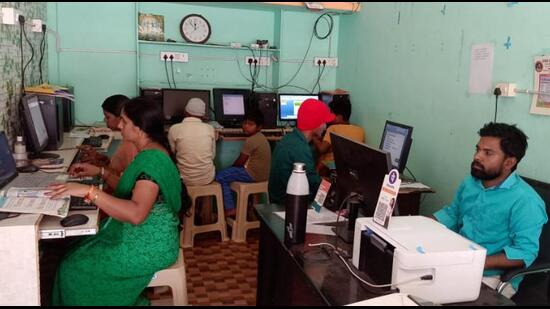
A trained graduate teacher in mathematics and a post-graduate in sociology, Nagaraju was being paid a paltry salary of ₹10,000 per month at a private school in Huzurnagar in the pre-Covid days. Following a nationwide lockdown in March 2020, the school was closed and he lost his livelihood.
Though the school reopened a few months later, the uncertainty continued due to periodical disturbances in the academic year and the introduction of online teaching mode. “I was paid only half the salary that was too little to sustain my family,” he recalled.
Nagaraju gave up teaching last year. With the support of his friends and relatives, he started an internet centre and a computer institute that teaches basic computer languages to the students.
“Now, I am able to earn ₹20-25,000 per month. I have the satisfaction of providing employment to a few people as well,” Nagaraju said. “There is no question of going back to teaching now. The Covid-19 pandemic taught me a good lesson in life,” he said.
So is the case with Badeti Ravi (35) from Nakrekal in Nalgonda district. A post-graduate in English literature and a graduate in education, Ravi struggled to eke out a livelihood for nearly a decade as an English teacher in a popular private school that was paying him just around ₹12,000 per month.
“During the pandemic, the school did not pay me even a single rupee. Frustrated, I gave up the teaching profession that was my passion in the past. After doing some petty jobs, I took up an agency for Life Insurance Corporation (LIC), besides working in a real estate company. This is more satisfying and fetching,” he said.
Like Nagarajy, Ravi, too, has vowed not to return to teaching again. “The same school that I worked at in the past has been calling me, asking me to join the job. The management even offered to increase the salary, but I am not interested,” he said.
The Covid-19 pandemic has taught a new lesson to many youngsters, who had chosen teaching because it is a noble profession and commands respect in society. Since there had been no recruitment in the government schools for the past eight years, they joined the private schools even for meagre salaries.
“But when there was a crisis in the form of pandemic, the private schools, particularly those in rural and semi-urban areas, simply dumped them as they were not in a position to pay salaries,” Sheik Shabbir, president of Telangana Private Teachers Federation, told HT.
Having no other option, many of these teachers have shifted to various other activities. Like P Satyanarayana, a post-graduate in Telugu literature in Suryapet town, who returned to agriculture after working as a manual labourer under Mahatma Gandhi National Rural Employment Guarantee Programme; Zaheer Ahmed, a Hindi teacher from Mancherial, took up painting as a profession and T Praveen from Jagitial who ended up as a fruit seller.
“Some other teachers have opened grocery shops and others, tiffin centres. Some women teachers have taken up tailoring and embroidery as their profession. All of them are happy and are not showing any interest in returning to the teaching profession,” Shabbir said.
According to official figures, there were 11,700 recognised private schools in Telangana during the pre-Covid days, providing employment to 120,350 teachers. “Unofficially, the number of teachers was more than 250,000,” Shabbir said.
However, during the pandemic, nearly 2,000 private schools were wound up due to financial constraints and poor enrolment. “According to the latest estimates, the total number of private schools in the state is around 9,500 to 10,000. And with the teachers shifting to other professions, these schools are facing severe scarcity of qualified teachers,” said Y Shekhar Rao, president of Telangana Recognised Schools Management Association (TRSMA).
Rao said there was a shortage of at least 35-40% of qualified teachers in the private schools, though the admissions in these schools were back to normal. “There has been no response from the candidates to advertisements and other forms of publicity. The teachers are not showing interest though the school managements are offering higher salaries, as they have found other avenues as more remunerative,” he said.
This staff crunch is being witnessed mostly in the semi-urban and rural areas and in medium-scale schools, which account for nearly 70 per cent of the private schools. “Apart from paltry salaries being offered by them, the way these schools treated them during the pandemic is also responsible for the lack of interest among the teachers to return to teaching,” said Vasireddy Amaranth, a prominent academic, who runs a chain of schools in the two Telugu states.
According to Shabbir, most of these schools were facing a shortage of subject teachers – maths, science and social studies, particularly in higher classes, which require trained graduate teachers. “They are able to manage the primary sections with ordinary graduate teachers. But they cannot teach higher classes,” he said.
TRSMA’s Shekhar Rao, however, said it was a temporary phenomenon. “This situation might continue for a couple of years. If there are no further waves of Covid-19, the situation will become normal and we are hopeful that more qualified teachers will be available for the private schools,” he said.


