
 E-Paper



Protests, cross-FIRs, now a ban at DU: Why campus is on the boil over UGC rules against caste discrimination | Explained
Delhi University became centre of storm over UGC's anti-casteism regulations, which have been stayed for now by the Supreme Court over definitions

 Prefer HTon Google


When Delhi University (DU) on Tuesday issued an order banning all public meetings, processions, and demonstrations on the campus for a period of one month, it did not expressly mention the nub of the issue — the UGC's rules against caste discrimination — but it underlined that recent protests had turned violent.
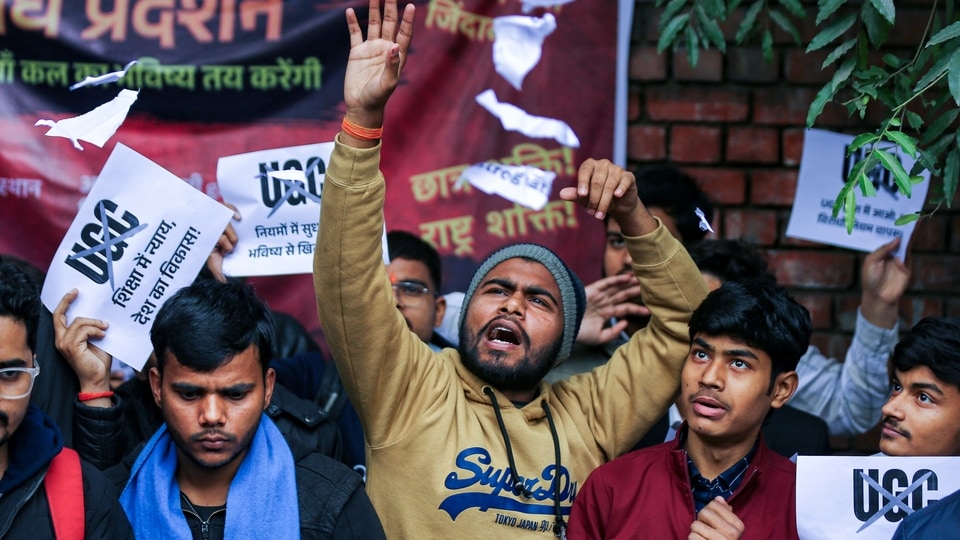
The premier university in the national capital finds itself at the epicentre of a storm over the University Grants Commission’s (UGC) anti-casteism regulations, which have been stayed for now by the Supreme Court.
DU's order, issued by the office of the proctor on February 17, 2026, cites "information received indicating that unrestricted public gatherings... may lead to obstruction of traffic, threats to human life, and disturbance of public peace". The restriction prohibits the assembly of five or more persons, the shouting of slogans, and the carrying of hazardous materials like mashal or torches.
Immediate trigger of DU ban on protests
The university’s decision to shut down protests for a month is not an isolated administrative reflex, but a response to a series of events that rocked mainly the North Campus over the past week.
On February 13, a demonstration supporting the UGC (Promotion of Equity in Higher Education Institutions) Regulations, 2026, descended into chaos. Organised by the All India Forum for Equity, and backed by the left-wing All India Students’ Association (AISA), this protest saw a face-off with members of the RSS student wing, the ruling BJP-affiliated Akhil Bharatiya Vidyarthi Parishad (ABVP).
A YouTuber identifying herself as a Brahmin journalist alleged that she was assaulted and subjected to “rape threats by a mob of nearly 500 people”.
Videos shared by AISA members and others showed she made casteist remarks and shoved a woman to the ground too.
The YouTuber claimed the crowd turned on her after asking about her caste. "The girls around me whispered rape threats in my ears just because I am a Brahmin; 'aaj tu chal, tera nanga parade niklega,' is what they said," she told reporters, alleging that police “remained passive”.
Counter-narratives emerged almost immediately.
AISA activists and another journalist said the woman provoked the crowd and attempted to snatch equipment from other reporters.
The Delhi Police later registered cross-FIRs at the Maurice Nagar police station, invoking sections of the Bharatiya Nyaya Sanhita (BNS) related to molestation, assault, and criminal intimidation.
Root of the row: 2026 equity regulations by UGC
At the heart of this turmoil are the UGC's 2026 regulations, notified on January 13, which were intended to replace the existing 2012 anti-discrimination guidelines.
These rules mandate that all higher education institutions (HEIs) establish Equity Committees, Equity Squads, and dedicated helplines to address discrimination.
The regulations were framed following a Supreme Court order on a petition filed by the mothers of Rohith Vemula and Payal Tadvi, both of whom died by suicide following alleged caste-based harassment on their respective campuses.
The new framework aims to provide a more robust mechanism for students from Scheduled Caste (SC), Scheduled Tribe (ST), and Other Backward Class (OBC) communities to seek redressal.
However, this sparked a backlash from General category or so-called upper-caste students, even faculty and others. They argue that the regulations are built on a "narrow definition" of discrimination — specifically, Regulation 3(c) defines "caste-based discrimination" as actions directed only against SC, ST, and OBC communities.
What top court said on UGC regulations
Amid protests starting from mid-January, the battle moved to the Supreme Court, which by January-end stayed the operation of the new regulations. A bench headed by Chief Justice of India Surya Kant commented there was "complete vagueness" in the rules and there was also potential for misuse.
It observed that the definition of caste-based discrimination was problematic.
"After 75 years of trying to make a caste-less society, whether the direction of policy-making is progressive or tending towards a regressive approach," the bench opeined, noting that the rules could divide society and cause “dangerous impacts”.
Petitioners against the rules, including researcher Mritunjay Tiwari and advocate Vineet Jindal, argued that the rules violate the constitutional guarantee of equality.
"The regulation wrongly assumes caste-based discrimination flows in only one direction," Mrityunjay Tiwari contended, arguing that it leaves General category students without institutional protection if they face harassment based on their caste identity.
For now, until the SC decides on the constitutional validity of the 2026 rules, it has directed that the older, 2012 regulations will continue to apply.
Political and academic fallout of UGC rules
The row has divided the political and academic landscape as well. Union education minister Dharmendra Pradhan attempted to soothe nerves: “I want to humbly assure everyone (that) no one is going to face any harassment... no one will have the right to misuse the regulation in the name of discrimination."
But senior advocate Indira Jaising, known for taking up rights cases, characterised the protests mainly by General category students as an "Upper-Caste reaction to the efforts of the SC, ST and OBC communities to deal with issues of discrimination".
But even Shiv Sena (UBT) leader Priyanka Chaturvedi questioned the implementation, asking on social media, “How should discrimination be defined — through words, actions, or perceptions?”
Within Delhi University, the one-month ban on protests has elicited some resistance. Mithuraj Dhusiya, an associate professor at Hansraj College, described the move as a “blanket clampdown”. Speaking to news agency PTI, Dhusiya questioned whether the administration was using traffic concerns as a pretext to "curb mobilisations over issues such as appointments... and the recent suspensions of teachers".
Not confined to DU
The unrest is not limited to DU, or to just university campuses.
At Jawaharlal Nehru University (JNU) in Delhi, the administration recently rusticated four student union office-bearers, including union president Aditi Mishra, for two semesters. The students were accused of vandalizing university property, including facial-recognition gates at the library, during protests that included opposition to suspension of the UGC's equity regulations. There have been protests at public universities in Lucknow, UP; and Hyderabad, Telangana, too
In Uttar Pradesh, the row reached Bareilly, where City Magistrate Alankar Agnihotri was suspended after escalating his protest against the state administration and the UGC rules, claiming they were "highly detrimental to the country" and had sparked outrage among Brahmin organisations. That was before the SC halted the rules.
DU vice-chancellor Yogesh Singh has, meanwhile, made a public plea for restraint, urging teachers and students to maintain trust in the judicial process.
"Social harmony is the greatest thing, and maintaining it is the duty of all of us," he said in a statement. "I appeal to all teachers and students of the university to maintain their trust in the Government of India and await the decision of the Hon’ble Supreme Court".
Politics on the issue has been cagey, guarded at best, as parties avoid angering either side.
After the SC's stay on the rules, the ruling BJP refrained from making any comment on the rules, The government is committed to ensuring "justice for all", BJP MP and national spokesperson Sudhanshu Trivedi said, when asked about the issue.


