
 E-Paper



Quota to be a poll plank but unclear if BJP will field more women candidates
While delimitation cannot be conducted till 2026, there is no word on when the census will be carried out

 Prefer HTon Google


The new law that reserves 33% seats for women in the Lok Sabha and legislative assemblies will be a major poll plank in the assembly polls in five states and 2024 general elections, where the ruling Bharatiya Janata Party’s outreach will be designed to focus on women’s issues and policies.
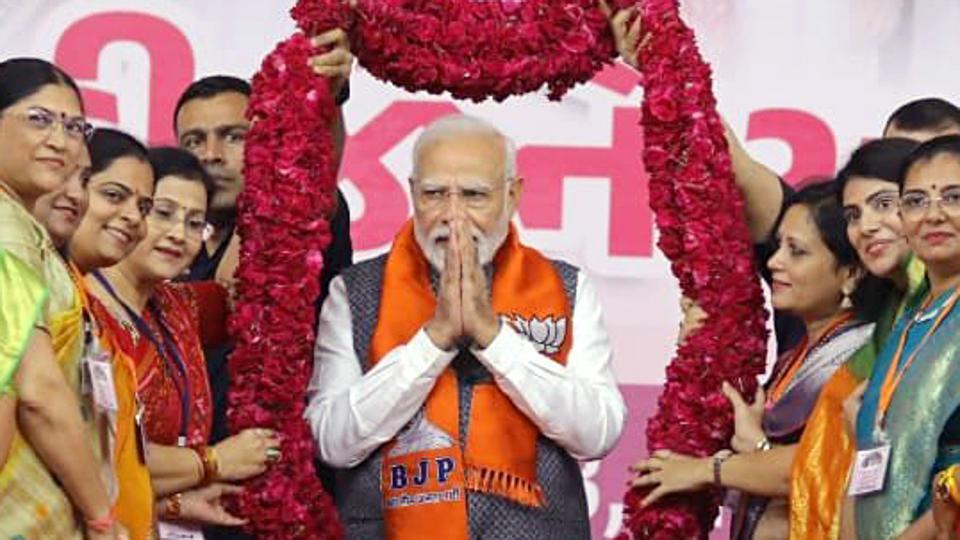
It is, however, not clear whether the party will field more women candidates.
We are on WhatsApp now. Click to join.
The law, known as the Nari Shakti Vandan Adhiniyam, will not come into effect anytime soon, as the implementation has been tied to the delimitation exercise to redraw constituencies and conduct of the decennial census; it must also be ratified by 50% of the states. While delimitation cannot be conducted till 2026, there is no word on when the census, which has already been delayed, will be carried out.
For the BJP that earmarks 33% of all posts in the party for women and has been gradually increasing the number of women candidates in elections, it will be tightrope walk as all eyes will be on whether the party makes a conscious decision to field more women in the upcoming election season.
There is no plan at present to field 33% women candidates in poll-bound states of Madhya Pradesh, Rajasthan, Mizoram, Telangana and Chhattisgarh, but the overall number will be decided based on a candidate’s chances of winning, said party functionaries who spoke on condition of anonymity.
“The party has been encouraging and grooming women leaders. The number of women MPs, legislators and ministers has been on the rise, and the party is committed to reserving 33% seats for women, but it may not happen in the upcoming elections,” a party functionary said.
Citing the example of Madhya Pradesh and Rajasthan, states that have had women chief ministers, the functionary said that social practices prevalent in some communities and regions act as barriers to women from being part of electoral politics.
“It is not uniform across the states, but there are regions or caste groups that tend to prefer men in public life. The process to change the mindset has already begun; the government too focuses on women-centric issues, and we are hopeful that when reservation is implemented, there would be no impediments to women getting their rights,” the functionary said.
In the 2018 poll, the number of women legislators in 230-member Madhya Pradesh assembly declined from the previous 31 to 17. Of these, eight were from the Congress and nine from the BJP (one more was added in a subsequent by-poll). In 2018, BJP had 24 women contestants and in 2013, it gave tickets to 28 women.
“There was a dip in the number of women given tickets, based on the feedback from constituencies,” the leader quoted above said. In the two lists of candidates released for the upcoming polls, there are 11 women among 79.
In the 200-member Rajasthan assembly, there has been a steady increase in women’s participation. In 2018, there was an increase in the number of women candidates, with 189 given tickets, the highest number in over a decade. The BJP gave tickets to 25 women in 2013, of which 19 won, and 23 in 2018, of which 10 won.
“The state has been led by a woman CM (Vasundhara Raje); there have been ministers and MLAs too. Women from the royal families, or from political families taking the lead is encouraging others; but for the change to be substantial, we need more women at the grassroots, at the panchayat and local bodies,” said a second leader.
Women voters outnumber men in the desert state. They also came out larger numbers to vote in 2018, with voter percentage at 74.66%, higher than the male voter turnout of 73.80%.
In Chhattisgarh and Telangana, too, the party is looking at increasing the percentage of women candidates. In Chhattisgarh, where the party has released the first list of 21 candidates, five are women. In 2013 and 2018, the number of women candidates in the 90-member assembly was 14 and 11, respectively, but only six and one emerged winners.
“There was an overall apathy towards the BJP from a large section of tribal and women voters in the state. That was a reason why both women and male candidates fared badly,” said the first functionary.
The party will also have to focus on fielding more candidates in Telangana, where it fielded 14 women in 2018 and five in 2013, and in Mizoram, where six women candidates fought on party tickets in 2018 and three in 2013.
Prime Minister Narendra Modi has given instructions to ensure there is adequate representation of women among the candidates, a third party functionary said. “When the central election committee meets, he always asks about the number of women candidates that are on the list,” he said.
Since all the political parties have supported women’s reservation, they should consider fielding more women without waiting for the delimitation and census, the prerequisite for implementation, said Ranjana Kumari, director of the Centre for Social Research, a think tank.
“We did not need the law to reserve seats for women. It was done because parties made excuses not to give seats to women,” she said. “Now that they have all agreed in principle to reserve 33% seats for women, why wait till 2029 (for the implementation)?”
The absence of a provision for reserving seats for other backward class women from the law should not prevent parties from giving them more tickets, Kumari said. “If they want to give seats, they can choose women from the OBC communities to show their commitment to the cause.”


