E-Paper



Rain deficit: Centre asks states to focus rural job scheme on water works
The Centre also shared lists of districts reporting deficient rainfall and those considered vulnerable to El Nino, and asked states to tailor works to local conditions

 Prefer HTon Google


The Centre has asked states to use the Viksit Bharat–Guarantee for Rozgar and Ajeevika Mission Gramin (VB-G RAM G) to prioritise water conservation and drought-mitigation works, as it looks to use the rural employment programme to accelerate water related works.
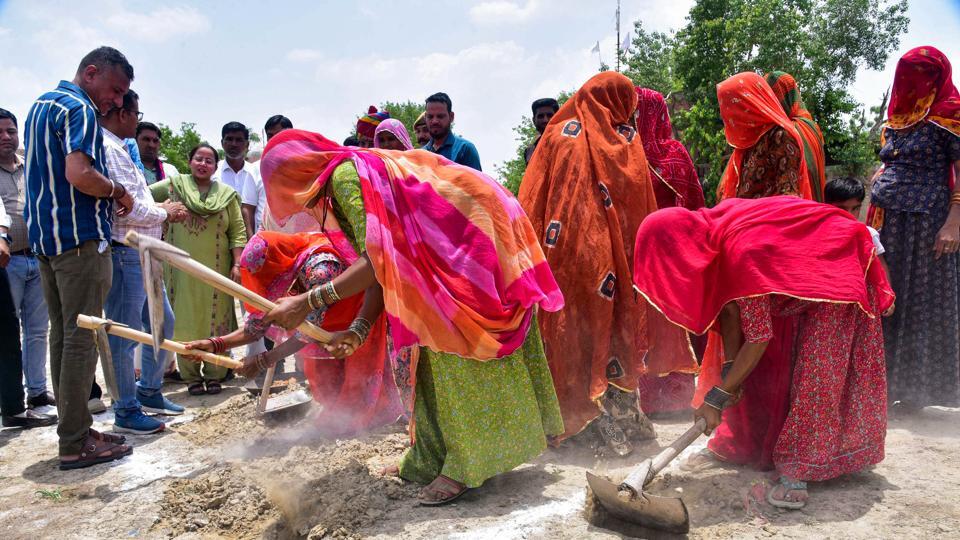
The rural development ministry told the states and Union Territories at a recent meeting to prioritise water harvesting, groundwater recharge, irrigation, watershed development and other natural resource management works, particularly in rainfall-deficient districts. It has also shared with states lists of districts reporting deficient rainfall and those considered vulnerable to El Nino, asking them to tailor works to local conditions.
The nudge comes at a time more than 40% of India’s meteorological subdivisions continue to report deficient rainfall.
Total rainfall in the Southwest monsoon season between June 1 and Aug 26 was 13% deficient.
Data shared by the rural development ministry with HT show that water conservation has emerged as one of the biggest categories of work under the programme. Of the total 9.3 million ongoing works, about 30% or 2.8 million are water related, the data showed.
These cover activities such as farm ponds, check dams, wells, micro-irrigation systems, water body renovation and recharge pits, a senior official of the rural development ministry told HT.
“While small works such as farm ponds, small wells, desiltation of water bodies, recharge pits etc will be completed sooner this year-- which may be able to help farmers during rabi sowing, help with groundwater water recharge-- other larger works may take slightly longer, which will help in long term increase in irrigation potential,increase in storage capacity, source sustainability of drinking water sources etc,” the official explained.
Not all of these, however, are new works which began under the revamped July 1 scheme. “Some of these works may have begun in May or June as generally water harvesting works are started pre-monsoon season in the summers,” the official added.
The official said the states were told to spend at least 65% of water-related expenditure under the National Water Security Initiative in over-exploited and critical groundwater blocks, 40% in semi-critical blocks and 30% in safe blocks. Water-stressed blocks identified by the Central Ground Water Board have also been mapped on the programme’s management information system, official added.
The ministry said the new scheme has already begun implementation in more than 160,000 gram panchayats, covering around 750,000 works, and has generated over 30 million persondays of employment since its rollout on July 1.
But experts said targets alone do not guarantee better outcomes.
“If the pressure becomes one of meeting a percentage, officials may end up finding enough ‘water works’ to achieve that target. Then we may have very impressive numbers on the MIS without necessarily improving water security on the ground,” Chakradhar Buddha, senior researcher at LibTech India, a not-for-profit research organisation, said.
The bigger question, he underlined, was not just how many water-related works were being undertaken but also how they are being selected.
“The more important question for me is how these works are being identified,” Buddha said. “What role are gram panchayats, gram sabhas and communities actually playing? Quite often it feels like the priorities and works are being decided somewhere above and coming down to the village, rather than emerging from a discussion within the village about what people actually need.”
The Centre has identified 315 El Nino-vulnerable districts including 111 high-priority districts where states have been advised to prioritise water conservation, groundwater recharge, irrigation and drought mitigation works.
Whether these interventions will help this monsoon, however, remains an open question.
According to Buddha, completing or restoring existing tanks, ponds, channels and check dams could improve water availability if rainfall picks up later in the season. “But newly created large numbers of assets cannot automatically be seen as an immediate response to rainfall deficiency,” he said, adding that the wage employment generated by the works may be as important in the short term as the assets themselves.
The government has left open the possibility of additional measures if the monsoon deficiency is higher than expected.
The Viksit Bharat - G RAM G Act does allow states to seek operational relaxations during natural calamities, including expanding the list of permissible works or providing additional wage employment. The ministry said any decision would depend on how the monsoon evolves and recommendations received from state governments.
Rohit Kansal, secretary in the ministry of rural development said,” Climate resilience has been embedded as a core design principle of the scheme. By converging demand-driven employment with investments in water security and sustainable natural resource management, the programme seeks to create durable community assets and improve ecosystem resilience. This integrated framework enables local planning to respond to emerging climate challenges even while ensuring-term livelihood security.”