E-Paper



Rapid antigen kits key in scaling up Covid-19 testing
An antigen is a protein (in this case present on the virus) that induces an immune response in the body in the form of production of antibodies against a disease, and detecting its presence through an antigen-based test determines a present infection.

 Prefer HTon Google


With at least 400,000 tests conducted for the second day in a row till Sunday morning , India is clearly ramping up its coronavirus disease (Covid-19) testing, with the introduction of rapid antigen testing being the key behind the sudden sharp increase in testing -- from around 250,000 tests a day a month ago.
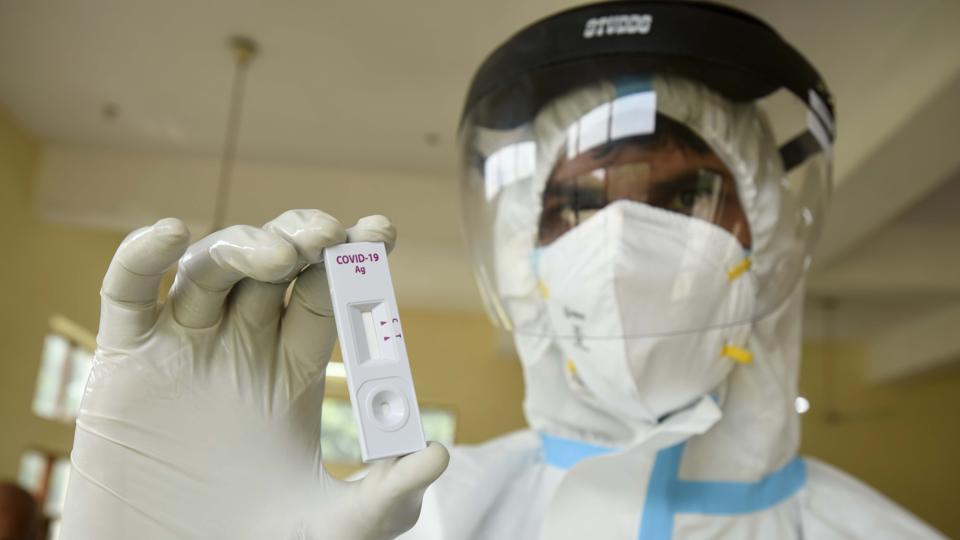
Nearly one in four Covid-19 tests for diagnosing the viral disease conducted currently uses a rapid antigen test kit.
An antigen is a protein (in this case present on the virus) that induces an immune response in the body in the form of production of antibodies against a disease, and detecting its presence through an antigen-based test determines a present infection.
According to the Union health ministry data released on Sunday, 4,42,263 tests were done in the previous 24 hours across roughly 1300 approved laboratories across the country.
Of this, nearly one lakh samples were tested using rapid antigen based testing kits to diagnose Covid-19. The rest were the fold standard reverse transcription polymerase chain reaction (RT-PCR) tests.
India aims to increase its testing capacity to one million tests per day on average in coming weeks.
“Antigen testing has also played its role in ramping up Covid-19 testing as it’s quicker, easier to perform and cheaper than RT-PCR,” said Harsh Vardhan, Union health minister.
India has conducted almost 10.6 million tests since January 22.
The antigen based kit largely being used currently, especially by governments, is Indian Council of Medical Research approved ‘Standard Q COVID-19 Ag detection kit’ developed by SD Biosensor, a South Korea based company that has its manufacturing unit in Manesar, Gurugram.
Delhi was the first state to start antigen based Covid-19 testing last month, and other states that have deployed antigen testing in a significant way include Maharashtra, Gujarat, Karnataka, Telangana, Uttar Pradesh, Punjab and some north Eastern states.
Experts say it is a good tool to perform mass testing.
“Since positives results are confirmed positives, it will work in picking up cases, even if it is not able to pick up all cases. In areas where the viral load is very high it should work well, and that’s what we want -- that cases are tracked early. RT-PCR is a better test but can’t be deployed on mass scale as it’s not only cumbersome and expensive but also takes much longer. It’s ok to conduct confirmatory negative tests through RT-PCR,” said Dr Amita Jain, head, microbiology department, King George’s Medical University, Lucknow.
According to health ministry, lower rate of Covid-19 deaths can also be attributed to aggressive testing along with improved hospital infrastructure by combining public and private sector efforts that enabled early identification of Covid-19 patients.
India’s case fatality rate as on Sunday was 2.31%. Patients are also recovering in large numbers on a daily basis, and Saturday’s government data showed highest recoveries in a single day of 36,145 Covid-19 patients. The total number of recoveries has reached 8,85,576, with the current recovery rate of 63.92%.
“Most positive cases do not require hospitalization, and those needing intensive care is actually a minuscule number. Most people who are in hospital have got moderate disease with good chances of recovery. The need is to take care of our old and vulnerable population, especially those with co-morbidities, who are at high risk of developing severe illness,” says Dr Rommel Tickoo, senior consultant, department of internal medicine, Max Healthcare.
...