
 E-Paper



Red Fort bomber Umar Un Nabi used shoe-triggered device: NIA probe rules out accidental explosion
The attack, linked to Al-Qaeda affiliates, killed 12 and injured 29, indicating serious terrorist intentions.

 Prefer HTon Google


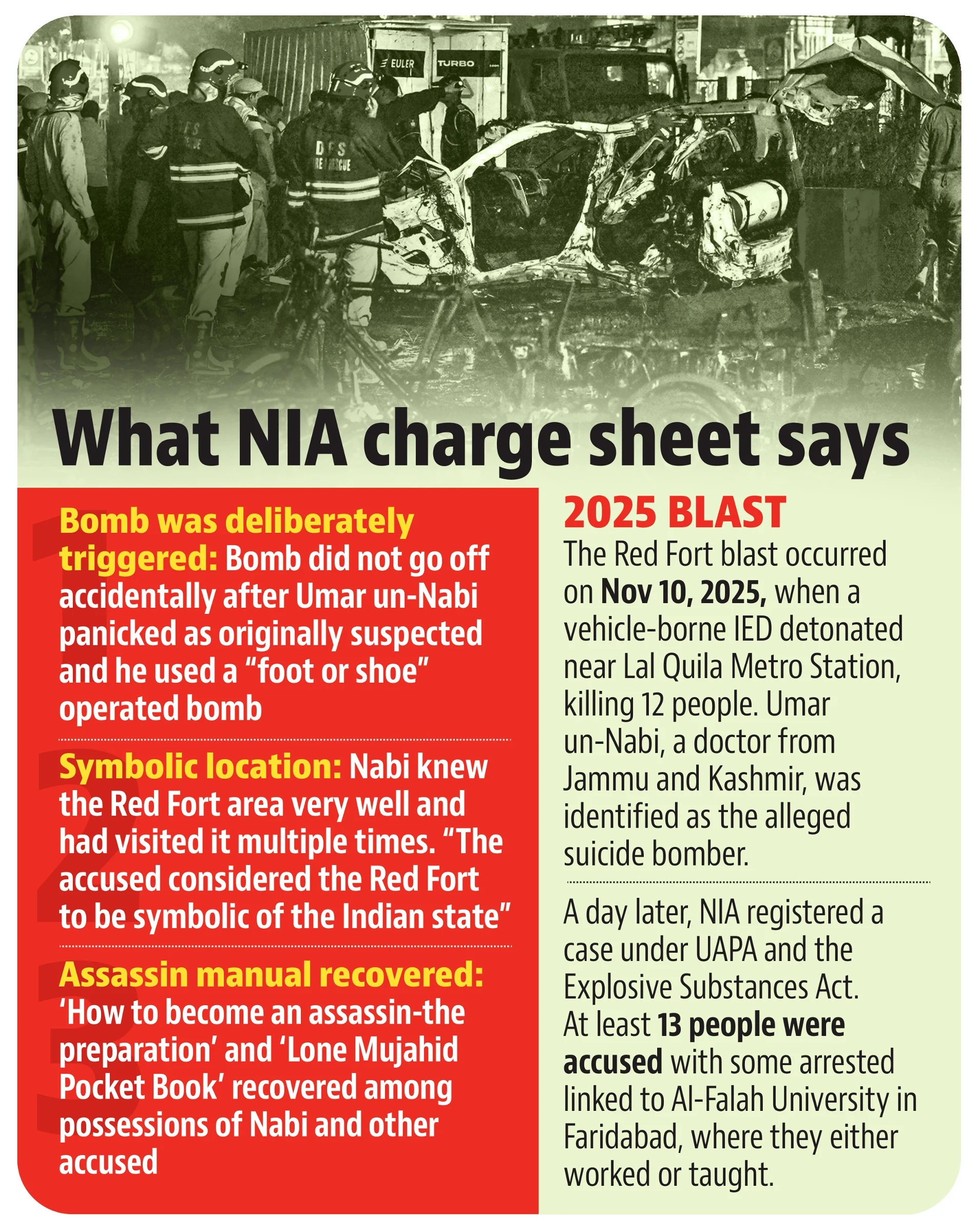
Dr Umar Un Nabi, the bomber in last year’s Red Fort terror attack used a “command mechanism” through a piezoelectric plate attached to his shoe to trigger the explosion, effectively making it a “foot or shoe” operated bomb, the National Investigation Agency (NIA) said in its charge sheet. The agency’s discovery removes the ambiguity that the bomb may have gone off accidentally after Nabi panicked, and establishes that it was deliberately triggered at Red Fort, considered by the group as a symbol of the Indian state.
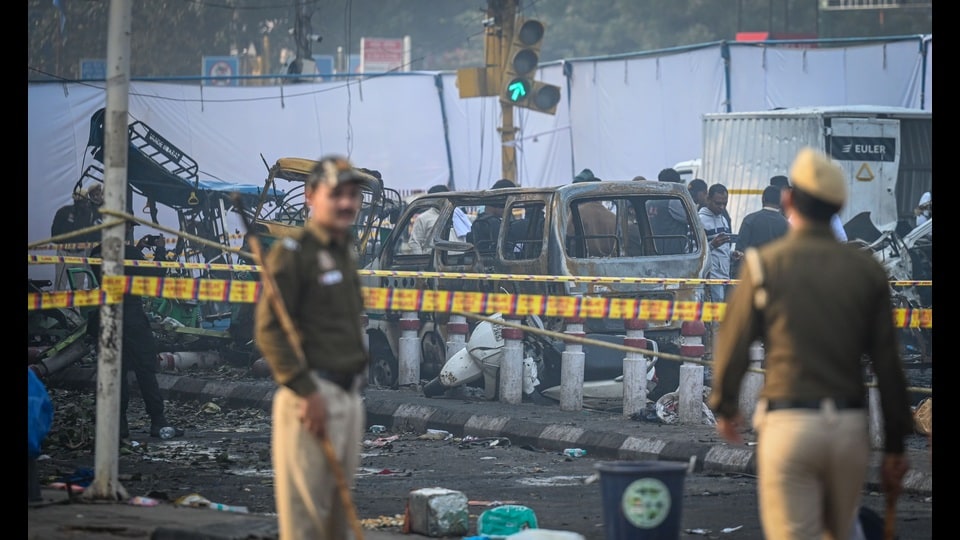
The federal agency filed a charge sheet in the bombing in May this year against 10 individuals but a Delhi court took cognizance of it only on August 29. HT has reviewed the document. Twelve people including Nabi were killed in the attack, 29 were injured and 24 vehicles were damaged in the blast, which was carried out by a group of doctors associated with Ansar Ghazwat-ul-Hind (AGuH), an affiliate of Al-Qaida in the Indian Subcontinent (AQIS).
Suicide bombing, ‘command mechanism’ through shoe:
Detailing how the bombing was carried out, the NIA charge sheet says that forensic reports conclusively established that a vehicle-borne IED was involved in the explosion. “A Red-Tape brand shoe with metal piece attached to the heel of only one shoe seized from the blast site, indicates a command mechanism was used for controlling the IED”.
“The swab taken from the nasal orifice, confirmed to be a body part of Nabi by DNA fingerprinting, tested positive for TATP (tri-acetone tri-peroxide) and ammonium nitrate. This shows that Nabi was inside the car at the time of explosion, and the IED was initiated by him using the command mechanism”, the charge sheet says.
The IED was developed by co-accused Jasir Bilal Wani, who is an explosives expert, using a transducer technique. In this, NIA explains in the charge sheet, a piezoelectric plate converts mechanical energy (pressure/vibration) into electrical energy, or vice versa, using special ceramic materials. When compressed, it produces a voltage. When voltage is applied, it vibrates or deforms to act as an actuator or transducer -- which converts one form of energy into another.
NIA claims to have established that Wani handed over the piezoelectric plate to Nabi, and that its seizure from the latter’s shoe at the blast site and analysis by explosives expert led to the conclusion that Nabi used “this trigger mechanism for causing the explosion in Hyundai i20 car laden with explosive material”.
Also Read | Court takes cognisance of Red Fort blast charge sheet
Why Red Fort:
Nabi, the NIA charge sheet reveals, knew the Red Fort area very well and had visited it multiple times. The agency has listed 12 occasions between December 2023 and May 2025 when Nabi, either alone, or with Dr Muzamil Shakeel and Dr Shaheed Saeed, visited the area. Besides, they bought electronic items for the IED from the Red Fort area.
“..the accused considered the Red Fort to be symbolic of the Indian state and handwritten notes seized from Nabi’s premises at Al-Falah University clearly mentioned that the AGuH members were against democracy and wanted the imposition of Shariat laws in India. Therefore, causing the blast near Red Fort, besides being a terrorist act, also amounts to waging war against the State. With this view, they had visited the adjoining areas of the Red Fort several times,” the charge sheet added.
Was somebody else to carry suicide bombing in 2025?
The NIA charge sheet reveals that Nabi and arrested member of AGuH Muzamil Shakeel were always looking for people they could radicalise to strengthen their group. Nabi, Shakeel and Saeed even targeted potential targets among students and fellow doctors in pursuit of the said objective.
Nabi convinced co-accused Jasir Bilal Wani and Yasir Ahmad Dar, a resident of Shopian (arrested in December 2025), to join the terror group, the agency said. “Wani and Dar were also motivated by Nabi and Irfan Ahmad Wagay (arrested ideologue) to become suicide bombers ...,” the charge sheet says.
“In November 2024, Nabi called Dar to Iqbal Park, Srinagar, and met him along with Wagay. Both radicalised Dar further and Nabi code-named him “45”. Shakeel also met Dar in Pulwama and assured him when the time comes, he would be called for the sake of Islam. In May-June 2025, Nabi and Wagay gave an oath of self-sacrificial operation, which was recorded in Wagay’s mobile”.
In August 2025, NIA says, Nabi asked Dar to be ready for ‘Shahadat’ (bearing witness to faith). But finding that he (Dar) was not ready, Nabi took his (Dar’s) mobile and deleted all chats on Telegram between them and others.
Also Read | Delhi court allows NIA to dispose remains of Red Fort blast victims
How the group was financed:
Dr Shaheed Saeed, a doctor from Lucknow who married Muzamil Shakeel, played a key role in financing this AGuH group, which called itself ‘AGuH Interim’. AGuH was formed in July 2017 by Zakir Rashid Bhat alias Zakir Musa, once a close aide of Burhan Wani, after parting ways with Hizbul Mujahideen. In the initial days, AGuH coordinated with other outfits in Jammu and Kashmir, but repeated crackdowns by the security forces led to its activities coming to an end. Officials in the intelligence community said AGuH was not widely accepted in Kashmir. After the killing of Musa by the security forces in May 2019, it became defunct.
But Nabi and others formed this Interim group to revive it.
“Shakeel was well aware of the fact that Saeed had worked in the Middle East as a medical professional and had a sound financial condition. To exploit her financially, he developed a close relationship with her and later married her in 2023. Over the next few months, he gradually radicalised her religious views and motivated her to join AGuH Interim to fulfil the objectives of re-organising the AGuH. During his period, he introduced her to other group members including Nabi, Dr Adeel Ahmed Rather and Wagay,” said the charge sheet.
Saeed, NIA says, gave ₹16 lakh in cash to Rather through Shakeel for propagating the cause of the group.
Nabi and Rather used a portion of this amount to procure arms and ammunition. “Likewise, raw ingredients for preparing explosives, such as Acetone, hydrogen peroxide, NPK fertilisers, collapsible water bags, chemicals, and other items were purchased by Nabi and Shakeel, with funding from Saeed,” the charge sheet says.
Apart from recovering cash from her locker in Al-Falah University, NIA also recovered a photo of her carrying an AK-47 rifle at Wagay’s residence in Srinagar.
Also Read | Al-Qaeda offshoot behind Red Fort blast that killed 11: UN Security Council body
‘How to become an assassin - the preparation’:
During the probe, the NIA recovered several documents from the premises of Nabi and other accused persons in Al-Falah University, Jammu and Kashmir and their digital devices. One of the documents, ‘How to become an assassin-the preparation’, NIA said, “is a manual containing instruction material on a wide range of combat, covert, and clandestine operational techniques. Its content includes training in hand-to-hand combat, basic martial arts, commando fighting methods, use of firearms, special ammunition, and general weapon handling skills, as well as offensive tactics such as sentry removal, ambushes and capture techniques”.
Another document recovered from the group is titled ‘Lone Mujahid Pocket Book’, which is a compilation of operational knowledge that can facilitate covert, unlawful and potentially violent activities involving explosives, fire, firearms, and vehicles, was published by the Inspire magazine of al-Qaeda.
Frequently Asked Questions


