E-Paper



SBI wants till June 30 to reveal details of electoral bond donors
SBI seeks more time to submit electoral bond details to ECI, citing complexity. SC had earlier declared 2018 EB scheme unconstitutional for anonymizing contributions.

 Prefer HTon Google


The State Bank of India (SBI) approached the Supreme Court on Monday seeking time till June 30 to submit details of electoral bonds (EBs) purchased since April 12, 2019, to the Election Commission of India (ECI), arguing that “decoding” the data and matching donors to the donations would be a “complex process”.
The application, if allowed, will mean disclosure of donors and recipients of EBs will come only after the upcoming Lok Sabha elections, which is expected to be conducted between April and May this year.
The bank highlighted that it needs to decode details of 22,217 EBs, which would involve decoding, compiling and comparing 44,434 (twice the number of EBs issued) information sets because the details relating to buyers and recipients of bonds are kept in two different information silos.
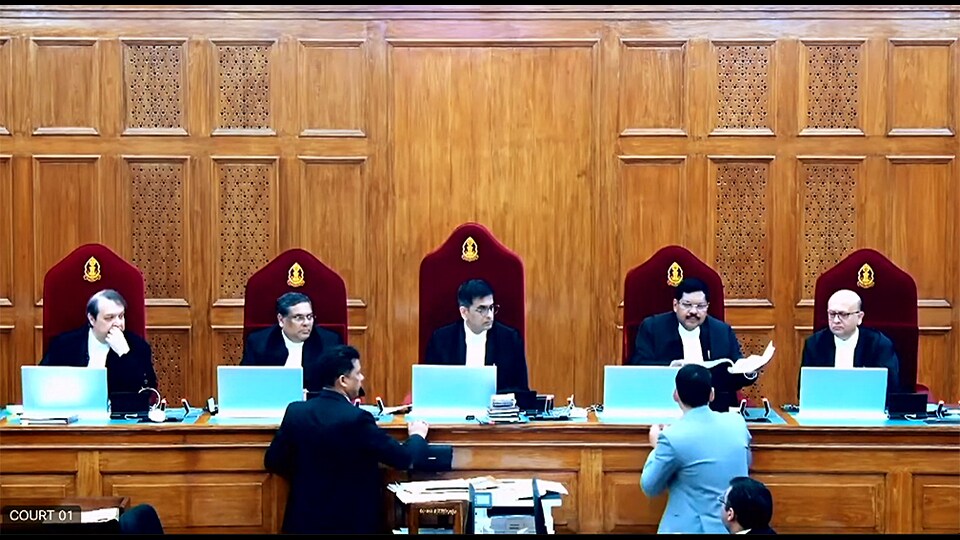
On February 15, a five-judge bench struck down the Centre’s 2018 EB scheme of political funding, declaring it to be “unconstitutional” because it completely anonymised contributions made to political parties and added that restricting black money or illegal election financing — some of the articulated objectives of the scheme — did not justify violating voters’ right to information in a disproportionate manner.
The bench, led by Chief Justice of India Dhananjaya Y Chandrachud, at the time also directed SBI — the only designated EB-issuing bank — to forthwith stop the issuance of EBs, adding that the bank will submit details of EBs purchased since April 12, 2019, till that date to the poll watchdog by March 6.
By March 13, the judgment ordered all funding received by political parties since April 12, 2019 — when the court issued an interim direction to the parties to submit such information with ECI — shall be made public by putting the information on the ECI’s website.
But two days before the end of the deadline, SBI filed an application in the top court, seeking to bring to the court’s notice “certain practical difficulties with the decoding exercise and the timeline fixed for it”.
“It is submitted that due to the stringent measures undertaken to ensure that the identity of the donors was kept anonymous, ‘decoding’ of the EBs and the matching of the donor to the donations made would be a complex process,” stated the plea, referring to the 2018 EB scheme and the standard operating procedure that SBI formulated for 29 authorised branches, spread all over India, with regard to sale and redemption of bonds.
According to the public sector bank, not only were details of purchases made at SBI branches not maintained centrally at any one place, but the data related to the issuance of the bond and the data related to the redemption of the bond were also recorded in two different silos.
“No central database was maintained. This was done so as to ensure that donors’ anonymity would be protected. It is submitted that donor details were kept in a sealed cover at the designated branches and all such sealed covers were deposited in the main branch of the applicant bank, which is located in Mumbai,” the plea said.
At the other end, SBI said, at the time of redemption by a political party, the original bond, and the pay-in slip would be stored in a sealed cover and sent to the SBI’s main branch in Mumbai.
“It can thus be noted that both sets of information’s were being stored independently of each other. Thus, to re-match them would be a task requiring significant amount of effort... the retrieval of information from each silo and the procedure of matching the information of one silo to that of the other would be a time consuming exercise,” it said.
SBI added that some of the details such as number of bonds etc are stored digitally while the other set of details such as name of purchaser, KYC etc are stored physically. “The purpose of not storing all details digitally was to ensure that it cannot be gathered easily to achieve the object of the scheme,” said the plea, adding the timeline of three weeks fixed by the court in its February 15 judgment would not be sufficient for the entire exercise to be completed.
The bank highlighted that between April 12, 2019 and February 15, 2024, when the EB scheme was nixed, 22,217 EBs were used for making donations to various political parties. “Redeemed bonds were deposited to Mumbai main branch by the authorised branches at the end of each phase in sealed envelopes. Coupled with the fact that two different information silos existed, this would mean that a total of 44,434 information sets would have to be decoded, compiled and compared,” said SBI’s application.
In its February 15 judgment, the Constitution bench ruled that amendments made in the Representation of the People Act, Income Tax Act, and Companies Act through the 2017 Finance Act violated the constitutional right of the electors to access information on the funding of political parties “which is necessary to identify corruption and quid pro quo transactions and governance information”.
The verdict came ahead of the Lok Sabha elections expected to take place this summer and was immediately welcomed by opposition parties — since the inception of the scheme, the Bharatiya Janata Party, in power at the Centre since 2014, received 54.8% of the electoral bonds purchased in this period — and civil society activists.
EBs, which are bearer banking instruments that do not carry the name of the buyer or payee, go for sale in 10-day windows in the beginning of every quarter — in January, April, July and October — besides an additional 30-day period specified by the central government during Lok Sabha election years.
The court was emphatic that the scheme violated the right to information.
“The electoral bond scheme and the impugned provisions, to the extent that they infringe upon the right to information of the voter by anonymizing contributions through electoral bonds, are violative of Article 19(1)(a)... Electoral bonds provide economically resourced contributors who already have a seat at the table selective anonymity vis-à-vis the public and not the political party,” the bench, also comprising justices Sanjiv Khanna, BR Gavai, JB Pardiwala and Manoj Misra, said in its February 15 verdict.
Jagdeep Chhokar, founder member & trustee of ADR, said: “This is not unexpected as speculation was doing rounds that the information will not be made available on one pretext or other. It is a bit difficult to believe that the SBI needs nearly 4 months to compile the data, which obviously is in digital form. It defies logic and understanding. This shows that when the Supreme Court gives a judgment, it is not being implemented in letter and spirit.”