
 E-Paper



Supreme Court does not stay CAA, takes up 237 petitions
Supreme Court gives government 3 weeks to respond to pleas against CAA rules, refrains from restraining citizenship grants under the law.


The Supreme Court on Tuesday refrained from restraining the Union government from the grant of citizenship under the recently notified rules for the Citizenship (Amendment) Act, or CAA, even as it gave it three weeks to respond to a bunch of pleas demanding that CAA rules be stayed and that no coercive steps be taken against persons belonging to Muslim community who have been deprived of the benefit under this law.
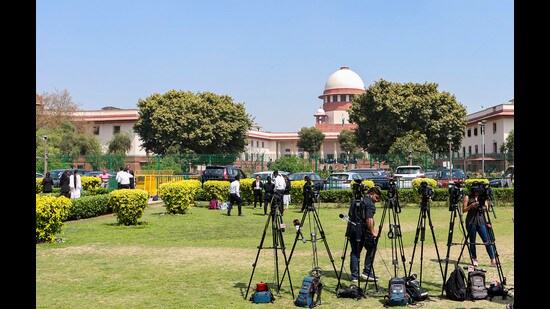
A bench led by Chief Justice of India Dhananjaya Y Chandrachud set April 9 as the next date of hearing and asked the government to submit its response by that date in light of the Centre’s resistance to any interim order that would prevent it from processing requests for grant of citizenship under CAA.
“Because they are not willing to make a statement, we have given them three weeks,” the bench, also comprising justices JB Pardiwala and Manoj Misra, told a group of senior lawyers, pressing for an interim order to effectively put CAA in abeyance.
Senior counsel Kapil Sibal, Indira Jaising, Vijay Hansaria, Sidharth Luthra, among others, appeared on behalf of the petitioners, seeking a stay of the CAA and the rules that were notified by the Union government on March 11, breathing life into the controversial law.
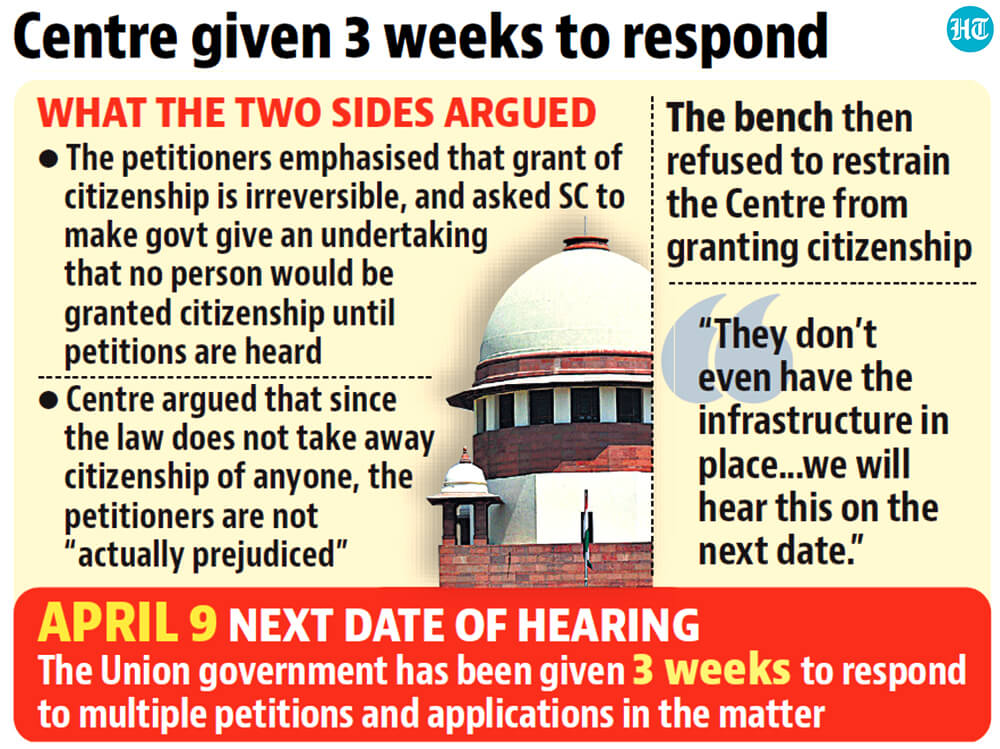
Emphasising that the grant of citizenship is an irreversible process, Jaising, Hansaria and Luthra requested the bench to make the government undertake before the court that no person would be granted citizenship until the petitions are effectively heard on the next date of hearing.
The lawyers, including Kaleeswaram Raj and Nizam Pasha, added that the law that fast-tracks citizenship to non-Muslim refugees who came to India on or before December 31, 2014, because of religious persecution in Pakistan, Bangladesh and Afghanistan, is bound to be prejudicial to Muslims on the ground of religion and must be stayed immediately.
Rebutting this, solicitor general Tushar Mehta, representing the Centre, argued that none of the petitioners is “actually prejudiced” since CAA is not a law to take away citizenship. “It does not take away citizenship of anyone. There is no prejudice caused to the petitioners. Those who have migrated here because of the persecution are to be granted citizenship. Also, citizenship is not given to any new person. They are already here. Those who entered before December 31, 2014, become entitled,” Mehta added.
He opposed the plea for an undertaking by the government, saying: “I am not willing to make any statement that nobody will be granted citizenship in the meantime...There are more than 200 petitions and at least 20 applications seeking a stay of the rules. I have to be given some time to bring my response on record.”
Read more: Supreme Court seeks Centre's response to pleas seeking stay of CAA rules
Responding, Sibal highlighted that the rules have been notified more than four years after the law received the presidential assent in December 2019. “The problem is that if any citizenship is granted, it will be an irreversible step. This process cannot be allowed to start. If they have delayed it for four years, they can wait for some more time,” he added.
As Mehta voiced his opposition, the bench questioned the law officer about any steps taken after the regulations were announced on March 11. “It is a three-tier system. Any request goes through the district committee, empowered committee and then the central government. My first submission will remain that whether anyone is granted or not granted, none of the petitioners is affected because of these rules,” replied Mehta.
While Mehta asked for four weeks to respond to multiple petitions and applications in the matter, the court granted him three weeks to do so, fixing the next hearing on April 9.
Read more: Debate on CAA at Gauhati University campus turns violent, six students injured
As the hearing came to an end, Jaising made a fervent request if the bench stated in its order that any citizenship granted before the next date of hearing would be subject to the final decision of the court.
But the bench retorted: “They are opposing...They don’t even have the infrastructure in place...we will hear this on the next date.”
The court was hearing separate applications filed by Indian Union Muslim League (IUML), All India Majlis-E-Ittehadul Muslimeen (AIMIM) chief Asaduddin Owaisi, Kerala government, Assam Congress leader Debabrata Saikia, and the Social Democratic Party of India (SDPI), among others, seeking a stay on the CAA rules.
Four years after the controversial law was passed to fast-track citizenship to non-Muslims who entered India from the three neighbouring countries on or before December 31, 2014, the Centre notified the rules on March 11.
Announcing the notification, which was expected after several ministers and officials over the past few months said that the rules would be released before this summer’s general elections, Union home minister Amit Shah said on X: “The Modi government notified the Citizenship (amendment) rules, 2024. These rules will now enable minorities persecuted on religious grounds in Pakistan, Bangladesh and Afghanistan to acquire citizenship in our nation... With this notification, PM Shri @narendramodi Ji has delivered on another commitment and realised the promise of the makers of our constitution to the Hindus, Sikhs, Buddhists, Jains, Parsis and Christians living in those countries.”
PHOTOS: Protests against CAA and NRC at Jantar Mantar, Delhi
The announcement of the rules, in keeping with the Bharatiya Janata Party’s (BJP) promise in its 2019 manifesto, was criticised by Opposition parties who said the timing of the notification is linked to the coming elections. The law itself was passed in December 2019, but the underlying rules were not framed. Its passage resulted in protests, which petered out only with the Covid-19 pandemic, and a clutch of petitions that remain before the Supreme Court.
A clutch of over two hundred connected petitions, filed in the top court since 2019, have challenged various CAA provisions on grounds of religious discrimination against Muslims and arbitrariness.
The petitioners include Congress leader Jairam Ramesh, the Indian Union Muslim League, and its MPs, Lok Sabha MP and AIMIM president Asaduddin Owaisi, RJD leader Manoj Jha, TMC MP Mahua Moitra, All Assam Students’ Union and Tripura royal scion Pradyot Kishore Deb Barman.
Responding to these petitions, the Centre’s affidavit in October 2022 stated that the legality of the CAA may not be within the scope of judicial review since matters of citizenship and foreign policy fall squarely within the domain of Parliament. The government asserted that issues concerning the sovereign plenary power of parliament, especially regarding citizenship, cannot be questioned by filing PILs.
According to the affidavit filed through the Union ministry of home affairs, the power of exclusion of immigrants is an incident of sovereignty belonging to a duly constituted nation-state and immigration policy. The policy, it added, impacts the foreign policy of a State and by extension, affects its security apparatus and would fall squarely within parliament’s domain.
The 2022 affidavit also sought to allay the apprehensions that CAA would incentivise influx of illegal migrants, pointing out the migrants who are entitled to citizenship under the law are already living in various parts of India.
IUML last week moved its plea contending that CAA rules create a “highly truncated and fast-tracked process” for the grant of citizenships to non-Muslim migrants from the specified countries, thereby making operational a “manifestly arbitrary and discriminatory” regime solely on the ground of religious identity.
“Since the CAA is discriminates on the basis of religion, it strikes at the root of secularism, which is the basic structure of the Constitution...India’s constitutional framework, read with obligations under the international law, mandates a framework of refugee protection that is non-discriminatory,” stated the plea, filed through advocate Pallavi Pratap.
It pointed out that waiting for the final judgment of the top court would not hamper anyone’s interest as the Centre itself has taken more than four years to notify the rules after the amendments received the presidential assent in December 2019.
“If this court finally decided that CAA is unconstitutional, people who would have received the citizenship under this Act will have to be stripped of their citizenships. Therefore, it is in the best interest of everyone to defer the implementation of CAA and impugned rules till this hon’ble court finally decides the matter,” IUML pleaded.
The Kerala-based political party urged the court to stay the implementation of CAA and the rules, adding that until the court decides, persons belonging to Muslim community may not be subjected to any coercive action under the Citizenship Act, Passport Act or Foreigners Act. IUML has also approached the registrar concerned to seek an urgent hearing of its plea. Similar applications were filed by Owaisi, Kerala government and some other petitioners too.


