
 E-Paper



Kolkata money laundering probe: SC junks ex-principal’s plea
A bench, led by CJI Dhananjaya Y Chandrachud, held that Ghosh cannot have a locus (legal standing) in a public interest litigation (PIL) that demanded an inquiry into the alleged corruption in the hospital


The Supreme Court on Friday dismissed a petition by former principal of RG Kar Medical College and Hospital, Sandip Ghosh, who had challenged the transfer of the investigation into alleged financial irregularities during his controversial tenure at the premier Kolkata facility to the Central Bureau of Investigation (CBI).
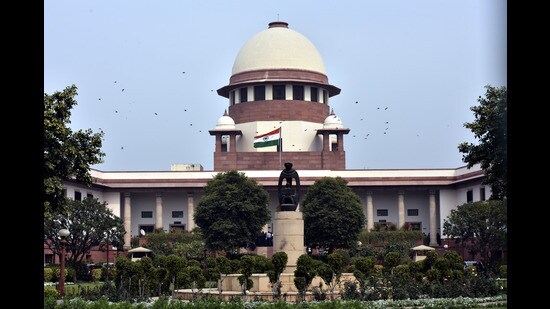
A bench, led by Chief Justice of India Dhananjaya Y Chandrachud, held that Ghosh cannot have a locus (legal standing) in a public interest litigation (PIL) that demanded an inquiry into the alleged corruption in the hospital, and that Ghosh could exercise all his rights under the criminal law as an accused.
“It cannot be disputed that you were the principal of the college when the offence took place. As an accused, you do not have any locus in a PIL when the high court is monitoring the investigation,” said the bench, also comprising justices JB Pardiwala and Manoj Misra.
Ghosh, who filed his petition on August 27, was set to be heard by the Supreme Court on September 6. However, before the hearing, he was arrested by the CBI on September 2 in connection with the case. His arrest follows widespread public outrage over his handling of the brutal rape and murder of a 31-year-old doctor at the hospital on August 9 -- an incident that has sparked national protests and outrage across West Bengal.
Representing Ghosh in the top court, senior counsel Meenakshi Arora argued that the Calcutta high court transferred the probe to CBI on August 23 without giving Ghosh a fair hearing, thus violating the principles of natural justice. She contended that the high court wrongfully excluded him from being heard, citing that he was neither a necessary nor a proper party in the original writ petition. Ghosh asserted that the court should have considered his side before transferring the investigation, as the outcome directly affected his rights.
Arora also assailed the high court’s decision to link the alleged financial irregularities with the criminal investigation into the rape and murder, both being probed by CBI. She maintained that the two cases were separate and that the court erred in assigning the financial probe to CBI simply because the agency was already investigating the criminal case.
“How can I be linked with the rape and murder case? The high court grossly erred in linking the two. Let those observations by the high court go...it forecloses my rights,” Arora complained.
But the bench replied that whether Ghosh could be linked to the rape and murder case was itself a matter of investigation at this stage. “Let us not stultify the investigation. We are seized of the whole matter and have asked CBI to file status report on the investigation into the rape and murder. We are here to ensure that the investigation is fair. Whatever emerges in the investigation, CBI will apprise us,” the bench told Arora.
At this point, Arora asked the court to clarify that CBI would probe Ghosh only regarding the financial irregularity allegations.
Solicitor general Tushar Mehta and additional solicitor general SV Raju, appearing for CBI and the Enforcement Directorate respectively, strongly opposed Arora’s plea, asserting that an accused cannot direct how he should be probed.
Agreeing with the law officers, the bench said that it was not open for Ghosh to dictate the direction or ambit of the investigation. “Even we, as a court, cannot direct an agency what and how to investigate,” added the court, rejecting Ghosh’s petition.
Notably, the same bench in the apex court is also overseeing the suo motu proceedings on the doctor’s rape and murder, and is monitoring the associated investigations.
On Monday, Ghosh was questioned by CBI for the 15th consecutive day before being arrested at the agency’s Nizam Palace office in Kolkata. He faces charges of cheating and violations under the Prevention of Corruption Act. Alongside Ghosh, three others have been arrested on similar charges.
Ghosh is accused of various crimes, including illegally using bodies for research, unauthorised sale of biomedical waste, and several financial irregularities, such as awarding contracts without proper tenders.
The Enforcement Directorate (ED) has also registered a money laundering case against Ghosh, based on CBI’s findings. Additionally, Kolkata Police has filed two first information reports (FIRs) against him.
Ghosh marked the first CBI arrest since it took over the investigation into the doctor’s brutal murder, although it pertained to the financial irregularities case.
A Kolkata Police civic volunteer, Sanjoy Roy, was arrested by the city police a day after the crime and handed over to the CBI on August 13.
.


