
 E-Paper



Seven months and counting: The longest Silger stir retains its verve
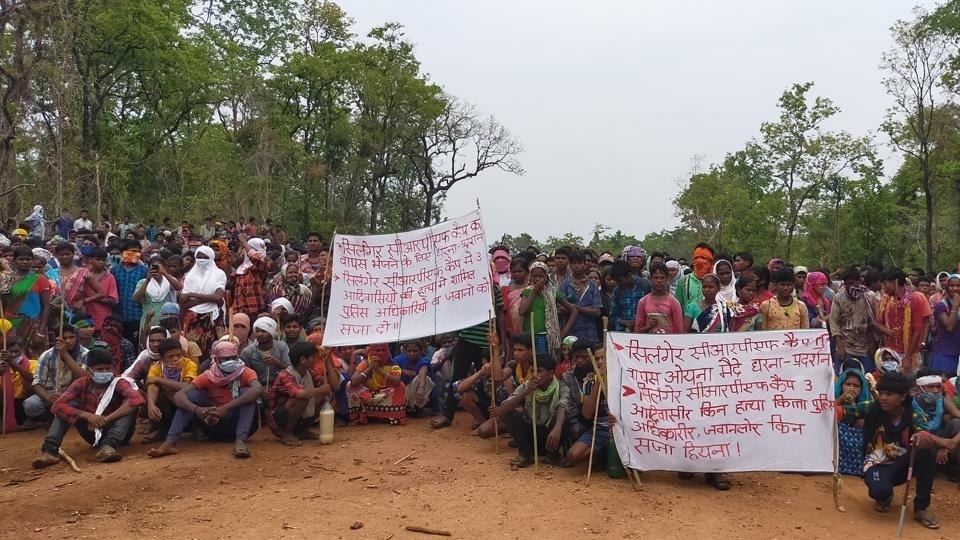
On May 12, residents of Silger began protests against a new camp of the Central Reserve Police Force.

 Prefer HTon Google


It is 10 pm on a cold December night. A group of about 30 teenaged boys and girls are gathered around bonfires under a tamarind tree in Silger village. The light from the fires cuts through the darkness, the silhouette of the forests flickering in the shadows. The gathering at this hour, in this part of Chhattisgarh, is unusual. For Silger is in the forested heart of south Bastar, the epicentre of a deadly, decades-long battle between security forces and Maoist insurgents. A battle where many innocents have been caught in the crossfire.
On a usual day, Silger would have been pitch black, and eerily quiet. But voices suddenly pierce the night air. The teenagers have started singing. The song is new, and has no name. But the chorus has the words “O adivasi re...jaago re”(Awake, O Adivasi). They start singing the verse, “tere saamne tere bhai ko goli maara re...tere saamne tere ghar dwaar cheen liya re (they shot your brother in front of you, they stole your home in front of you).”
It is a song of protest.
Around the singers, there’s movement in the makeshift tarpaulin tents, and scores of protesters emerge and join in. Thousands of kilometres away, farmer collectives may have won their battle with the government and left for home in joyous victory marches, but in the Chhattisgarh hinterland, a protest, now the longest in Bastar’s history, has been going on for the past seven months. A protest that has all the markings of the region’s macabre and complicated history – protest against a security camp, four deaths, a typical government response centred on calling the dead and protesters Maoists or sympathisers, and a long impasse that has gone on into winter without any constructive intervention.
The beginning of the Silger protest
On May 12, residents of Silger began protests against a new camp of the Central Reserve Police Force. For four days, the number of protesters swelled. The villagers argued there was no permission for the camp, and that it would only bring more harassment to residents. The security agencies argued that it was the villagers who had asked for the camp, that it was key to driving away Maoists and bringing any form of development, and that the protests were being pushed by Maoist cadre.
Five days later, as the number of protesters kept rising and more villages joined in, there was sudden gunfire. Chhattisgarh Police said it was an exchange of fire with Maoists in the crowd, but villagers claimed the security forces unilaterally opened fire. Three people were brought dead to the hospital. A few days later, a fourth woman succumbed to her injuries as well.
“On the night of May 16, the protesters returned to their villages, but the next afternoon some people, including some Maoists of Jagargunda Area Committee, reached the camp and started firing. When the camp was attacked, the security personnel retaliated,” Sunderaj P, inspector general of police in Bastar, had said at the time.
A day later, Sunderaj told the media that the three that died immediately were from “frontal organisations” of the Maoists.“The deceased were identified as Uska Pandu, a Bhumkal commander from Timmapur village (Sukma); Kowasi Waga, DAKMS (Dandakaranya Adivasi Kisan Majdoor Sangthan) member from Chhutwahi; and Kursam Bhima, militia member from Gundem village (Bijapur),” he said.
But two weeks later, a two-member fact finding team comprised of noted economist and human rights activist Jean Dreze and lawyer activist Bela Bhatia visited the spot, and said they found no evidence that supported the police claim that an armed group of agitators took over the protest on May 17, and intended to burn down the CRPF camp, leaving the forces with no choice but to open fire.
The report said the camp was set up in the dead of night at around 3 am on May 12, without informing villagers, and about 40-50 of them were dispersed by force when they protested against the camp the next day.
“On May 14, about a thousand adivasis of five gram panchayats started a mass protest... People shouted slogans demanding the removal of the camp. Every day the police tried to disperse them, sometimes with lathis, sometimes with “mirchi pataka” or tear gas. Dozens of protestors sustained minor injuries... and returned to their villages for local treatment,” the activists alleged.
Witnesses alleged that by May 17, the number of protestors grew exponentially, perhaps touching 10,000, and some of them started pelting stones after a baton charge, and tear gas and bullets being fired into the air to control the crowds, Dreze and Bhatia said.
“By that time the forces were on both sides of the road with protesters in the middle. Soon police firing started. Three protestors were killed on the spot (one of them, Uika Pandu, also called Murali, of Timmapuram village, who was hit in the head, was only 16 or 17 years old), at least another three had bullet injuries and as many as 40 were injured in one way or another,” they said.
Chhattisgarh Police maintained that the CRPF camp was established to facilitate construction of a road on the Basaguda-Jagargunda axis, as it was an important corridor for Maoists and a stronghold of the People’s Liberation Guerrilla Army Battalion number 1, led by Maoist commander Hidma.
Sunderaj had then refuted claims made in the fact-finding report and said villagers were properly briefed about the nature of the camp on May 13 by police and an executive magistrate, and they returned convinced with the response.
“Meanwhile, the Maoists were planning to destabilise this camp to protect their corridor. So the Naxals mobilised their frontal organisation members and militia cadres from the surrounding area and sent them to Silger on May 17 with a conspiracy to instigate violence and launch an attack on the security forces deployed in the Silger camp,” the Bastar police chief said.
How has the protest run for seven months
On May 20, a group of protesters banded around the Mool-Vaasi Bachao Manch (platform to save indigenous people), the aim of which was to streamline the Silger protest. Raghu Madyami, 21, president of the Manch, has been leading the protest with 26 other office bearers since then.
The Manch later formed a cultural wing, the Mool Niwasi Sankriti Kala Manch, which now composes songs , slogans and plays. For the past seven months, the platform has sought to build systems that are sustainable for a mass protest.
In the middle of December, when HT reached the spot, there were about 20 small camps of protestors. “Each camp belongs to a village taking part in this protest. Every five days, a group of villagers come here and reside in their village’s camp. They bring their food and cook. Each day at around 11am, we protest outside the Mokur camp, which is 700 metres from here, and the next day, another group comes to replace them,” said Raghu, sitting outside the Timmapuram village camp in Silger.
For the Manch or other protestors who come from far-flung areas, villagers donate cereals. “We have also developed two acres of land for vegetables in the last seven months,” said Raju Sori, president of Mool Niwasi Kala Manch.
A day starts at 7am, and protesters cook and eat by 10. They then march towards the camp to mark their protest and return by 2pm. Groups then begin to search for wood for fires that must burn at night. By 7, dinner is done, and from 8pm to midnight, they sing the winter away. Every day for the past seven months.
Silger’s impact in Bastar
The Silger protest has marked a new shift in the Maoist-state conflict in Bastar, inspiring more protests against the establishment of security camps, and other sites. Over the past few weeks, there have been demonstrations at a newly made Border Security Force camp in Kanker district, and the sites of alleged police atrocities like Sarkeguda and Gompad.
The firing in Silger led to a rethink in the police establishment on how to establish new camps, according to an Indian Police Service officer serving in Bastar. “As security forces penetrate core Maoist areas, some protests will be there, but it can be handled by the resolution of genuine demands of villagers and winning their confidence,” he said requesting anonymity.
Soni Sori, a tribal rights activist, said that the state government was mistaken in its belief that the protest would die a natural death, and this could have political consequences. “I believe that it is the longest protest of tribals in the history of Bastar against any government. The way people reacted after the agitation against the Salwa Judum, which sidetracked the Congress for 15 years, similar things will happen in the next election. I am not sure if they will return to power,” she said.
“None of the questions that the Adivasis tried to raise through the movement have been answered by the government yet,” Bhatia said. “Why was a camp established on village land without telling them, or without a gram sabha (village council meeting)? Why was a judicial enquiry not ordered into the killings of the three protestors and the woman who succumbed to her injuries later? Why has the report of the enquiry conducted by the Sukma deputy collector not been made public yet? When will the guilty policemen be punished?”
Government response
Despite the hard stance police and the administration initially took on the firing, over the months the Congress-led Chhattisgarh government has made a climbdown, attempting to reach out to protesters. On July 1, a delegation of protesters and activists met with chief minister Bhupesh Baghel, where the families of the victims were offered a compensation and jobs.
“When the chief minister asked about our demands, we told him that we want an inquiry into the matter led by three retired judges, which will include a Dalit judge, a tribal and one non-tribal judge. The chief minister also offered compensation and jobs, but the people were not ready to accept. They want an investigation first,” said Soni Sori, who was present in the meeting.
Telam Ramdas, one of the many protesters from Gomguda village, said that they wanted to see administrative action before they accept compensation. “Our demands are simple – terminate the official responsible for killing our brothers, and take back the camp,” he said.
While no judicial probe has been ordered, the state government ordered an enquiry at the level of the sub-divisional magistrate on August 12, which is yet to submit its report. “The probe is ongoing and in its last stages,” said Vineet Nandanwar, collector, Sukma.
In an interview with HT on December 17, chief minister Baghel defended his government’s stance, and pointed to the attempts at dialogue. “Which government has met and talked to the people where the incident has taken place? We have sent the member of Parliament, legislators and also the members of their own community to have dialogue with them,” Baghel said.
Asked why then his government had failed to quell the protests, Baghel said, “Those helpless people have been made to sit to protest at gunpoint. But it is the very first time that the population over there is with us, on our side. The camps are established on their demand only.”
Back in Silger, 497km from Raipur, the group of protesters is still singing, and it is now close to midnight. When the clock strikes 12, the protesters will return to their camps to adjourn for the day.
They will be back tomorrow. One young protester said, “We will sing every night until our demands are met.”
-kW0H-U20214218012MgB-250x250%40HT-Web.jpg)


