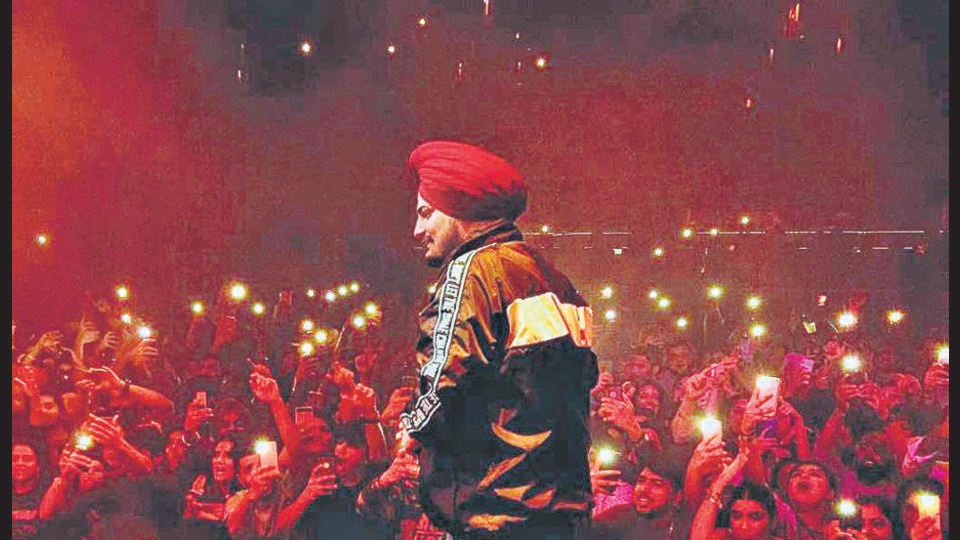
The video is still up on his YouTube page, one of the last that he uploaded, and has at last count 14 million views. On May 15, Sidhu Moosewala released a song called the “Last Ride”, a homage to rapper Tupac Shakur, the American rapper who was shot dead in his car in 1996 at the age of 25. The song’s cover photo is the vehicle Tupac he was travelling in that day, and has the lyrics “Ho chobbar de chehre utte noor dassda, ni ehda uthuga jawani ch janaja mithiye (The glow on the face of this young man shows that he will die young).” Two weeks later, in a planned attack on Sunday evening, 29-year-old Moosewala was dead, his slumped body behind the wheel of a black Mahindra jeep riddled with bullets. The song could well have been the chronicle of a death foretold.
(ANI)
Hours after his murder, Punjab Police DGP VK Bhawra said it was the fallout of inter-gang rivalry, with members of the Lawrence Bishnoi gang declaring that they had carried out the murder as an act of revenge for the killing of Vicky Middukhera, an Akali Dal Youth Wing leader, for which they held Moosewala responsible. Though this is the first killing of a singer in Punjab since militancy ended three decades ago, the attack has shone a spotlight on the dark underbelly of Punjabi music industry, their affinity for violence and guns in their eminently popular music, and its relationship with organized crime.
The rise of Moosewala
The rise of Shubdeep Singh Sidhu, more popularly known by his stage name Sidhu Moosewala, was nothing short of meteoric. In 2016, after having completed a course in electrical engineering from Punjab, Moosewala moved to Canada on a student visa. One year later, he released his first rap single called “So High”, followed quickly by two back-to-back albums.
But for most of his six years as a performing artist, one of Moosewala’s primary motifs was guns. His social media handles on Instagram, Facebook and Twitter often showed him carrying weapons, or in the company of armed men. At one point, the logo of his YouTube channel showed a man dressed in black, his face covered, carrying an AK-47 assault rifle.
The singer first ran afoul of the law in February 2020 when he was booked under sections 509 (intentional insult with intent to provoke breach of the peace), 294 (reciting obscene songs) and 149 (unlawful assembly) of the Indian Penal Code (IPC) in Mansa district for allegedly promoting gun culture through a song titled Panj Golian (five bullets). After he got bail, Moosewala released a song called “Sanju”, taking pride in the cases registered against him under the Arms Act, comparing himself with Bollywood actor Sanjay Dutt, who has once also been booked for the illegal possession of an assault rifle.
The police then registered another case against him under the Arms Act and sections 188 (disobedience to order), 294 (obscene acts and songs) and 504 (provocation to break public peace) of the IPC in July 2020 for glorifying the use of weapons and boasting about the FIRs through this song.
It wasn’t just Moosewala. In 2020, the teaser of a movie called Shooter was released, allegedly glorifying the life of gangster Sukha Kahlwan, a man with more than 48 cases against him including murder, extortion, and criminal intimidation. The film was later banned.
Moosewala was controversy’s favourite child, but there was no denying Moosewala’s popularity, so much so that when the Congress hunted for a candidate for the Mansa assembly constituency, his home district, they landed on him. There were murmurs of outrage, pointing to his provocative music, but afforded a meeting with Rahul Gandhi himself, Moosewala fought the elections on a Congress ticket, but lost to the AAP’s Vijay Singla, ironically the man removed by the Bhagwant Mann government on charges of corruption.
Protection, money and gangsters
But if Moosewala’s music, and that of other Punjabi artists, brought an unprecedented, almost cult-like, popularity, with huge traction on social media, this in turn has brought an influx of money, which has meant the increasing involvement of criminal gangs.
Senior Punjab police officials, involved in operations against organized crime, said that the flow of wealth from dubious sources, and extortion, has only increased in the recent past. The intelligence wing of Punjab Police, for instance, has gathered details about 12 cases in the past three months where ransom was paid by singers in the name of protection money. The Jaggu Bhagwanpuria and the Lawrence Bishnoi gangs are among those that lead this racket, the police said. “In certain cases, it has been found that certain persons linked with these gangs receive money from singers in the form of ‘hawala’ abroad as well,” a senior police official said.
Another senior officer with the Anti-Gangster Task Force (AGTF), constituted by chief minister Bhagwant Mann after he took over, said singers get routine extortion calls from gangsters. “Since a huge amount of black money is involved in the music industry, the gangsters take advantage. Many singers don’t even report such calls and pay up. Those who hesitate get death threats,” the officer said.
The first case of attack for ransom emerged in 2018 when gangster Dilpreet Dahan allegedly attacked producer and singer Parmish Verma in Mohali on April 13 that year. Verma received a bullet injury in the attack as he was returning home from a show in a city mall. Dahan was arrested for the attack.
A few days later, on June 2, 2018, singer and film producer Gippy Grewal also received a call for ransom of ₹10 lakh from the Dahan gang, after which the matter was reported to the police. “We keep receiving such complaints. Sometimes singers and producers relent and ask us not to name them as complainants in the media,” a DSP said, requesting anonymity.
A Jalandhar-based office-bearer of an association of music producers admitted that calls from gangsters for protection money have become routine. In fact, on March 24 this year, singer Mankirat Aulakh, reached out to CM Mann, citing threat from gangsters, and asking for protection.
Moosewala and his rivalries
But Aulakh has himself had his own fair share of controversies, not least his famed rivalry with Moosewala. When Vicky Middukhera was killed on August 7, 2021, by a group of gangsters, Moosewala’s former secretary Shubhamdeep Singh was named as accused by the police. He fled to Australia. Aulakh said that Muddukhera was “akin to a brother”, and soon after the killing, the Lawrence Bishnoi gang announced that it would avenge his death.
On Monday, another gang, headed by Davinder Bambiha alleged that Aulakh was involved in the death of Moosewala. In a Facebook post on Sunday evening, the gang also alleged that Aulakh extorted money from singers in the Punjabi music industry. While Aulakh could not be contacted despite repeated attempts, he condemned Moosewala’s killing on social media.
In October, the Mohali police had alleged that it was the Bambiha gang that had claimed responsibility for the murder of Middukhera on August 7, but also alleged that they believed the gang had entered the music industry, and had invested in two music companies. Former DGP Shashikant said that the gangsters have now adopted a model akin to the Mumbai underworld, sensing the money involved in the music and film industry. “It is the industry itself that is responsible for this menace. They have glorified this culture to the extent that it has started becoming counterproductive,” the retired IPS officer said.
Punjab Congress chief Amarinder Singh Raja Warring and former home minister Sukhjinder Singh Randhawa said that the singer was given security cover during their party’s rule in Punjab as the IB had shared specific inputs about the threat to his life and that of former DGP Punjab Sumedh Singh Saini.
In his recent TV interviews, Moosewala termed the security withdrawal as an attempt by the AAP government to get political mileage.
Jailed but free
Moosewala’s assassination has also renewed focus on criminal activities in Punjab being controlled from within jails across India. Lawrence Bishnoi for instance is currently lodged in Delhi’s Tihar jail under the stringent Maharashtra Control of Organised Crime Act. On Monday, prison authorities conducted searches in Bishnoi’s cell and his accomplice Shahrukh, reportedly seizing “prohibited items”, a day after the murder. The Delhi police also questioned Bishnoi’s key accomplices, Kala Jathedi and Kala Rana, also in police custody in separate cases.
Of 700 known members of the 80-odd organised gangs that are active in Punjab according to the state police’s records, 350 are currently lodged in different jails across the country, including Jaggu Bhagwanpuria, Neeta Deol, Dilpreet Baba Jaggu, apart from Bishnoi. Last week, a mobile phone was recovered from Jagdish Singh Bhola, accused of running an organised drug racket, from his person in a Patiala jail. “In the recent past, many heinous crimes, murders, extortion rackets have direct links with gangsters lodged inside the prisons. We have thus far been unable to control it, as there is no proper monitoring and technical specialization,” a jail official in Punjab admitted.
However, experts of the music industry trace the roots of the violence back to the music itself, and the glorification of “macho culture”. Renowned music director Atul Sharma, who has recorded 8,000 Punjabi music albums and 50,000 songs, said, “The culture, particularly in rural Punjab, has always glorified bandits from Dullah Bhatti, Jagga Daku, or Jat Jeuna Maur.”
Filmmaker Daljit Ami, director of the Educational Multimedia Research Centre, said: “The daredevil culture that we see along with the rise of guns and popular music has always been an intrinsic part of the culture. In Punjab, one of the eternal heroes is Mirza who is still remembered for saying, ‘Meri bakki ton daran farishte, Mere kolon khuda darda’ (Angels are scared of my mare, and God is scared of me).”

 E-Paper