E-Paper



Siwan, Sitapur have a bigger air pollution problem than Delhi
Europeans for a long time believed the earth was flat and were scared of undertaking long voyages on sea, lest they fell off the planet

 Prefer HTon Google


Europeans for a long time believed the earth was flat and were scared of undertaking long voyages on sea, lest they fell off the planet. It is unfair to blame them completely for this, for nobody had mapped the earth to remove this fear. Reversing this analogy is useful in evaluating India’s policy response to the problem of air pollution.
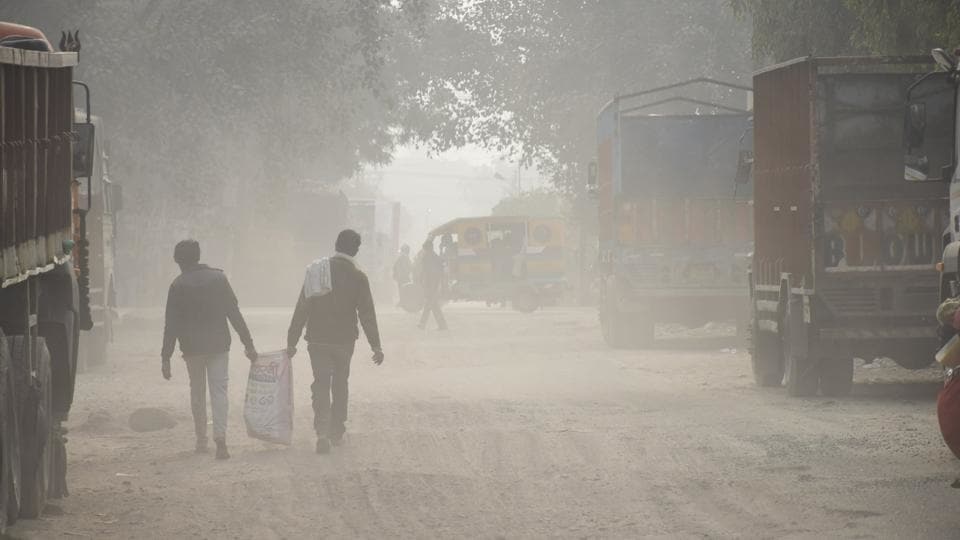
Every year, as pollution levels spike in October and November, both governments and the courts scramble to control the menace in Delhi and its adjoining districts in the national capital region (NCR). Anyone who follows these processes in the news will believe that pollution is only a problem around the national capital and all is well in the rest of the country. This appears more to be result of lack of pollution data from other parts in northern India than anything else. An HT analysis, which has used satellite data to map pollution levels, shows air pollution is a problem that needs a much wider geographical outlook than just a Delhi-centric focus. Here is why.
India’s air quality monitoring data is geographically skewed, but satellite mapping can help
The Central Control Room for Air Quality Management (CCR) database counts 321 air quality monitoring stations in India. They cover just 156 cities, while there were 640 census districts in the 2011 census. Of the total air quality stations, 22% are located in just three mega cities: Delhi (40 stations), Mumbai (21 stations) and Bengaluru (10 stations).
Does a lack of air quality stations mean we have no idea about pollution levels in the rest of the country? HT has found a solution to this problem by using satellite imagery based data.
Particulate matter such as PM2.5, which are 2.5 micrometre wide or less, prevent light from travelling through the air. NASA’s Terra and Aqua satellites take snapshots of this to find where such particles are higher in concentration. This provides an index called aerosol optical thickness or depth (AOD). This index varies between 0 and 1, with values closer to 0 representing a clear sky and values closer to 1 representing a hazy sky.
Monthly averages of AOD are available for 0.1-degree grids (a box bound by two latitudes and longitudes 0.1 degree or 11.1km apart). For October and November, 321 of 632 census 2011 districts (Delhi’s districts merged as one) have this data since 2000 such that over 80% of their grids are represented in nearly all years. More on this later. These 321 districts cover large parts of the states in the northern plains, where air pollution in winter is higher.
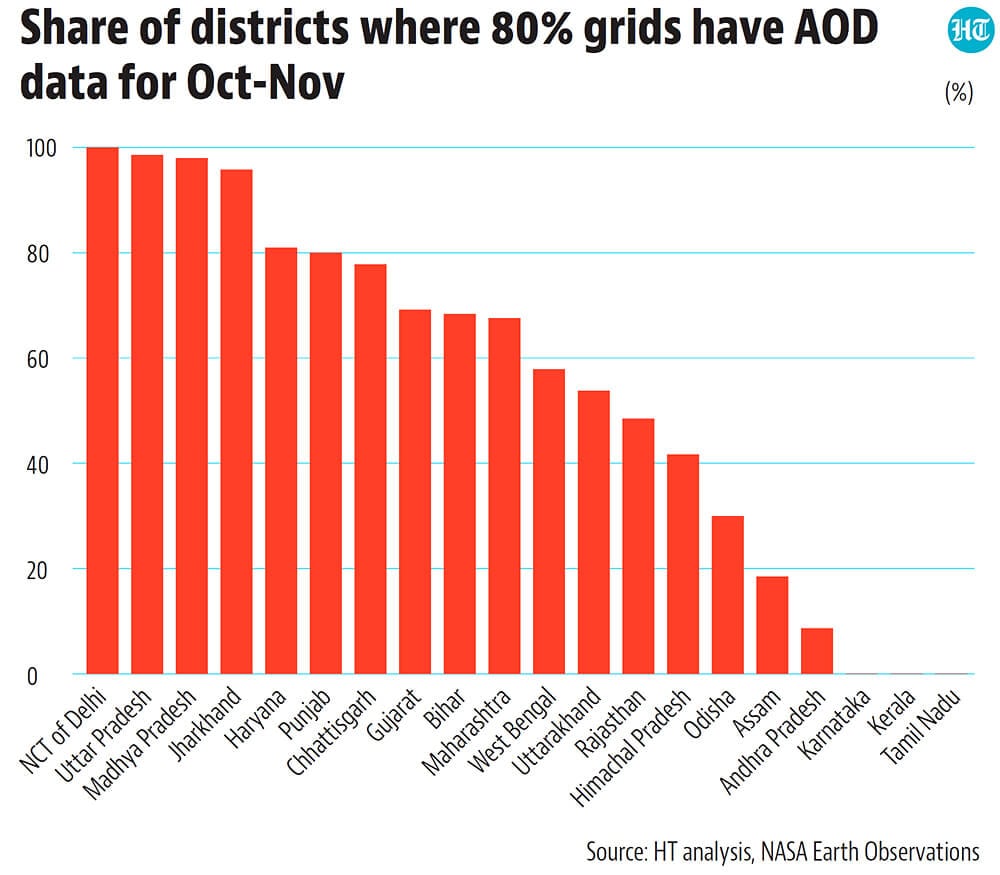
NCR was India’s most polluted region in the early 2000s, but not anymore
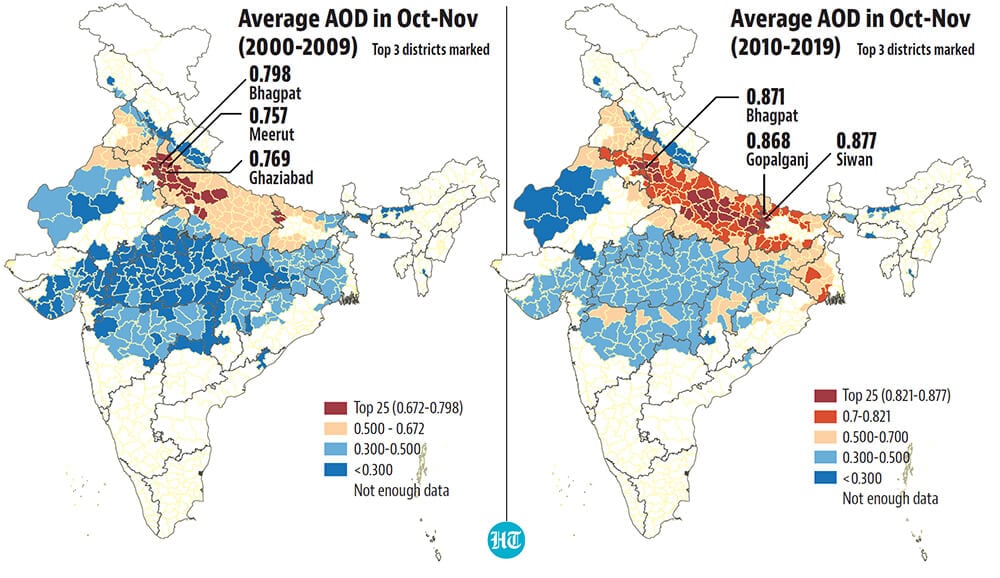
The story of Delhi-NCR being the most polluted region, if the AOD data is any indication, holds true in the first decade of the 2000s. The average AOD for October and November for 321 districts shows that Delhi and NCR were indeed one of the most polluted regions in the country in the early 2000s. In the 2000-09 decade, the top eight and 12 of the top 25 most polluted districts were in NCR.
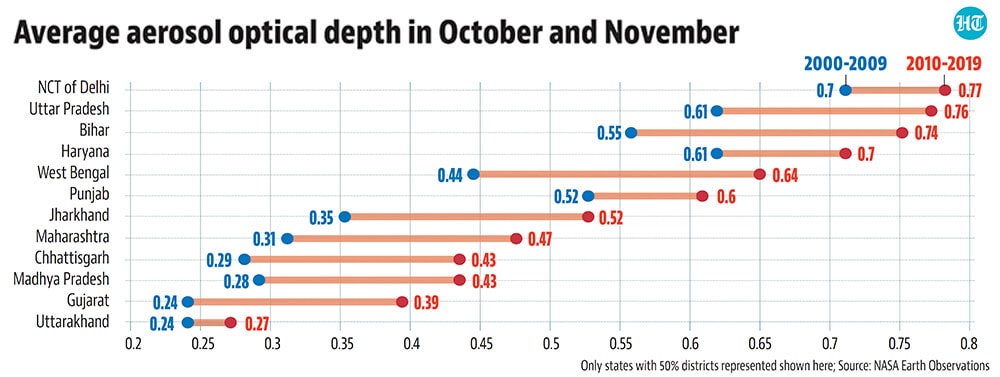
This changed in the past decade. In the 2010-19 decade, only two of the top 10 districts (Baghpat and Ghaziabad) and only seven of top 25 districts were from NCR. Delhi, which was ranked 16th out of 321 districts in 2000-09, ranks 57th in 2010-2019. To be sure, this does not mean that absolute pollution levels in Delhi have fallen. Average AOD in Delhi for October and November has increased from 0.70 in 2000-09 to 0.77 in 2010-19. The most polluted districts now are located further east, such as Siwan and Gopalganj in Bihar, and Sitapur, Auraiya and Ballia in Uttar Pradesh.
Delhi’s air is still the most polluted at the state level, but worsening slower than others
There are several districts in India – a large number of them in Uttar Pradesh – that score worse than Delhi in bad air quality now. It does not mean that Uttar Pradesh as a whole has worse air quality than Delhi. The average AOD for Delhi is still 2% worse than the average for the districts in Uttar Pradesh. What is worrying is that Delhi’s gap with the state was bigger (14% higher) in the 2000-09 period. The case is the same with states such as Bihar and West Bengal, where air quality is much closer to Delhi’s now. Although states such as Bihar and West Bengal are not as well represented as Uttar Pradesh in satellite data, the degree by which air quality has deteriorated in these states warrants more attention.
Satellite data is a proxy, not the complete picture
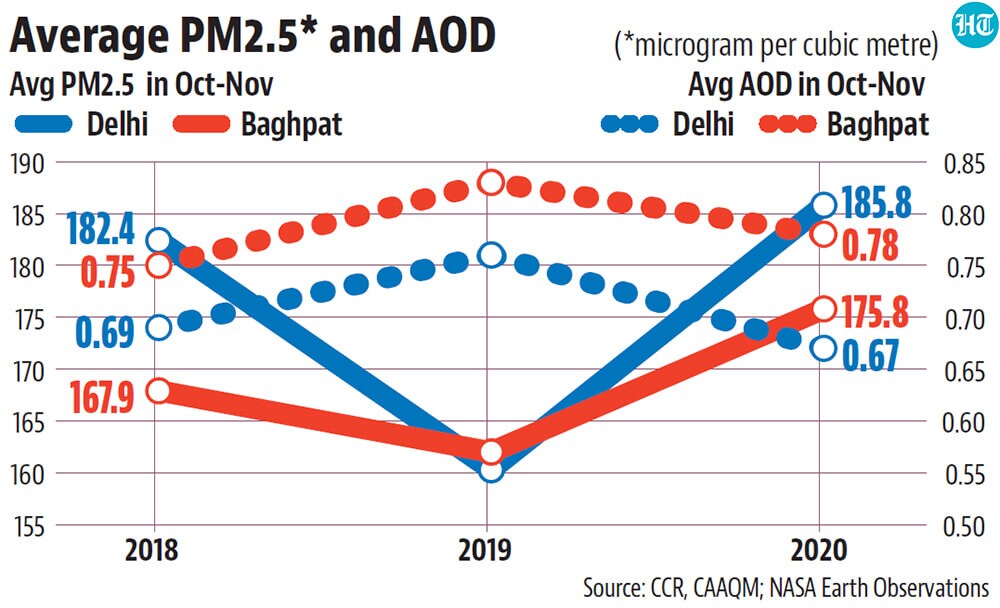
While the satellite AOD data gives better spatial representation, it may not be ideal for looking at trends in time, particularly when comparing one day or year with another. Unlike air quality monitoring stations, which operate all day at one place, NASA’s Terra and Aqua satellites move around the earth. Their monthly averages are therefore snapshots taken daily at just one point in time. It is possible that the peak – which can affect the day’s average – comes at a different point in the day. Comparison with PM2.5 data suggests the same. Both AOD and PM2.5 are higher in Baghpat in Uttar Pradesh than in Delhi. But the time series trends are not the same for AOD and PM2.5. It suggests that we cannot rely on satellite data alone to measure air quality. There can be no substitute for having more air quality stations set up and running, at the very least in India’s northern plains.