
 E-Paper



Stalin seeks govt nod to give aid to Lankan Tamils
Stalin met Prime Minister Narendra Modi in New Delhi on Thursday, during his four-day visit to the national capital, and submitted a detailed memorandum of 14 demands.


Tamil Nadu chief minister MK Stalin on Thursday sought the Centre’s approval for the state government to provide humanitarian aid, including essential commodities and life-saving medicines, to Sri Lankan Tamils in the wake of an economic crisis in the island nation.
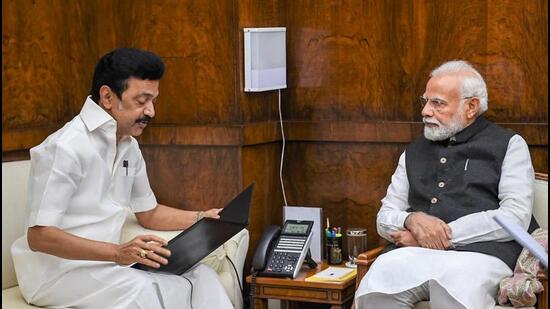
Stalin met Prime Minister Narendra Modi in New Delhi on Thursday, during his four-day visit to the national capital, and submitted a detailed memorandum of 14 demands, including those related to the economic crisis in Sri Lanka.
Referring to adversities being faced by Lankan Tamils, Stalin said in the memorandum: “Many of them have embarked on the perilous journey due to unaffordable essential commodities in Sri Lanka.”
More “people may be arriving in the state due to worsening economic condition in Sri Lanka”, the memorandum noted.
“In this juncture, the government of Tamil Nadu is willing to provide essential commodities and life-saving medicines to the Sri Lankan Tamils living in Northern and Eastern parts of Sri Lanka and Colombo as well as those working in plantation sector… and help the Sri Lankan Tamils especially the vulnerable group of women and children,” it added.
“It is requested to accord necessary permission to undertake this benevolent activity,” the memorandum added.
The Dravida Munnetra Kazhagam (DMK) chief also urged the Union ministry of home affairs to advise the Sri Lankan government to ensure equal political and civil rights to the Tamils living there.
As the leader of the DMK, which is the third largest party in the Lok Sabha, Stalin met Congress president Sonia Gandhi and other non-Bharatiya Janata Party (BJP) lawmakers in Parliament. On April 2, Stalin is set to open DMK’s office in Delhi and invitations have been sent to all political leaders, including those from the BJP and the All India Anna Dravida Munnetra Kazhagam (AIADMK).
Gandhi and West Bengal chief minister Mamata Banerjee are expected to attend the inauguration of the office, which is seen as the DMK’s move to take the party to the nation level.
On Thursday, Stalin also met Union home minister Amit Shah, defence minister Rajnath Singh and Union minister for transport Nitin Gadkari. On Friday, he is scheduled to meet finance minister Nirmala Sitharaman and textiles and commerce minister Piyush Goyal.
In his half-an-hour meeting with PM Modi—the second in Delhi since the DMK formed the government in Tamil Nadu last May—Stalin raised the plight of Lankan Tamils living there as well as repeated attacks on Tamil fishermen by the Lankan Navy.
The DMK leader reiterated the demand to retrieve uninhibited island Katchatheevu, which was ceded by India to Sri Lanka in 1976, to restore traditional fishing rights for Indian fisherman in the Palk Bay.
On March 22, 16 Lankan Tamils (three men, five women, seven children and a four-month-old baby) had reached Tamil Nadu by sea. A day later, they were booked under the Passports Act, 1967 and the Foreigners Act, 1946 for illegal entry into India. At present they are lodged at the permanent transit camp in Mandapam for Sri Lankan Tamils in Rameshwaraman in Ramanathapuram district.
During the civil war in Sri Lanka, there was an exodus of Tamils to the state. A total of 304,269 Lankan Tamil refugees have come to state since the 1980s. As of September last year, the number of Lankan refugees living in the state’s 108 rehabilitation camps was 58,696. In addition, 34,148 refugees are staying outside the camps and are registered with the local police station.
Besides the Lankan issue, Stalin reiterated Tamil Nadu’s opposition to Karnataka’s Mekedatu dam project along the Cauvery river that flows through both states. He urged the Jal Shakti ministry not to issue clearance and requested the Cauvery Water Management Authority not to approve any related project activities without the consent of Tamil Nadu.
Stalin’s other key demands included abolition of the National Eligibility cum Entrance Test or NEET so that Tamil Nadu may be allowed to fill all professional seats, including for MBBS/BDS/AYUSH courses, solely on the basis of Class 12 marks.
Stalin told reporters in Delhi that in his individual meetings with Modi and Shah, he stressed on the abolition of NEET. “We passed the anti-NEET bill for the second time in the assembly. But the governor is delaying in forwarding the bill to the President. I’ve asked the PM and HM to look into this.”
Amid the ongoing Russian invasion of Ukraine, Stalin sought the National Medical Commission’s urgent intervention to find a way out to enable the students to continue their studies in medical colleges in India right from where their studies in Ukraine were disrupted.
Stalin also asked for the National Education Policy, 2020 to be revoked. The DMK has consistently opposed NEP particularly since the state follows a two-language formula (Tamil and English). “Any attempt to make a third language mandatory… will become an imposition and put the students of Tamil Nadu at a serious disadvantage,” Stalin said in the memorandum. Stalin also repeated a demand made by state’s finance minister Palanivel Thiaga Rajan for GST period of compensation to be extended by another two years beyond June.
Stalin requested for the spent nuclear fuel (SNF) from the Kudankulam nuclear plant in Tamil Nadu’s Tirunelveli district to be transported back to Russia rather than storing it within the premises, citing concerns of adverse impacts.


