
 E-Paper



Bharat Bandh: Strike evokes mixed response
The bandh call coupled with protests against the Citizenship (Amendment) Act, or CAA, and the National Register for Citizens (NRC) that are ongoing in various parts of the country.


New Delhi: Barring West Bengal, the 24-hour Bharat Bandh called by 10 trade unions and some student organisations on Wednesday was peaceful in most parts of the country. Daily life was affected in Left ruled Kerala, West Bengal and parts of Punjab, were union workers stopped road and rail traffic.
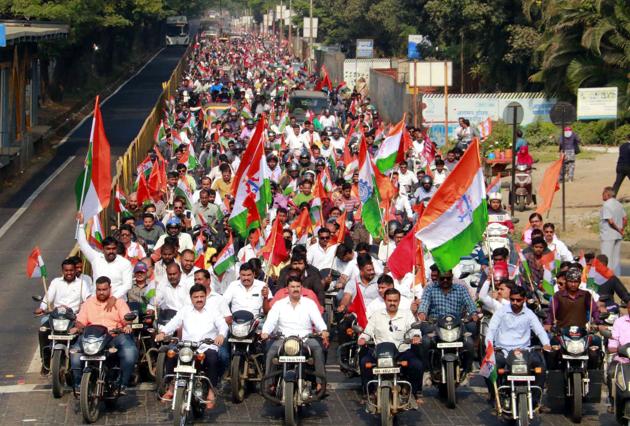
The bandh call coupled with protests against the Citizenship (Amendment) Act, or CAA, and the National Register for Citizens (NRC) that are ongoing in various parts of the country. Protests were held by students at various campuses, including Delhi University, Jadhavpur University, Mumbai University, IIT-Kanpur, IIT-Mumbai, IIT-Ahmedabad, Panjab University, Patiala and Banaras Hindu University.
EAST
Incidents of violence and arson were reported from various parts of West Bengal with buses, a police vehicle and government properties being vandalised by strikers who tried to enforce the 24-hour bandh.
A major protest was reported from Malda district, where tyres were burnt, government buses were ransacked and stones and crude bombs were hurled on police, who tried to control the mob. The police then lathi charged the mob, lobbed teargas shells and fired rubber bullets, officials said.
In various parts of the state, railway tracks and roads were blocked, affecting normal life. Violence and rail blockade was reported from East Burdwan, East Midnapore, Cooch Behar districts and from Dum Dum, Jadavpur, Lake Town and parts of central Kolkata.
In East Midnapore and Jadavpur, the police used batons to disperse the mob as crude bombs were found in the Barasat area of the North 24 Parganas district, police said.
The strike also paralysed daily life as public transport was not available in most places in the state. However, flight services were normal at Netaji Subhash Chandra Bose International Airport. Train services were partially affected in some sectors of the Sealdah, Howrah and Kharagpur sections because of obstruction by protesters.
In Jharkhand and Chhattisgarh, the impact of the strike was visible in the mining areas and the banking sector.
North
In northern India, the impact of the strike was felt mostly in Punjab, with mixed response in neighbouring Haryana, Himachal Pradesh and Uttarakhand.
The activists of several farmer associations asked traders at several places in Congress-ruled Punjab to keep their shops and business establishments closed. There were reports of a partial shutdown of shops and other establishments in Patiala, Ludhiana, Bathinda, Hoshiarpur, Amritsar, Jalandhar and several other places.
With the state-run roadways unions joining the strike, most buses were off the roads in Punjab and road and rail traffic was blocked in several places, such as Amritsar, Sangrur and Longowal. Most of the public sector banks were also closed.
Students and teachers of Panjab University in Patiala joined the protest and did not allow others to enter the campus. They were protesting against violence at Jawaharlal Nehru University in Delhi.
There was mixed response to the strike in Uttar Pradesh with no violence reported from anywhere. The impact could be seen in industrial towns such as Kanpur, Moradabad and Agra.
South
Nobel laureate and renowned biophysicist, Michael Levitt, was left stranded in a houseboat in Alappuzha on Wednesday after protestors stopped his boat for more than three hours even as the bandh crippled normal life in Kerala.
Levitt, who won the 2013 Nobel Prize in chemistry, was on a three-day visit to the state. His boat was anchored near Alappuzha after a trip to Kumarakom. When it was about to leave the jetty, protestors gathered and threatened the crew. It was allowed to leave only after boat operators alerted officials.
CITU leader, PP Chitaranjan, said since the tourism sector was exempted from the strike it should not have happened. He said the party will look into it. Similarly many tourists complained that their vehicles were blocked by strike supporters. Many pilgrims for the ongoing Sabarimala pilgrimage season were seen stranded.
Vehicular traffic came to a standstill and shops and business establishments remained closed in many part of the state. In some places it was a forced shutdown, shop owners said. Earlier many trade bodies had announced their plan to open their shops but later they succumbed to the pressure of strikers. No violent incident was reported from the state.
The strike had very little impact on daily life in the Telugu states of Telangana and Andhra Pradesh. Except in nationalised banks and public sector undertakings, which remained closed as the employees stayed away from work, there was no major breakdown of any services.
Work was halted at Visakhapatnam Steel Plant (VSP), according to a trade union leader as over 30,000 employees stayed away from work. Activists of the Communist Party of India (CPI) and Communist Party of India (Marxist) (CPI-M) were prevented by police from stopping state-owned RTC bus services at Vijayawada, Guntur, Ongole, Tirupati and Visakhapatnam.
The MPs of the Left parties were among 800 workers of trade unions arrested in Coimbatore even as the bandh had little impact in the rest of Tamil Nadu. Its effect was visible in Kanyakumari and Theni districts. Like other states, banking services were affected in Karnataka.
WEST
The impact of the bandh was only visible in industrial areas of Gujarat, Maharashtra and Rajasthan, where the presence of trade unions is strong, and in the banking sector.
In Maharashtra, the impact was minimal except for nationalized banks, insurance companies, manufacturing units and some Public Sector Units. Thousands of workers gathered at Azad Maidan to show their solidarity to the strike. Localized demonstrations also took place in places like Lalbaug, Mahul, Andheri and Vile Parle.
According to Vishwas Utagi, Co-convenor, Trade Unions Joint Action Committee (Maharashtra), which organised the strike, the whole aim was to dissuade any activity which will affect the common man. “We were very clear that we will not organize Rasta Roko or use force to shut shops. We wanted people to voluntarily participate in this agitation and they did,” said Utagi.
In Gujarat, the impact could be seen in the industrial towns of Surat, Rajkot, Vadodara and Mehsana.
Senior trade union leader, Amrish Patel, claimed that industrial production was hit in the state due to the strike. “I have not come across a single incident of strike today. All factories and services are running without any interruption,” said Bhavesh Lakhani, executive committee member of Gujarat Chamber of Commerce and Industry.
In Rajasthan, the impact of the strike was seen in Sikar, Sriganganagar and Hanumangarh districts, where public transport was affected as roadways employees associated with the Centre of Indian Trade Unions (CITU) went on strike.
CITU Rajasthan president, Ravindra Shukla, claimed the strike had been successful and received a good response. “Workers of textile units in Reengus (Sikar), Bhawanimandi (Jhalawar) and of other units located in Jaipur participated in the strike. The strike impact was also visible in the krishi mandis of Hanumangarh and Sriganganagar,” he said.
Sectoral impact
Workers from the mining sector, power and banking sector participated in large numbers.
“About 1.5 million power sector employees and engineers, including 25,000 in Uttar Pradesh, are on the strike, which is a success,” Chairman of All India Power Engineers Federation (AIPEF), Shailendra Dubey said.
Power sector employees are protesting against the Centre’s proposed amendments to the Electricity Act as well as other privatisation policies of the government, which they say are against the interest of consumers and employees.
Mining activities in Jharkhand and Chhattisgarh were affected because of the strike, claimed trade union leaders, even as officials said that the situation was normal in the sector.
The strike called by four national trade unions in the coal belt on Wednesday evoked mixed response at the collieries of Bharat Coking Coal Limited (BCCL) and Eastern Coalfield Limited (ECL) in Jharkhand.
The joint front of the trade unions convener, AK Jha, said production and dispatch of coal was badly affected and coal production fell by 60% to 70%. “After marking their attendance, the miners came out from mines and railway siding (coal loading point). So management may claim miners’ presence but production and dispatch was hampered badly as miners supported the strike,” said Jha.
Director (personnel), Bharat Coking Coal Limited (BCCL), RS Mahapatra, said that there was no impact of trade unions strike as company registered normal attendance of miners in mines and posted normal production of coal in all shifts on Wednesday.
The strike in the coal mines of South Eastern Coalfields Limited (SECL) located in the Korba district of Chhattisgarh was seen to have mixed effects but the strike in Manikpur under SECL’s Korba area had a widespread impact. The strike was mixed in Gevra and Deepka mining areas of Korba district.
Other trade unions are protesting the government’s proposed changes to the labour laws.
(With inputs from regional bureaus)


