
 E-Paper



Study shows Covid-19 can spread in public vehicles
One Covid-19 infected person passed on the disease to 23 of 67 passengers on a bus, a new study published this week determined, showing the virus can spread readily in a closed, small setting like public transport.

 Prefer HTon Google


One Covid-19 infected person passed on the disease to 23 of 67 passengers on a bus, a new study published this week determined, showing the virus can spread readily in a closed, small setting like public transport.
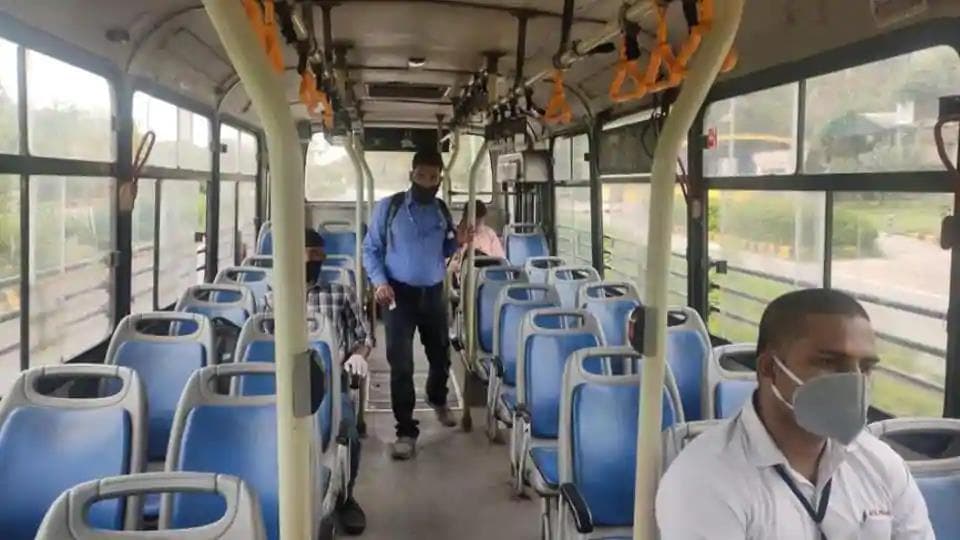
The findings are significant for India as it enters the fourth phase of the Unlock plan, with more public transport – including buses and metro trains – being allowed to run soon.
According to the report in JAMA Internal Medicine, a journal of the American Medical Association, the spread happened in one of two buses that carried a group of 128 people who visited a worship event in eastern China. “Those who rode a bus with air recirculation and with a patient with Covid-19 had an increased risk of SARS-CoV-2 infection compared with those who rode a different bus,” said the authors, who studied the spread that took place on January 19 in Zhejiang province. 
The super-spreader, whose gender was not specified, had no symptoms such as a fever or cough at the time of travel, said the study, and this was a period before wearing of masks was made mandatory in China. Passenger mapping that the sickest people were in the front and back of the bus, outside the perimeter of 1-2 metres (three-six feet) that infectious droplets are believed to travel.
“The investigations suggest that, in closed environments with air recirculation, SARS-CoV-2 is a highly transmissible pathogen,” said the study.
A similar investigation of a outbreak cluster in the southern Chinese city of Guangzhou, Sars-CoV-2 was found to have spread between diners’ tables more than one metre apart at a restaurant in, where three families dined on January 24.
One person who had come from Wuhan developed a cough later that day and tested positive, and by February 5, nine other diners tested positive. The study was published in US Centers for Disease Control and Prevention’s journal, Emerging Infectious Diseases in April, found that the airflow direction was consistent with droplet transmission.
An earlier experimental study published in NEJM in April had demonstrated that the virus remains viable in aerosols for 3 hours or longer, but epidemiological evidence from actual community transmission among people was missing.
In early April, a high-level US scientific panel was the first to flag that the Sars-CoV-2 is airborne and could stay suspended in air in the ultrafine mist produced from normal breathing.
Asymptomatic and pre-symptomatic spread of infection – studies show people are the most infectious one to two days before developing symptoms – further raise the risk of people infecting others in crowded public transport, such as buses and metros.
For mobility to resume, safe behaviour is non-negotiable, experts say. “For buses, we must have thermal screening, spaced seating; masks (compulsory); supervised boarding (from back) and deboarding (from front); and open windows. For metros, thermal screening; orderly boarding and deboarding procedures ; and spaced seating, where possible,” said Dr K Srinath Reddy, president, Public Health Foundation of India.
That apart, he suggests encouraging work from home, wherever possible. “We should try to encourage employers to stagger office hours to reduce crowd density of peak hours,” said Dr Reddy.
The other option is using the government’s contact-tracking app Aarogya Setu, which is being used by 154.5 million users, to track risk and allow only safe passengers to board. “Many offices have done this, but it has to be done at a public-service scale. The app should be made stronger with personalised, useful and direct messaging to people, including tracking symptoms and communicating back to people, providing advice on how to protect themselves, and which routes to take and which areas to avoid. A more functional app will motivate people to use it, so people get into the habit of checking their Aarogya Setu before stepping out to minimize risk,” said Dr Anurag Agrawal, director, Council of Scientific and Industrial Research-Institute of Genomics an Integrative Biology, New Delhi.
But simple masks are the best strategy, followed by safe behaviour. “Mandatory masks, and not riding if you have a cough, cold, fever or were in contact with a positive person are obvious precautions. Older adults, people with cancer, chronic diseases or compromised immunity must avoid crowded buses and metros even with protection. People take out masks when they are speaking, eating, or having a conversation, which is the worst thing that can happen,” said Dr Shiv K Sarin, director, Institute of Liver and Biliary Sciences, New Delhi.
The challenge is asymptomatic spread and the fact that everyone doesn’t have a smart phone. “For that, you can have SMS, and those who have no phone should go through a queue to have their temperature and symptoms checked. It’s unlikely we will face a problem for which a solution is unimaginable,” said Dr Agrawal.
“With public transport opening, people must take precautions and protect themselves. We need a bottom up approach, we need social change,” said Dr Sarin.


