
 E-Paper



Suicide attacker in foiled Handwara assault linked to Hafiz Saeed’s JuD
A member of the Pakistan-based Jamaat-ud-Dawa (JuD) was among three suicide attackers involved in a foiled assault on an army camp in Jammu and Kashmir’s Handwara on October 6, investigation revealed.


A member of the Pakistan-based Jamaat-ud-Dawa (JuD) was among three suicide attackers involved in a foiled assault on an army camp in Jammu and Kashmir’s Handwara on October 6, investigation revealed.
The JuD — a front of the Lashkar-e-Taiba (LeT) terrorist group — is headed by Hafiz Mohammad Saeed, the Pakistan-based rabid anti-India fanatic wanted for the 26/11 Mumbai attacks of 2008.
The National Investigation Agency (NIA), the anti-terrorism agency formed after 26/11, found during its probe into the Handwara attack that one of the fidayeens was carrying a booklet with a Pakistani mobile number, 3022900405, written on its flap.
The number is associated with two Facebook accounts of Fahad Saqi and a Twitter handle, @saqifahad.
The profile picture of one of the Facebook accounts and the Twitter handle are identical. The alleged Saqi is seen in uniform and cap with “Security JUDP” — acronym for JuD Pakistan — inscribed on his clothes. The badge matches the JuD’s insignia.
“The profile picture matches with that of one of the dead attackers,” a home ministry official said.
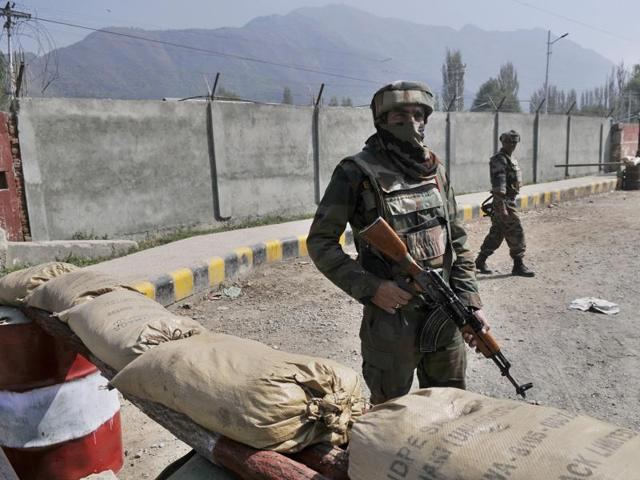
The attackers tried to raid a Rashtriya Rifles camp at Langate in Handwara, but they failed to breach the perimeter security and were killed.
The Truecaller application that connects contact lists of users and helps identify a phone numbers shows the number was issued by Pakistani mobile service operator Mobilink. The user’s name is Mnann, according to the app.
Most of the accounts followed by Saqi or his followers on Facebook and Twitter appear connected to the JuD. All three accounts were created much before the October 6 attack.
“The NIA has sought details of these accounts of Twitter and Facebook,” the ministry official said.
Besides, other indicators point to Saqi as one of the doomed attackers.
Investigators found a name, Fahadullah, written on the front and back pages of the booklet in English and Urdu. “Fahadullah could be the code name given to Saqi by his handlers,” the official said.
The booklet — titled Hasan-ul-Muslim and containing prayers from the Quran — has more evidence linking Saqi with the JuD.
It was published by Dar-ul-Andalus, whose website is www.dar-ul-Andalusia.com. The address is “4, Lake Road, Chauburji, Lahore”— which is also the address of Masjid al-Qudsia, a mosque where Hafiz Saeed is the chief patron.
The NIA inquiry found that Dar-ul-Andalus is the JuD’s publishing arm and has long been printing its propaganda material.
Read: We will carry out surgical strike in Kashmir: JuD chief Hafiz Saeed


