E-Paper



Kesavananda Bharati case: SC creates special web page on 50th anniversary
SC in its 1973 verdict established firmly that Parliament does not enjoy unfettered power to amend the Constitution and that there are certain basic features that are beyond the scope of alterations

 Prefer HTon Google


The Supreme Court on Monday released a special web page to celebrate the 50th anniversary of its historic 1973 judgment in the Kesavananda Bharati case that evolved the doctrine of basic structure and laid down that Parliament can amend any part of the Constitution but cannot tinder with its basic structure – a check on the executive and the legislative powers of the government.
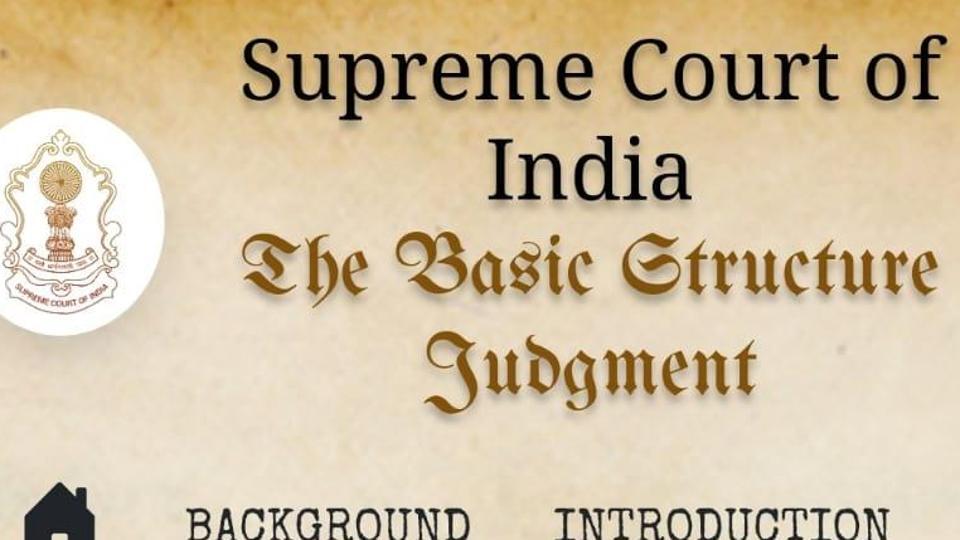
As soon as the first bench assembled on Monday morning, Chief Justice of India Dhananjaya Y Chandrachud informed the lawyers present in his court hall that the apex court administration has dedicated a special web page for paying a tribute to the landmark judgment in the Kesavananda Bharati case.
“Today is the 50th anniversary of the Kesavananda Bharati case. We have dedicated a web page with all the opinions, written submissions and everything related to the case for all the researchers, students and others to look at it,” the CJI said.
Also Read: Kesavananda Bharati, whose Supreme Court case was genesis of ‘basic structure’, dies
HT reviewed the web page, which contains the individua opinions by all the 13 judges on the bench in the 1973 case, which was decided through 11 separate judgments.
The judges on the bench deciding the Kesavananda Bharati case were, then CJI SM Sikri, justices JM Shelat, KS Hegde, AN Grover, AN Ray, B Jaganmohan Reddy, DG Palekar, HR Khanna, KK Mathew, MH Beg, SN Dwivedi, AK Mukherjea and YV Chandrachud.
Arising out of land reform litigation, the Supreme Court in its 1973 verdict established firmly that Parliament does not enjoy unfettered power to amend the Constitution and that there are certain basic features that are beyond the scope of alterations.
It clarified that Parliament is authorised to amend any part of the Constitution, including the fundamental rights, but at the same time such amendments cannot remain immune from the power of the constitutional courts to exercise its power of judicial review to scrutinise all amendments and not just those affecting fundamental rights.
The top court, by slender majority of 7-6, declared that the Parliament has the power to amend any and every part of the Constitution but only to the extent that such amendment does not violate the basic structure of the Constitution.
While the constitution bench in its judgment identified some of the features, including supremacy of the Constitution, unity and sovereignty of India, secular character of the Constitution and separation of power as the basic structure of the Constitution, the court clarified the list is not exhaustive. Later, the top court added some more features such as rule of law, judicial review and free and fair elections to the list of basic structure.
Delivering the 18th Nani Palkhivala Memorial Lecture at Mumbai in January, the CJI had termed the 1973 verdict a “groundbreaking” judgment that guides the judges like a “North Star” in interpreting and implementing the Constitution. Palkhivala was a lead lawyer in arguing the Kesavananda Bharati case before the 13-judge bench.
“The basic structure of our Constitution, like a North Star, guides and gives a certain direction to the interpreters and implementers of the Constitution when the path ahead is convoluted. The basic structure or the philosophy of our Constitution is premised on supremacy of the Constitution, the rule of law, separation of powers, judicial review, secularism, federalism, freedom and dignity of the individual and unity and integrity of the nation,” justice Chandrachud had said during his address.
The CJI had further pointed out that the basic structure judgment is a “rare success story” which was emulated by India’s neighbouring countries such as Nepal, Bangladesh and Pakistan.
“Different formulations of Basic Structure doctrine have now emerged in South Korea, Japan, certain Latin American and African countries. The migration, integration, and reformulation of the doctrine of basic structure in constitutional democracies across continents is a rare success story of diffusion of legal ideas in our interconnected world,” he added.