
 E-Paper



Supreme Court notice to Gujarat on Teesta Setalvad bail plea, hearing on Aug 25
Teesta Setalvad’s lawyers told the Supreme Court that the June 25 FIR against her “germinated out of the order of this court”


NEW DELHI: The Supreme Court on Monday sought the response of the Gujarat government on a bail plea filed by social activist Teesta Setalvad who was arrested on June 25 for alleged fabrication of evidence and tutoring of witnesses in the 2002 Gujarat riots cases.
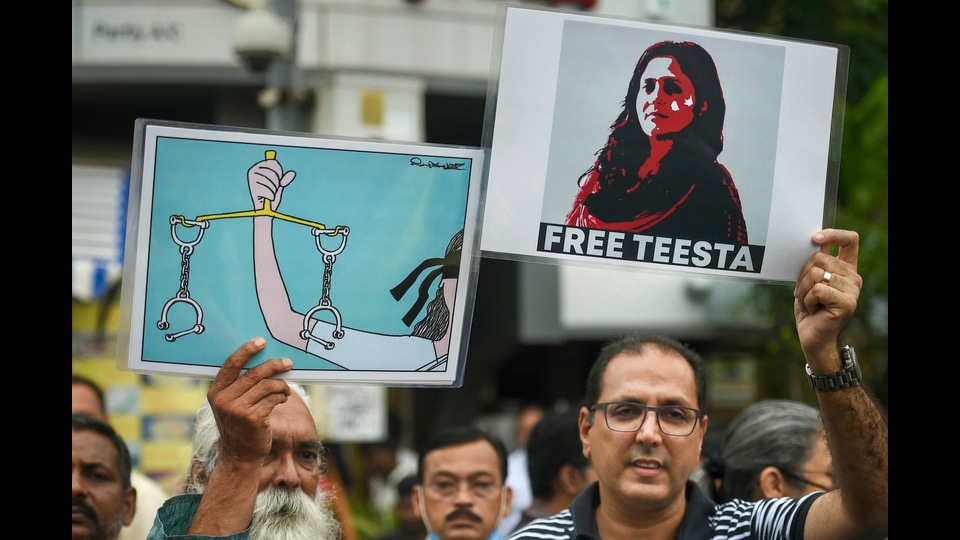
The state government has been told to respond by August 25 when the court will hear the petition.
“Considering the facts and circumstances of the case on record, let notice (to Gujarat government) be made returnable on August 25,” a three-judge bench of the top court headed by justice Uday Umesh Lalit said.
The bench, also comprising justices S Ravindra Bhat and Sudhanshu Dhulia, was initially inclined to put off the case to next week, but eventually listed the case for Thursday after senior lawyer Kapil Sibal, appearing for Setalvad, said it was a question of her personal liberty as she was in custody for nearly a month and a half.
The bench also said that it will consider if it can grant any relief to Teesta Setalvad when her plea for bail is pending in the Gujarat high court.
Setalvad petitioned the high court after a city court in Ahmedabad rejected her bail request on July 30. The high court issued notice to the state government on August 3 but kept the matter for hearing on September 19.
Setalvad’s lawyers, Kapil Sibal and Aparna Bhat, stressed that the first information report (FIR) filed against the activist flowed from the Supreme Court’s June 24 verdict dismissing Gujarat riots victim Zakia Ehsan Jafri’s petition for a probe into the larger conspiracy behind the 2002 riots. Zakia was helped by Setalvad, who too moved an application to intervene in the proceedings before the top court.
In its June 24 ruling, the court order rebuked Zakia Ehsan Jafri for the “audacity” to question the integrity of the special investigation team (SIT) that probed the riots cases under the top court’s monitoring and every functionary involved in the process to “keep the pot boiling” for an obvious ulterior design. The verdict added: “All those involved in such abuse of process, need to be in the dock and proceeded with in accordance with law.”
At one point during Monday’s hearing, the bench asked Sibal if it was appropriate to entertain the petition when Setalvad’s bail plea was pending before the high court. Sibal argued that it was.
“The case has germinated out of the order of this court. The FIR (first information report) verbatim produces statements from the judgment (of June 24). How can a proceeding for bail lie before the high court.” He said the FIR was registered just a day after the Supreme Court delivered its June 24 judgment.
When the court wished to enquire from the state government, Sibal said that no one was appearing for the state government since it hadn’t filed a caveat.
Before issuing notice, justice Lalit told Sibal that as a senior lawyer prior to his elevation, he appeared for key accused in the Sohrabuddin fake encounter killing case. “As a lawyer, I have represented some accused in the Sohrabuddin matter. I don’t know if the petitioner herein took a stand against those accused. I thought I have a duty to inform you. However, Sibal said, “I have no objection.” Lalit had represented Union home minister Amit Shah in that case. The bench recorded Sibal’s statement in the order saying, “The petitioner has no objection to this bench hearing the proceedings.”
In her petition, Setalvad said she was targeted by the State as she raised critical issues before the top court “challenging the administration.”
Along with Setalvad, the Gujarat government named sacked IPS officer Sanjiv Bhatt and former DGP RB Sreekumar in the same FIR for forging and fabricating evidence, tutoring witnesses and making them depose on pre-typed affidavits.
Setalvad’s petition said she has been targeted by the state for providing support to victims of riots and challenging the administration.
She added that the special team led by former CBI director RK Raghavan, which probed nine Gujarat riots cases, did not find any evidence of tampering, forgery, or influencing of witnesses by either the petitioner or any other person. She also questioned the long delay in deciding the bail plea. The trial court kept her request pending for three weeks before rejecting it and underlined that the high court posted the matter after a month and a half in violation of guidelines on bail laid down by the Supreme Court.


