
 E-Paper



Supreme Court pulls up Chandigarh admin over ‘haphazard growth’ in city
Pointing out that Chandigarh Master Plan 2031, and the relevant Apartment Rules prohibit the mushrooming of apartments, the court lamented that the Chandigarh Administration is blindly sanctioning building plans though these plans are in effect converting one dwelling unit into three apartments.


Haphazard developments must be arrested before they damage the environment and heritage status irretrievably, the Supreme Court underlined on Tuesday as it pulled up the Chandigarh administration for “blindly” permitting apartments to mushroom in the city, and restrained the authorities from sanctioning any plan to convert single dwelling units into a block of flats.
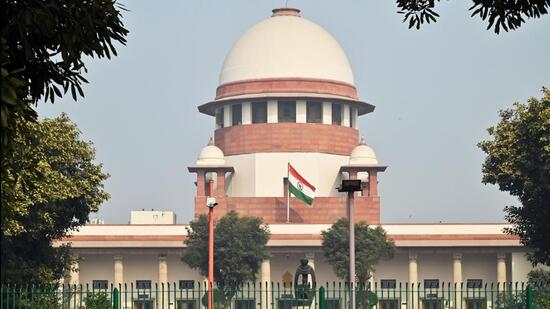
Reproaching the Union territory administration for “turning Nelson’s eye” to single dwelling units being converted into apartments despite regulations prohibiting the change, a bench led by justice BR Gavai held that the heritage status of Chandigarh must be preserved, adding that authorised construction will “injure the lungs” of India’s first planned city.
“The fragmentation/apartmentalisation of residential units in Phase I (northern sectors) of Chandigarh is destructive of the vision of Le Corbusier (the French architech who designed Chandigarh). It is also opposed to the concept of protecting and preserving the heritage status of Corbusian Chandigarh,” said the bench, which also comprised justice BV Nagarathna.
Pointing out that Chandigarh Master Plan 2031, and the relevant Apartment Rules prohibit the mushrooming of apartments, the court lamented that the authorities of the Chandigarh Administration are blindly sanctioning building plans though these plans are in effect converting one dwelling unit into three apartments.
“Such a haphazard growth may adversely affect the heritage status of Phase-I of Chandigarh which is sought to be inscribed as a UNESCO’s heritage city,” said the bench, imposing a bar on making any changes in the densification of the northern sectors of Chandigarh without an approval of the Chandigarh Heritage Conservation Committee and a subsequent ratification by the Centre.
The court also ordered freezing of the floor area ratio (FAR) in the northern sectors, adding the number of floors in the area will be restricted to three with a uniform maximum height as fixed by the Heritage Committee keeping in view the requirement to maintain the heritage status.
In a ruling that comes close on the heels of Joshimath in Uttarakhand finding itself in the midst of a disaster due to land subsidence, the top court also made an appeal to the legislature and the executive at the Centre and the states to make necessary provisions for carrying out environmental impact assessment (EIA) studies before allowing urbanisation.
The bench called it is “necessary that a proper balance is struck between sustainable development and environmental protection”, and urged the cabinet secretary to the Union of India and states’ chief secretaries to pay heed to the court’s call.
To be sure, experts have blamed the land subsidence at Joshimath to a hydel power project in its vicinity and rampant infrastructure development without a plan, making the fragile Himalayan ecosystem even more vulnerable.
“It is high time that the legislature, the executive and the policymakers at the Centre as well as at the state levels take note of the damage to the environment on account of haphazard developments and take a call to take necessary measures to ensure that the development does not damage the environment,” said the bench.
It regretted that although the competent legislatures have, from time to time, enacted laws for ensuring planned development of the cities and urban areas, enforcement thereof has been extremely poor and the people have violated the master plans, zoning plans and building regulations and by-laws with impunity.
The court cited the example of Bengaluru, lamenting how a city, once considered to be one of India’s best cities has been ruined on account of haphazard urban development.
“The warning flagged by the city of Bengaluru needs to be given due attention by the legislature, executive and the policy makers. It is high time that before permitting urban development, EIA of such development needs to be done,” stressed the court.
In the present case, a batch of petitions before the Supreme Court challenged the November 2021 order of the Punjab & Haryana high court, which held that mere construction of three floors on a private plot and utilisation of the same as independent units would not amount to fragmentation or “apartmentalisation” unless there is a subdivision of the property by metes and bounds.
The top court set aside the high court order, noting it allowed the developers and plot owners to induct co-owners in the property by selling them certain shares in the property and permitting construction of independent floors.
“The result of the judgment of the high court is that though the construction of apartments is prohibited, still the construction of a building and converting it into apartments would not be impermissible since the same would not be apartments within the meaning of the 2001 Rules. It goes on to hold that though the developers/builders are in effect indulging into construction of three apartments in a building, the same does not amount to apartmentalisation. In our view, this would amount to permitting something indirectly which is not permitted directly,” held the bench.
“The top court’s judgment has given protection for what we have been fighting for 25 years now. It will help in mitigating pollution and traffic chaos. Otherwise, in the next 10 years, it would have become another Ludhiana,” ML Sarin, senior advocate and member of Sarin Memorial Legal Aid Foundation, said.


