
 E-Paper



‘Swadeshi should be mantra of life’: PM Modi pitches for self-reliance
This is the latest in a string of speeches where Modi has pushed indigenous products and self-reliance, flagging global economic turbulence.

 Prefer HTon Google


Ahmedabad: Swadeshi should be everyone’s life mantra and irrespective of who is investing, production must take place domestically, Prime Minister Narendra Modi said on Tuesday, making a pitch for self-reliance and Make-in-India products a day before US President Donald Trump’s additional 25% tariffs kick in.
He was speaking after flagging off exports of Maruti Suzuki’s first electric vehicle, the e-VITARA, from the Hansalpur facility in Gujarat to over 100 countries and inaugurating production units for lithium-ion battery, cell and electrode manufacturing for strong hybrid e-vehicles.
“Swadeshi should become our life mantra. Let’s embrace swadeshi with pride. The things that will be made here by Japan are also swadeshi,” Modi said on a day Japan’s Suzuki Motor Corporation committed to invest over ₹70,000 crore in the country in the next five to six years.
“My definition of swadeshi is very simple: it doesn’t matter whose money is invested, whether it is dollars, pounds, whether the currency is black or white, it doesn’t matter to me. What matters is that in production, the sweat belongs to my countrymen… Those products will have the fragrance of my country’s soil,” he added.
This is the latest in a string of speeches where Modi has pushed indigenous products and self-reliance, flagging global economic turbulence.
The punitive 50% tariffs on India — among the highest imposed on any US trading partner — stems from President Donald Trump’s August 7 executive order adding a 25% penalty for India’s Russian oil purchases on top of an existing 25% reciprocal tariff. Modi had earlier asked businessmen to display “swadeshi only” boards outside their shops as he reiterated India would not compromise on the interests of farmers and small businesses against the backdrop of speculation that greater access to the sensitive agriculture sector was a factor in the US-India trade talks.
Modi called the EV production and battery manufacturing plant a new chapter and a big leap towards the goal of “Make in India, Make for the World”. He said EVs made in India will be exported to 100 countries. “...hybrid battery electrolyte manufacturing is also starting,” the PM said.
Modi highlighted the transformation of India-Japan relations. He said Suzuki Japan was manufacturing in India, and the cars were being exported to Japan, demonstrating the strong bonding between the nations and the confidence of global companies in India.
“Maruti Suzuki is the largest car exporter in India today. In a way, Maruti Suzuki has become the brand ambassador of Make in India. Now the company plans to replicate this success in the EV sector. Vehicles running in several countries will proudly bear the ‘Made in India’ tag,” the PM said.
Modi referred to the project’s origins in his tenure as Gujarat chief minister. “In 2012, when I was the chief minister...we allotted land in Hansalpur to Maruti Suzuki…we had a vision of Atmanirbhar Bharat [self-reliant India] and ‘Make in India’ even then,” he said.
The PM remembered the late Japanese businessman Osamu Suzuki and said the government conferred the Padma Vibhushan, the country’s second-highest civilian award, upon him. Modi said he was pleased to witness the expansion of Suzuki’s vision for Maruti Suzuki India.
Modi said he was visiting Japan next week and added that the relationship between the two countries went far beyond diplomatic ties and was rooted in culture and mutual trust. Modi noted Japan was a key partner when the “Vibrant Gujarat” Summit was launched 20 years ago.
India had the power of democracy and the advantage of demography, he said, adding: “India also has a vast pool of skilled workforce, creating a win-win situation for every partner.”
Modi said India was working to make its manufacturing sector efficient and globally competitive. He spoke about India’s industrial transformation over the past decade.
Modi said while “the world is struggling with supply chain disruption,” the policies implemented since 2014, including Make in India, globally competitive industrial corridors, plug-and-play infrastructure, and production-linked incentives, are now proving their worth.
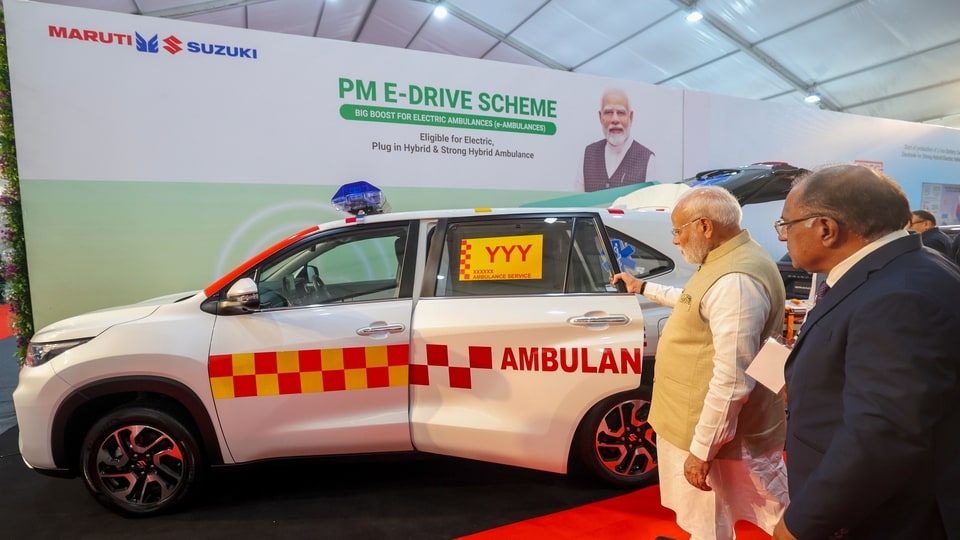
“Last year, during my Singapore visit, I realised how our old cars, old ambulances, can be converted to EVs. Maruti Suzuki has accepted the challenge and developed a working prototype in just six months,” he said.
Modi added that they align perfectly with the PM E-DRIVE scheme. Modi said that under this ₹11,000 crore scheme, a dedicated budget has been allocated for e-ambulances.
Referring to the launch of the production of Li-Ion battery cell and electrode at TDS Lithium-Ion Battery Gujarat Pvt Ltd (TDSG) in Hansalpur, Modi said India was totally dependent on imports for these batteries till a few years ago.
“A battery is the most critical part of the EV ecosystem. To strengthen EV manufacturing, it was important that India produce batteries too. With that vision, we laid the foundation of TDSG battery plant here in 2017. For the first time in India, three Japanese companies have come together to produce battery cells,” he noted.
In the last decade, electronics production in India has increased by 500%, mobile phone production has increased by 2,700% and defence production rose by 200%, Modi said.


