
 E-Paper



Tehran will welcome any Indian initiative to reduce tensions: Iranian envoy
India has sought to adopt a nuanced position in view of its strategic partnership with the US and its dependence on Iran for unfettered access to Afghanistan and Central Asia through Chabahar port.


Days ahead of Iran’s foreign minister Javad Zarif’s arrival in New Delhi, the Iranian envoy said his country will welcome any Indian initiative to reduce tensions triggered by the killing of General Qasem Soleimani in a US airstrike.
Zarif is expected to arrive in New Delhi on January 14 to speak at the Raisina Dialogue, a think tank event backed by the external affairs ministry. He is also expected to meet his Indian counterpart S Jaishankar – the first high-level contact between the two sides since the recent escalation in West Asia.
India has sought to adopt a nuanced position in view of its strategic partnership with the US and its dependence on Iran for unfettered access to Afghanistan and Central Asia through Chabahar port. Prior to US sanctions kicking in last June, Iran was also among India’s top three energy suppliers.
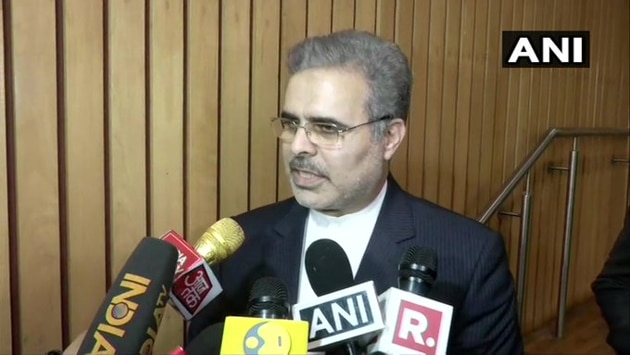
“India usually plays a very good role in peace in the world. India belongs to this region. We welcome all initiatives from all countries, especially India as a good friend for us, to not allow escalation,” Iranian ambassador Ali Chegeni told reporters on the margins of a condolence meeting for Soleimani at the embassy.
Describing India as a “good friend”, Chegeni noted Zarif had a “very good discussion” with Jasishankar on Sunday. “We have no problem with India,” he said.
He added, “We are not for war, we are looking for peace and prosperity for everybody in this region. We welcome any Indian initiative or any project that can help peace and prosperity in this world.”
The remarks came hours after Iran fired more than a dozen ballistic missiles at two Iraqi bases where US forces are stationed in retaliation for Soleimani’s death. There was no immediate response from Indian officials.
The visit of Zarif, who will be accompanied by deputy foreign minister Seyed Sajjadpour, will
give India and Iran a chance to exchange detailed notes on the situation and to find ways to reduce tensions while ensuring New Delhi’s interests in the region aren’t affected, people familiar with developments said.
India has so far called for stability in the region and restraint by all players, and Chegeni’s comments indicated Iran too wasn’t keen on further escalation.
Referring to Soleimani’s killing and the Iranian missile strikes, Chegeni said: “We hope it won’t be needed to be repeated, but if anyhow, it is repeated, this won’t be the last one for us. I hope it won’t be repeated from both sides.”
He said the US drone strike that targeted Soleimani was an “illegal act” which violated international laws as the commander of al-Quds Force was killed in a third country. He accused the US of “supporting terrorists” as Soleimani had played a key role in the campaign against the Islamic State, which poses a threat to India, Europe and other parts of the world.
Defending the Iranian missile strikes at exactly the same time that Soleimani was killed on Friday, Chegeni said, “This is not revenge, this was the right of our people.
Trita Parsi of the think tank Quincy Institute said de-escalation and restraint was now needed on the part of both Iran and the US.
“Neither American nor Iranian interests will be served by full-scale war, certainly the rounds of attacks taking place in Iraq have further destabilised the country, which is already in the midst of a severe political and security crisis,” he said.
“There is still time for both sides to find a path away from war. What is needed is an immediate ceasefire followed by vigorous diplomacy, if not directly between Tehran and Washington, then through the facilitation of countries like Oman, Switzerland or Japan, which in the past have helped to defuse US-Iran tensions, or through the auspices of the UN Secretary General.”


