
 E-Paper



Terms of Trade: What is a good foreign policy for India?
India’s foreign policy must rise above sectarian interests and elite complacency to align economic strategy with long-term national security, growth goals

 Prefer HTon Google


A lot of modern commentary on foreign policy in India is the equivalent of the proverbial tailor-made gentleman. It is keen to align itself to the actions of the regime to look good and patriotic without necessarily worrying about consistency, substance and most importantly, foresight. To be sure, this is often a result of lack of understanding; sometimes due to indoctrination (even if inadvertent) and sometimes sheer confusion about what exactly is good foreign policy and national interest. The almost uncritical celebration of India’s pivot from being a strategic ally to the US to the latest détente with China along with old friend Russia is a perfect example of this. There are many who are celebrating India’s acts as an effective counter to Trump and his acolytes’ anti-India tirade, but there are also apprehensions about Chinese intent towards India, especially given the long-pending Sino-Indian border dispute. Many in the West are looking at India’s move as something like a quasi-justified tantrum because of being ill-treated by the US.
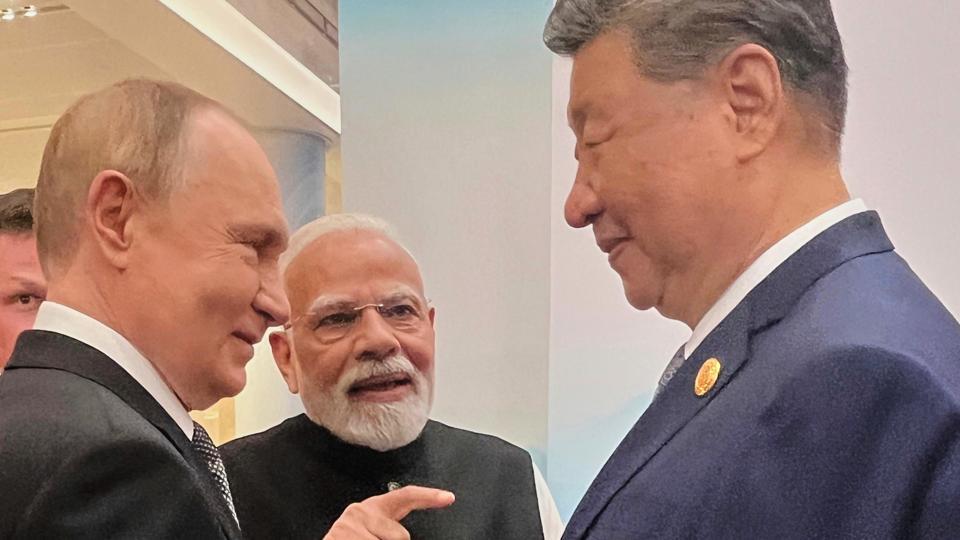
To be sure, none of these versions is devoid of some element of truth. But neither answers a basic question about India. What exactly should be the ideal foreign policy framework for India? Let us look at some issues one by one.
The first and foremost requirement for a nation state is to preserve its territorial integrity. Despite border disputes and skirmishes on its eastern and western borders, no rational voice will agree that there is an imminent threat to India’s territorial integrity. Sure, the status-quo has to be actively and literally patrolled but this is nothing India cannot continue to do. The medium to long-term challenge to preserving territorial integrity is modernising and expanding India’s military capability, especially vis-à-vis China. That requires significantly more economic resources in terms of military spending than India can afford right now. The only way to achieve this is to increase GDP growth rate.
Also Read: Terms of Trade: From strategic ally to voodoo doll
How does India push forward its growth rate to a level which is close to the 7.8% June quarter number on a sustained basis without a statistical boost from inflation adjustment, which is what explains the latest GDP print. There is virtually no example in history where a country even half of India’s size has managed to achieve a sustained high growth rate without external engagement.
The US and China are the world’s top two economies. India will soon become the third largest. The US is the global leader in high-tech knowledge, finance and high value services. China is the proverbial factory of the world with an excess capacity to overwhelm any other economy and closing its technological knowledge gap with the US and the West at large at a very fast pace.
India has made significant gains from plugging itself in the high-end services economy of the US. It is one, perhaps the only area, where the costs of a delinking with India, unlike in merchandise exports, are likely to be painfully, if not prohibitively high for the US economy. But there is good reason to believe that these gains have peaked already and our strategic approach should be focused on defending rather than advancing them. This is reason enough to desist from any provocation vis-à-vis the US or US companies with whom India or Indians do business or work. But India’s medium to long-term economic requirement is not going to be fulfilled from riding the services export or outsourcing wave. What we need is a boost to manufacturing which can bring us three tangible benefits. One, generate employment outside India’s overcrowded and extremely poorly paying farms. Two, help reduce the trade deficit by reducing imports either in absolute or value-added terms. And, three, add a significant long-term positive delta to overall economic growth.
Also Read: Donald Trump’s policy on India is backfiring, says Congresswoman Sydney Kamlager-Dove
It is on the manufacturing front that an economic engagement with China is absolutely essential. China controls the critical raw materials to produce things such as electronics (rare earths), pharmaceuticals (active pharmaceutical ingredients) , even fertilizers. It also controls, explicitly and otherwise, companies and skilled personnel (iPhone manufacturing is a good example) which are essential to kick-starting such production in another country. To be sure, even parts of the government realize the importance of working with China on this. This year’s Economic Survey – the flagship publication of the finance ministry – flagged this issue much before Trump poured cold water over the Indo-US partnership. What should be India’s approach to China then?
China’s own history is instructive on how to tackle dilemmas involving cooperation with an adverse neighbour. In its early days of opening up to the world under Deng Xiaoping, China aggressively pushed for a closer economic relationship, even closer than the US, with Japan despite a bitter history with it and a pending border dispute. Deng was confident of what he was doing because he was sure of what he wanted from China’s Japanese engagement: technology for the Chinese economy. He did not allow the neighbourhood tension or unsettled disputes to hold back the engagement. The relationship was far from smooth. Even after Deng’s passing, Japanese companies such as Sharp tried to sabotage China’s plans to take a lead in things such as making display panels etc. But what the Japanese or the rest of the world were unwilling to give China on a platter, it acquired by a dogged pursuit of its domestic enterprise.
This is where the elephant in the room lies for India. Why is Indian capital, barring a handful of exceptions, unwilling to take the risk of creating a strong domestic manufacturing base despite such a large market? Sure, it might or rather will lead to failed ventures, lost capital, even bankruptcies, but why the entrenched reluctance?
The cliched explanation we hear is lack of reforms. But this is a lazy analysis. Lack of these so-called reforms have not prevented the fast pace of creation of the super-rich in India. In fact, India punches way above its overall economic weight in terms of number of dollar billionaires or ratio of sale of ultra-luxury cars and just luxury cars.
What if the ongoing phase of wealth creation in India is driven by a combination of a captive market in provision of services (think health and education) facilitated by a withdrawal of the state and tacit understanding to allow private rent seeking in manufacturing by preventing competition from foreign made commodities –this is where the much-bemoaned inverted duty structure comes from – thereby creating large-scale friction in the process of creative destruction and Indian manufacturing becoming globally competitive. What if all this is a quid-pro-quo of sorts?
Also Read: SCO summit: Assessment from the Indian lens
This is not a problem mass politics can solve. Majority of Indians are too bogged down in sustenance issues which is manifesting itself in growing pressure for fiscal palliatives. But then reforms are rarely driven by mass politics. India’s 1991 reforms were definitely not. It is essentially a function of how the vanguardist elite wants to resolve the key contradiction facing the country at any given moment. Policy choices, whether foreign or domestic, military or economic, are all derived from this characterization of the central contradiction.
Democracy has a lot of good things going for it. More importantly, it can prevent a lot of very bad things. But sometimes it can lead to a situation where the political economy of winning elections does not necessarily align with the political economy strategy of securing and advancing long-term national interest. There is good reason to believe that the Indian political economy is caught in this low-level equilibrium trap and the malaise is party-agnostic. This is essentially a failure of the Indian elite tied to short-term sectarian interests rather than some intellectual problem or elusive search for a foreign policy or economic reform silver bullet.
(Roshan Kishore, HT’s Data and Political Economy Editor, writes a weekly column on the state of the country’s economy and its political fall out, and vice-versa)


