
 E-Paper



HT This Day: May 17, 1944 -- Bloodiest battle of Burma front ends
The last Jap in the last bunker has been eliminated


The last Jap in the last bunker has been eliminated. The battle of the Kohima Ridge and the biggest battle of the Indo-Burma front has ended. The whole of the Kohima Ridge-consisting of the Deputy Commissioner’s bungalow area, Summer House or Garrison Hill, Kuki Picket, F.S.D. Ridge, D.I.S. Ridge, Jail Hill and G.P.T. Ridge-is now in our hands, writes D. R. Mankekar, Associated Press war correspondent.
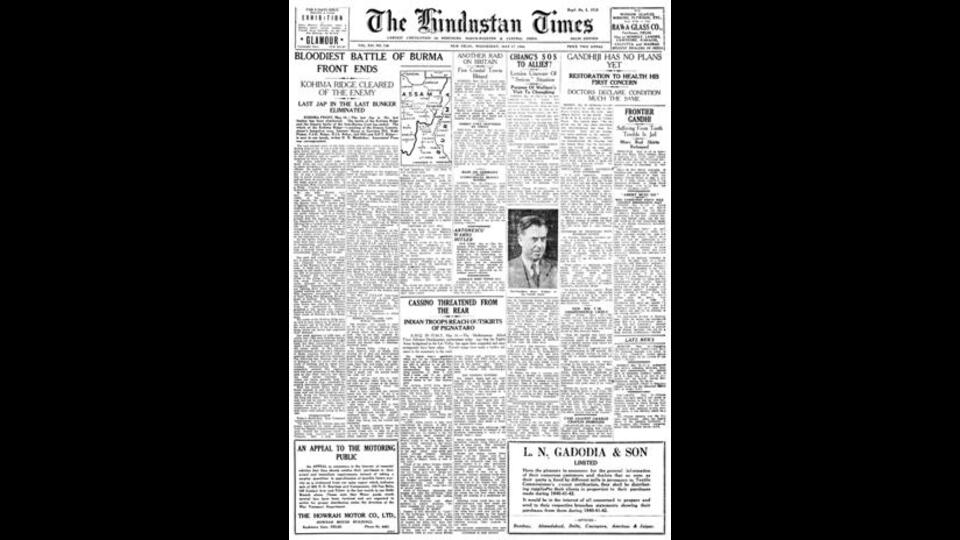
The only pitched battle of the Indo-Burma front so far, it was a hard slogging match lasting forty days with the Japs grimly determined to hold on to their positions and we equally determined to throw them out.
The enemy suffered over 3,000 in dead, while our own casualties were no mean including a high proportion of officers. No quarter was given and every inch of the ground was fought for. It was a triumph of coordination in which infantry, tanks, artillery and air force all played their part, but the tanks played the stellar role. A well-known West County Regiment and a Home Counties Regiment covered themselves with glory.
As one high British military officer described it, the battle of the Kohima Ridge was literally the bloodiest battle of the Burma front. The various sites of fighting were littered with Jap dead making the task of counting them almost impossible. In the latter stages, the battle reduced itself to a bunker busting process-a laborious grim process with the starving Japs clinging desperately to their bunkers and fighting like a hunted animal turned to bay. Then tanks would have to be brought in to hammer at the bunkers with armour-piercing shot. This has been a battle unlike any other fought on the Indo-Burma front so far.
All the battles fought so far on this front have been essentially operations of maneuvering and outmaneuvering each other, but this was the first time that a pitched battle with a single concentrated front has been fought.
NEXT JOB
The next and comparatively easy Job is clearing the entire Naga village and Treasury Hill on the eastern side of the Manipur Road of the Japanese. A large part of the village is already in our hands but the Japanese are still in occupation of a commanding “pimple” and the southern out- skirts of the village while the enemy had made Treasury Hill further south, adjacent to the village, his stronghold. Thereafter will commence our fighting drive down the road to Imphal meeting and squashing on the Way Japanese strongholds, the first of them being Mao Songsang, 20 miles south of Kohima. The liquidation of the Japanese forces in the Kohima area leaves two Japanese concentrations, one north-west of Kohima guarding a line against our columns pushing down from the north and the other south of Kohima at Mao Song-sang.
The battle of the Kohima Ridge may be said to have begun on April 4 when the enemy put in his first attack on the most southerly of the six features along which our forces had organized their defences.
Our small garrison of 3,500 men, of which only 1,500 were first-line troops, strung out on these six features, fought hard, but were overwhelmed, and by April 6 two features had fallen into the enemy hands. At this juncture reinforcements arrived and a battalion of Home Counties Regiment took up positions inside the garrison perimeter. The following day, however, the road to Dimapur was cut about two miles north of Kohima, and so, apart from wireless communication, they were completely isolated. The Japanese then also took possession of the Bazaar area as also other features one after the other except Garrison Hill where our forces gallantly held out through a 13-day siege, repeatedly repulsing determined Japanese assaults.
Then the United States Army Air Force stepped in and day after day came over and dropped supplies accurately, flying low despite machinegun fire from the enemy. For 13 days the men had had no respite-no chance to wash or shave, little water, meagre rations, never more than two hours’ consecutive sleep a day, so much so that many were almost asleep on their feet.
‘COMMUNIQUE’
Today’s South-East Asia Command ‘communique’ says:
“On May 14 in the Kohima area our troops supported by tanks advanced from the Deputy Commissioner’s bungalow, cleared the Japanese block at Kohima road junction, and reached Treasury Hill, a mile further north, where they joined another force which had advanced from the west. Our tanks had a successful day, destroying fifteen bankers and killing one hundred and fifty Japanese. In the Kohima operations more than three hundred enemy dead have been counted in addition to those in destroyed strongpoints. We have captured four guns.
“North of Imphal in the neighbourhood of Kanglatongbi our operations are proceeding.
“In the Kaladan, west of Labawa, 10 miles west of Daietme, we repulsed another enemy attack, inflicting heavy casualties.”
“In North Burma enemy bombers and fighters attacked an emergency airstrip of the Chinese-American forces in the Mogaung Valley and caused a few casualties, but only slight material damage.
“East of the Mogaung river the Chinese continued to reduce Japanese pockets in Warong. West of the river in the Malakawng area the Chinese are driving south. Patrolling and mortar duels continue in the Mansum area. At Njip, south-east of Waza, our levies successfully ambushed a party of a hundred Japanese.”
“R.A.F. medium bombers of the Strategic Air Force, Eastern Air Command, on the night of May 14 bombed Indaw railway station and dumps and stores at Kalewa. On the following day and night R.A.F. and U.S.A.A.F. medium bombers attacked the Kalewa-Kalemyo Road and the Tiddim Road. The Tiddim Road was observed to be unserviceable at milestone 87, as a result of previous attacks, R.A.F. and I.A.F fighters, fighter-bombers and dive-bombers of the Third Tactical Air Force on May 14 and 15 attacked enemy positions, fox-holes, dumps and gun positions in the areas of the Tiddim Road, Kabaw and Chindwin valleys, Kohima, Palel and Buthidaung.”
“In North Burma U S.A.A.F. fighter bombers hit the ferry bridge at Kazu, 20 miles south-east of Myitkyina. Long-range R.A.F. fighters on May 14 and 15 damaged locomotives and road and river transport in the Arakan and Central Burma.”
“On May 15 U.S.A.A.F. long-range fighters carried out a sweep over Heho and Kangaung airfields. They destroyed 15 enemy aircraft in the air and on the ground, probably destroyed two more, and damaged 11 without loss to themselves. From all these operations no Allied aircraft in missing.’
KOHIMA RIDGE-ONE VAST BURIAL GROUND
The Japanese who stayed to resist on the barren, shell-torn Kohima Ridge stayed to die. They perished in a hell of horror before the fury of our attack. One by one their bunkers became burial pits as tank and anti-tank cannon and hand-placed bulk explosives burned and blasted them to shapeless, shattered hulks.
The Kohima Ridge, writes a 14th Army observer, with its lifeless trees sticking out of shell and mortar-pocked ground like scaffold poles, is one vast grim burial ground. Today, troops were burying enemy slain in the positions where they had fought and perished. Theirs was no warrior’s burial. A sprinkle of quicklime, a few hasty digs with a spade, and the ground sealed the body forever.
Burial parties were also at work, clearing Japanese bodies from the tennis court on the terrace of the Deputy Commissioners bungalow which fell into our hands yesterday.
Here, a heavy anti-tank gun belched death into the bunkers. To put it in position men had had to dismantle it and manhandle the heavy iron parts to the summit of a steep hill.
How many Japanese died in their positions on the F.S.D. feature will never be known. Covering unseen in their “ underground fortress “ sappers destroyed them with heavy slabs of gun-cotton and blocks of ammonal which they thrust into the tunnels and detonated.
As each mighty explosion rocked the earth the tunnels caved in and the ground closed over to keep its secret forever. Among the booty which the Allies collected were four guns---75 mm regimental gun and three 75 mm battalion guns.
West Africans marching from the Kaladan for new operations in the Kalapanzin foothills have given the Japs their best lesson in mobility, writes an observer with the force. To the enemy it has been a painful course of instruction ever since the West Africans first joined them in combat In the Kaladan. At Htabaw a Jap headquarters was caught in an ambush because, as a captured order later disclosed the enemy had not believed that several thousand men could have moved without observation from their own harbour. The Japs were actually moving to “annihilate” the Africans in a location they had already left. They themselves were trapped in a narrow ‘chaung’ and slaughtered.
CAPTURE OF D.I.S. HILL
After four hours of fierce fighting. men of the 15th Punjab Regiment have captured the vital feature known as “D.IS. Hill.” writes an Indian Army observer.
During the course of the two days battle they were completely at the mercy of the elements and had to face in turn rain, mist, cold and intense heat. Heavy casualties were inflicted on the enemy.
The commanding officer of the battalion, though wounded in both arms continued to direct the operations to their successful conclusion.
At the same time British troops operating to the left art right of the 15th Punjab Regiment similarly occupied two other equally vital features called “F.S.D. Hill” and “Jail Hill”.
This action has resulted in the clearing up of most of the Jap pockets of desistance in commanding positions on their front.


