
 E-Paper



The return of traffic congestion
The firm’s traffic data is powered by 600 million connected devices ranging from cellphone carrier data to vehicular GPS data.


Traffic congestion in four of India’s major cities – Mumbai, Bengaluru, Delhi, and Pune – have crawled back very close to levels seen before the Covid-induced lockdown, which had caused global annual traffic congestion to fall for the first time in at least 10 years, a report released on Wednesday showed.
Every year, Amsterdam-based location technology specialist TomTom releases the TomTom Traffic Index, a report detailing the traffic situation in 416 cities in 57 countries. The firm’s traffic data is powered by 600 million connected devices ranging from cellphone carrier data to vehicular GPS data.
What is Congestion level percentage?
Congestion level percentage is the extra travel time a driver experiences compared to an uncongested situation. The report determines a baseline by calculating the pace of free-flow travel time in a region. For instance, a 50% congesting level means that an hour-long journey would take 30 minutes more (so an hour-and-a-half) than it would during the city’s uncongested conditions.
Indian cities congested again
In India, the big change is how far congestion levels have fallen due to the global pandemic, and how by the end of December, most cities were again very close to levels before the pandemic.
New Delhi saw a decrease (average of 9%) in congestion, and an 18% and 14% average decrease in congestion during morning and evening rush hours respectively. The other three cities from India featured in the Index – Mumbai, Bengaluru, and Pune saw an average decrease in congestion levels by 12%, 20%, and 17% respectively.

Global rankings
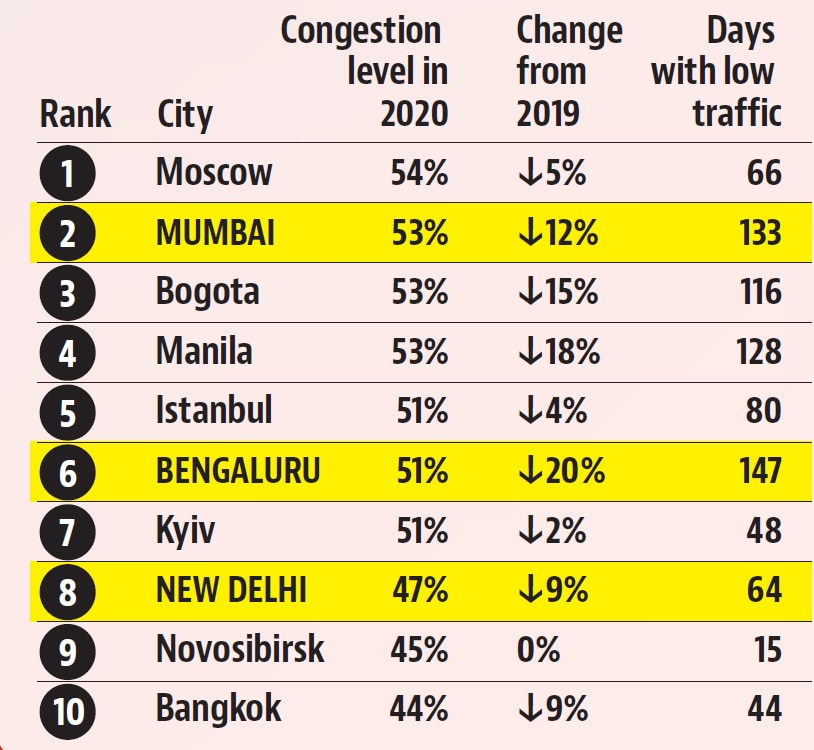
Overall, Moscow was the world’s most congested city in 2020, despite a congestion fall of 8% from 2019. Bengaluru was the most-congested city in the world in 2019, but it fell to 6th spot in 2020 with nearly a 30% of drop in traffic year-on-year.
Despite drop in congestion levels, three cities from India featured in the TomTom Traffic Index’s global top 10 list – Mumbai (2nd), Bengaluru (6th), and New Delhi (8th). Pune, the only other Indian city mapped in the overall rankings, was on the 16th spot.
Need for action
Werner van Huyssteen, TomTom India, general manager, said, “Although traffic congestion in India was down in 2020, it’s not going to become a trend unless we take action. We might even see traffic levels shoot up again as people get back to work and back into old routines. That’s why now is the time that India’s city planners, policy makers, employers – and drivers – must take stock of what they will do to make the roads less congested in the future."
Source: TomTom Traffic Index, 2020


