E-Paper



Trump warns Brics of extra 10% tariffs
Trump made the announcement on his social media website, Truth Social, and said there would be no exceptions to the policy

 Prefer HTon Google


US President Donald Trump has threatened countries with an additional 10% trade tariff if they aligned themselves with the “anti-American policies of BRICS” even as the grouping adopted a joint declaration at their summit in Rio de Janeiro that appeared to criticise, without naming the US, “unilateral” tariffs that had disrupted the international trade system.
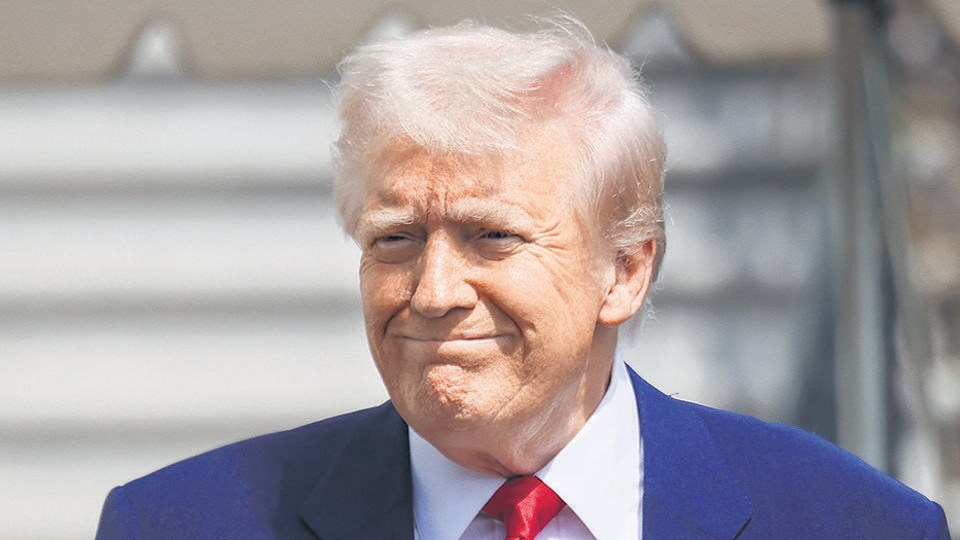
Trump made the announcement on his social media website, Truth Social, and said there would be no exceptions to the policy. On April 2, Trump imposed elevated tariff rates on dozens of nations that run meaningful trade surpluses with the US, and a 10 per cent baseline tax on imports from all countries that were to vest from July 9. Late Monday, he announced tariffs of 25% on goods from Japan and South Korea beginning on August 1, as he moved to impose unilateral rates on countries that have not yet secured trade deals with his administration.
It is unclear how Trump’s BRICs-linked linked tariff threat will impact the ongoing US-India talks for a trade agreement. There was no official response from India.
However, people familiar with the matter, requesting anonymity, pointed out that the Rio de Janeiro Declaration is not specifically against any particular country. Moreover, India has not criticized the tariff policy of the US or any other country in particular, they said. “India spoke about dispute resolutions by peaceful means. It spoke about the Global South. It condemned terrorism as a matter of principle rather than just of convenience,” these people said.
India is in favour of fair and equitable trade deals, and also negotiating the same with several developed nations such as the European Union, the United Kingdom, besides the US, they said.
The grouping - which initially began as a coalition of emerging market economies including Brazil, Russia, India, China and South Africa - expanded to include 11 nations in 2023 and now represent 49% of the world’s population and 39% of global GDP.
The BRICS declaration on the first day of the summit on Sunday raised “serious concerns” about the rise of tariffs which it said were “inconsistent with WTO (World Trade Organization) rules.” The BRICS added that those restrictions “threaten to reduce global trade, disrupt global supply chains, and introduce uncertainty.” The statement to also appeared to criticise US military strikes on Iran and also expressed concern at the humanitarian situation in Gaza and called for Israel to withdraw its forces for Gaza and other “Occupied Palestinian Territory”.
Brazil President Luiz Inacio Lula da Silva said no one talked about Trump’s tariff threat at the second day of the summit and the grouping did not want to “affront” anyone. However, he said it was “irresponsible” for Trump to threaten countries with tariffs while on social media, a Reuters report said.
BRICS is an important platform for cooperation among emerging markets and developing countries, Chinese Foreign Ministry spokesperson Mao Ning told reporters in Beijing. “It is not a bloc for confrontation nor does it target any country,” she added. China’s President Xi Jinping did not attend a BRICS summit for the first time since he became his country’s leader in 2012.
Russia , whose leader Vladimir Putin also did not appear in person at the summit, said BRICS was “a group of countries that share common approaches and a common world view on how to cooperate, based on their own interests.” “And this cooperation within BRICS has never been and will never be directed against any third countries,” said Kremlin spokesman Dmitry Peskov.
The Trump administration’s concerns with BRICS in part stem from efforts by particular members - including Russia and China - to push for reducing global reliance on the dollar for international trade and finance. In the past, BRICS nations have welcomed efforts to transact more trade in local currencies instead of the dollar.
The Trump administration has taken a dim view of these efforts.
“BRICS was put there for a bad purpose...I told them if they want to play games with the dollar, then they are going to be hit by a 100% tariff,” US President Donald Trump said earlier this year.
The matter has also come up in the US-India relationship. In June, US Commerce Secretary Howard Lutnick said that India’s membership of BRICS was an irritant in bilateral ties.
For its part, India has been clear in its support for trade in national currencies between BRICS nations. However, it has nixed talks of creating a common BRICS currency in the past. Prior to the BRICS summit in 2023 in South Africa, then Foreign Secretary Vinay Kwatra clarified that talks between BRICS nations were not focused on a common currency. This clarification came after both Brazil’s President Lula and Russia’s Foreign Minister Sergei Lavrov expressed some support for the idea.
BRICS serves as a political and diplomatic coordination forum but it does not have a constitutive treaty, a budget, or a permanent secretariat, the people quoted above said, pointing out that its members are free to pursue their own economic, political and cultural policies as they don’t have identical positions on several issues.
“Now the ball is in Trump’s court. He will do what he has to do. The US is a valued and strategic partner of India, and the two are currently engaged in negotiating an ambitious, mutually beneficial, Bilateral Trade Agreement (BTA). Both are positive for our long-term partnership as America is the world’s biggest economy and India is the world’s fastest growing major economy,” one the people quoted above said.
(With inputs from Rajeev Jayaswal in New Delhi, Associated Press and Bloomberg)