
 E-Paper



Upliftment or crackdown? Madrasa survey in UP sparks uncertainty
The survey seeks information on the organisation that runs a particular madrasa; when it was set up; whether it is operating out of a privately owned or rented building; if the building is safe and has pure drinking water, furniture and other facilities; the number of teachers, students and staff; the curriculum; and whether students were previously enrolled in other institutes.

 Prefer HTon Google


At 5am on September 12, a large contingent of police landed up outside Gujar Tola village in Uttar Pradesh’s Amethi district. With darkness still on the horizon, bulldozers rolled in to demolish the 13-year-old abandoned structure. The authorities explained that the madrasa was demolished after a local court ruled that it was constructed illegally on land meant for a pasture. But the incident raked up concerns among a section of the Muslim community about a controversial ongoing exercise: A government survey of all madrasas in the state. The exercise, which began on September 10, is being conducted across all unaffiliated and unaided madrasas with a 12-point questionnaire on education pattern, affiliation and funding – fuelling fears that the government is looking to crack down on the Islamic centres for learning.
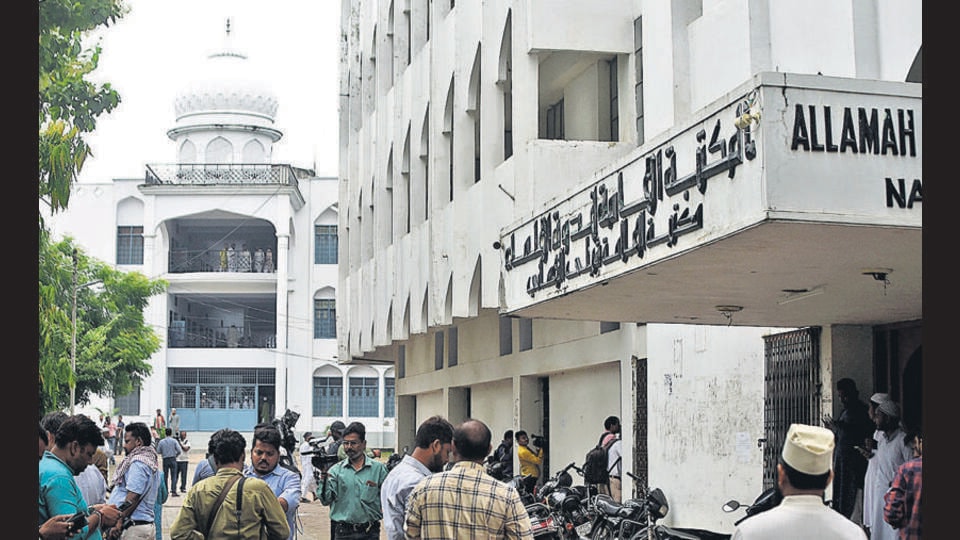
The survey seeks information on the organisation that runs a particular madrasa; when it was set up; whether it is operating out of a privately owned or rented building; if the building is safe and has pure drinking water, furniture and other facilities; the number of teachers, students and staff; the curriculum; and whether students were previously enrolled in other institutes.
“The surveyors want us to reveal our income source and affiliation to any non-governmental organisation, Why? This has fuelled fears of a crackdown,” said a madrasa owner, requesting anonymity
The government has quickly moved to allay concerns. State minister for minority affairs Dharampal Singh told HT that the survey was aimed to improve the standard of education in these centres. “Merely religious education can’t make the students who study here become successful as doctors, engineers, bureaucrats and managers. They should also learn Hindi, English, mathematics and other relevant subjects,” he said. Irrespective of the row, it appears certain that the survey will herald a change in madrasa education pattern in India’s most-populous state.
The exercise has acquired a controversial edge because it comes at a time when authorities in some states have said that a section of madrasas were indoctrinating young people. But such statements, and possible links to some recent crimes have fuelled fears that the government was looking to crack down on Islamic culture amid similar rows over wearing the hijab in Karnataka schools, eating halal food in Kerala and offering namaz in Haryana.
Madrasa culture
Home to around 45.6 million Muslim people, Uttar Pradesh is dotted with over 16,000 registered madrasas of varying sizes, repute and strength, going back to over a 100 years, with some of the popular madrasas like Darul Uloom in Deoband set up in 1866, where 1,000 students largely study theology.
Some other popular madrasas – such as the Jamia Hafsa Lilbanat in Lucknow’s Yasingan – are meant exclusively for girls, some others, like the Mamia Anwar-Ul-Uloom in Prayagraj, are English-medium. In all, around 20 lakh students graduate annually under the state’s madrasa system, according to officials figures. However, the actual figure is likely to be higher as there are a number of several unregistered madrasas in the state.
Since 2021, the government has run a madrasa modernisation scheme – it started in 1993 – that covers 21,126 teachers in 7,442 madrasas in the state. Under the scheme, the Centre pays ₹12,000, while the state government chips in ₹3,000 per month to postgraduate teachers in science, mathematics, English, Hindi and social studies in madrasas. National Council of Educational Research and Training (NCERT) books are provided to madrasa students but officials admit that not all get them.
Sheshnath Pandey, registrar of the UP Madrasa Education Board, said the government decided to order the survey after receiving complaints about fake madrasas taking crores in government grants.
Many madrasa owners say that they impart “deeni taalim” (religious education) to students who, after becoming well-versed in theology, go on to become teachers, qazis, imams, and muezzins of mosques. “Yes, we impart deeni taalim but we also impart English teaching to our students. We have produced scholars who are doing well across the globe,” said a senior official at the prominent Lucknow-based Islamic seminary Nadwatul Ulama. Founded in 1894, it was among the first of the madrasas to be surveyed.
The owners of the madrasas surveyed so far – there aren’t any exact numbers yet – are still to hear from the government about the outcome. They seem confident that enrolment with the madrasa board will not become mandatory. “So far as we know madrasa board recognition isn’t a must until we seek government grants,” said a madrasa board owner, requesting anonymity.
“I think the issue isn’t one of affiliation with the madrasa board. The issue is identifying the number of unaided, unrecognised madrasas,” said Bharat Lal Gond, district minority officer, Saharanpur. Gond’s jurisdiction covers the yet-to-be-surveyed Darul Uloom Deoband, an Islamic seminary of global fame in Saharanpur.
Others point out that madrasa affiliation stopped in 2017. In May this year, the government announced that new madrasas won’t be eligible for government grants but many old madrasas affiliated with the government also have complaints of irregular funding.
Modernising education
The government says the focus of the survey is education.
“Look, our Constitution is secular and none can be forced to follow any religion. But, if big and prominent seminaries like Nadwa or Darul Uloom just focus on “deeni taleem” alone and not link their students to modern education, the prospects of their students won’t improve. So, we plan to get madrasa students to learn NCERT syllabus too. And, madrasa education system will also be run on the same pattern as the government’s basic education,” minister Singh said.
The government also dropped hints that the NCERT curriculum could be rolled out uniformly in madrasas after the exercise is completed on October 25. As if on cue, the madrasa board decided that from October 1, study timings for madrasa students will be from 9am to 3pm, an hour more than earlier.
“This additional one hour would be for better, focused training in modern subjects for students enrolled with us,” said Iftekhar Ahmad, the head of the UP madrasa board.
Not everyone is so upbeat. Take Maulana Abrar Khan, a madrasa teacher at Madrasa Arabiya Anwarul Uloom in Bhinga, Shravasti, for instance. This cleric, a graduate of the madrasa system himself, feels that those passing out with knowledge of theology, after courses in “munshi, moulvi, aamil, kaamil and faazil” from madrasas have a better value system. “I feel that students who pass out from madrasas respect their elders more than the ones who receive modern education,” he said.
Renowned madrasas such as the Nadwatul Ulama also say that they are already getting their students to learn modern subjects. “Our students are taught English, Hindi, social studies,” said a Nadwatul official, requesting anonymity.
The government admitted that this was true. “During our surveys, we did come across madrasa students who take religious education in madrasas and then also are enrolled in nearby schools for modern education. This is a wonderful model,” said Gond.
Some madrasas – especially those in rural areas – found it difficult at first to furnish papers. In Meerut, Qazi Zainur Rasheedin formed an 11-member committee to assist madrasa owners in the district, which has nearly 600 madrasas with nearly 50% of them unaffiliated. “Our teams are interacting with madrasa owners and guiding them on how to prepare documents so that they could answer the queries better,” said Haji Sheeraz Rehman, general secretary of the committee.
Hidden agenda?
But concerns linger among the community, especially with the government’s announcement that the state’s Waqf properties – donated for religious purposes or charity for community welfare – will also be surveyed for checking revenue records. Uttar Pradesh accounts for the bulk of Waqf properties, which have been under scrutiny over allegations of being encroached upon by land sharks, or being used by unscrupulous elements for commercial gains. “We are only attempting to put revenue records in order,” said Singh.
The two surveys will not be conducted simultaneously, but some see a link. “In one instance, we are made to tell the source of funding in case of unaided, unrecognised madrasas, nature of donation in case of Waqf property. All our mosques, too, are largely on Waqf property and so, it effectively means probing us, right from nature of our education to our religion,” said a community leader, requesting anonymity.
Maulana Arif, a principal at madrasa Darul Uloom Masoodia Misbahiya in Bahraich, is unsure of the madrasa survey. “The survey is welcome per se, provided there is no hidden agenda,” he said. He appeared amused at the government’s emphasis on modern education in madrasas. “I think those days when madrasas were limited to Islamic education are long gone. Today, madrasas also impart modern education like science, maths and computers along with religious studies,” he added.
Samajwadi Party chief Akhilesh Yadav described the move as an attempt to give communal colour to the exercise. Bahujan Samaj Party (BSP) chief Mayawati has criticised it, while Asaduddin Owaisi, who heads the All India Majlis-e-Ittehadul Muslimeen, described the exercise as a “mini-NRC”, referring to the controversial citizenship verification test in Assam in 2018.
“The BJP government’s intent on madrasas is not good. This whole attempt to interfere in such private madrasas which run on community donations, is inappropriate,” Mayawati had said soon after the government announced its plan.
The government believes that despite the controversy, the exercise will help make the lives of Muslim students better. “This is why we started the survey in the first place. Once we have all the data, we can plan better for students,” said Danish Azad Ansari, UP’s junior minority minister who is also planning job fairs in minority-dominated pockets to provide jobs.
These fairs are timed to start around the time the madrasa survey exercise concludes. The UP government is thinking of felicitating madrasa students who score well. But in this, the Opposition sees a design to keep the political pot boiling ahead of the 2024 elections. “The BJP will keep engaging in such polarising exercises to ensure it continues to get political oxygen,” said Samajwadi Party leader IP Singh.
“Why is there such noise around this survey? Shouldn’t the government know how many students are availing education through madrasa system? Should we not attempt to better it, link students with employment,” countered Danish Azad.


