
 E-Paper



US says ties with India and Pak independent, stand on their own merits
The American position was articulated on a day when Secretary of State Antony Blinken hosted visiting Pakistani foreign minister Bilawal Bhutto Zardari for a meeting and attended a special event with him to mark 75 years of diplomatic ties


Washington: A day after external affairs minister S Jaishankar asked the United States (US) to reflect on the cost of its ties with Pakistan, and rubbished the explanation given by the US for its military support to Pakistan, the US said that it does not views its ties with India and Pakistan in relation to each other, encouraged both to have “constructive” relations with each other, and pointed out that the support for F16 was a sustainment programme and not an additional one.
Also Read: Agree with PM Modi, not the era of war: US Secretary of State Blinken
The American position was articulated on a day when Secretary of State Antony Blinken hosted visiting Pakistani foreign minister Bilawal Bhutto Zardari for a meeting and attended a special event with him to mark 75 years of diplomatic ties. Blinken called the US-Pakistan relationship “resilient”, but also said that both of them had “talked about the importance of managing a responsible relationship with India”.
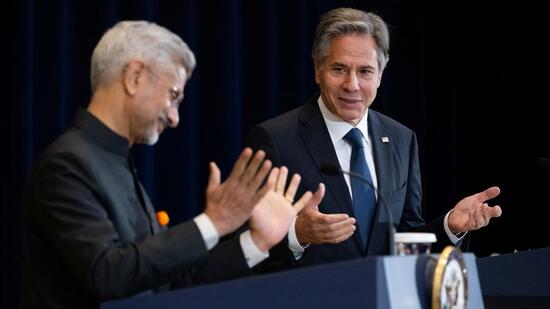
On Tuesday, when asked about the support to Pakistan and what threats it faced at a press conference with external affairs minister S Jaishankar, Secretary of State Antony Blinken said, “This is about sustaining an existing programme and not adding a new one. We have an obligation to do that…There are clear terrorism threats that continue to emanate within Pakistan or from the region, be it from TTP or IS-Khorasan...The threats are clear.”
To a question on his advice to Pakistan to manage ties with India, Blinken said that the US always encourages its friends to “resolve their friends”. He did not comment on the Pakistani response to the advice.
On Monday, in response to a question on Jaishankar’s statement, State Department spokesperson Ned Price said, “These are both partners of ours with different points of emphasis in each, and we look to both as partners because we do have in many cases shared values, we do have in many cases shared interests.”
Price added that the relationship with India stood on its own, as did the relationship with Pakistan. “We also want to do everything we can to see to it that these neighbours have relations with one another that are as constructive as can be possible. And so that’s another point of emphasis.”
The fall of Kabul in August 2021 and America’s exit from Afghanistan had seen ties between the two countries dip, as criticism in the US mounted about what many saw as Pakistan’s dubious role through the years of the war with its active support to the Taliban. But since the fall of the Imran Khan government and the election of the Shehbaz Sharif government in Pakistan, there has been incremental normalisation in ties between Washington DC and Islamabad. Khan had alleged that his ouster was a result of an American conspiracy, a claim that the US rejected firmly.
When asked how the US saw Pakistan’s role in Afghanistan and support to Taliban during the 20-year US presence in the country, and whether the State Department had reviewed that aspect of ties, Price said that it would be hard for him to summarise ties over that long a period. “I suppose what I would say broadly, of course, is that Pakistan was not a monolith during that time. We saw different governments, and we saw with the passage of years different approaches to the Taliban and to Afghanistan at the time.”
He then pointed to the fact that there was a new government in Pakistan now, and the reason they were meeting was because both countries had shared security interests. “It is neither in our interests nor in Pakistan’s interest to see instability, to see violence in Afghanistan.” The US, he added, had also been “intensely focused” on the devastating following the torrential floods in Pakistan.
After the Secretary of State met the Pakistani foreign minister, the State Department said in a statement that Blinken had expressed his sorrow at the floods and reaffirmed the US commitment to the people of Pakistan, “noting the nearly $56.5 million in flood relief and humanitarian assistance provided this year as well as the additional $10 million of food security assistance announced today”. “The Secretary and the Foreign Minister also discussed partnering on food security, economic prosperity, regional stability, and Afghanistan.”
At a separate event, Blinken spoke about the floods and American support, adding, “We will continue to stand by Pakistan, to stand by its people, today and in the days to come, because that’s what we’ve done for each other in both directions through much of our shared history.”
Blinken said the two countries continued to work on counterterrorism issues. “We have a shared stake in Afghanistan’s future after two decades of war. We have had our differences; that’s no secret. But we share a common objective: a more stable, a more peaceful, and free future for all of Afghanistan and for those across the broader region. “
He added that in the discussions, they had also talked “about the importance of managing a responsible relationship with India”. “And I also urged our colleagues to engage China on some of the important issues of debt relief and restructure so that Pakistan can more quickly recover from the floods.”
Commenting on the renewed high-level US Pakistan engagement, Asfandyar Mir, senior expert at USIP, said that Blinken appeared to want a working relationship with Pakistan.
“To that extent, the recent engagements between Pakistan and the US mark a reset, in particular after a tumultuous period in bilateral ties spanning the Taliban’s takeover of Kabul in August 2021 to Imran Khan’s conspiracy theory that the administration engineered his removal.”
He said that the administration had a “strong memory of the past”, which will continue to colour the relationship. “But it also seems to want to be forward looking and bank a modicum of goodwill which will give it influence on key issues like counterterrorism, Afghanistan, potential India-Pakistan tensions, and Pakistan’s alignment with China. There also appears to be feeling that a less adversarial, more functional relationship with Pakistan on balance is better for Indo-Pacific priorities.”
But Mir warned that one shouldn’t “overstate the trajectory” of US-Pakistan ties. The current engagement marked only a “moderate improvement” and there remained a ceiling on the relationship.


