
 E-Paper



Uttarkashi cloudburst: Vulnerable zone bears brunt of disasters
Since 1970, nearly 5,600 have died in Uttarakhand floods, worsened by climate change and unplanned development, with recent downpour causing more casualties.

 Prefer HTon Google


Close to 5,600 people have died in flash floods mainly caused by extreme rainfall events, cloudbursts and glacial lake overflows mostly in five districts of Uttarakhand since 1970, Uttarakhand State Disaster Management Authority (USDMA) data shows. This includes 4,127 people who died in the devastating June 2013 Kedarnath flash flood.
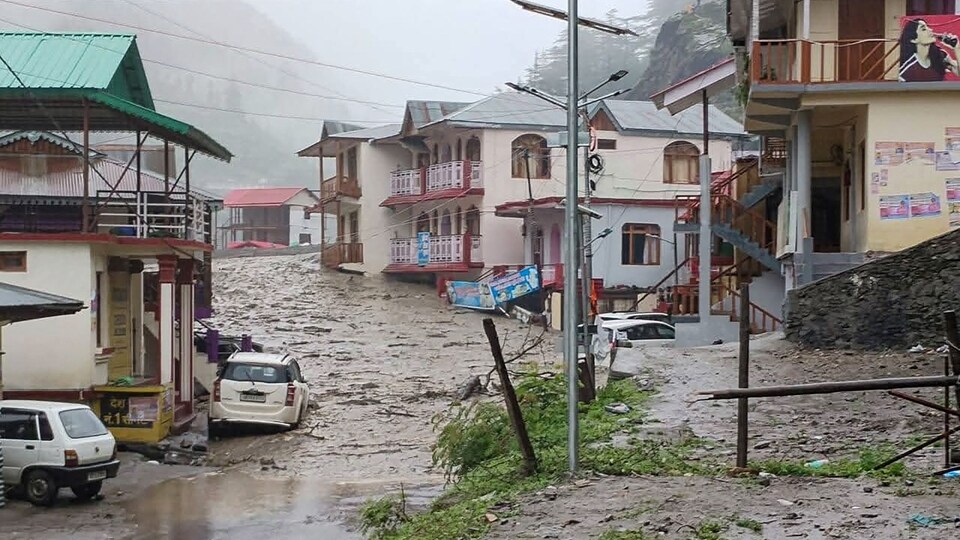
On Tuesday, at least four people died and several others were reported missing in Dharali village of Uttarkashi district around 200 km north of state capital Dehradun because of sudden heavy gush of water in the Kheer Ganga river at about 1 pm with tonnes of debris, bringing down several multi-storey houses at confluence of the river with Bhagirathi.
Also Follow | Uttarkashi cloudburst live updates
The incident is not in isolation.
Uttarkashi falls in the central Himalayan region that has witnessed frequent extreme rainfall events. Studies by USDMA showed that districts of Uttarkashi, Chamoli, Rudraprayag, Bageshwar and Pithoragarh are highly vulnerable to the impact of cloudbursts or extreme rainfall, whose intensity is increasing with temperature in the Himalayan region rising, as they fall in the high seismic Main Central Thrust (MCT) zone that has witnessed frequent earthquakes in recent years.
Also Read | Screams, houses swept in flashflood: Shocking video of Uttarkashi cloudburst
According to the National Centre for Seismology, Uttarakhand recorded 17 earthquakes since January 2025, of which 14 were in the MCT that covers Uttarkashi, Rudrprayag, Bagheshwar and Chamoli districts. Uttarkashi is in seismic zone IV and other three districts fall in zone V.
“The rocks of the area are highly fragile in nature because of a number of thrusts and faults. Geomorphology and physiographically, high relief difference, steep slopes, thick overburden and streams are common characteristics of features in the area,” said Sushil Khanduri of USDMA in a paper published in 2022 in the International Journal of Earth Sciences.
His study said that the Garhwal-Kumaon Himalaya is vulnerable to cloudburst or extreme rainfall as when the monsoon clouds are obstructed in main Himalayan range, the clouds rise upwards (sometime up to 9 km), form dense Cumulonimbus cloud (formed with towering mass with a flat base at low altitude). “This happens due to moist thermodynamic instability and rapid dynamic lifting of cloud by step topography,” he said, giving this as a reason for north-western Himalaya witnessing high frequency of extreme rainfall or cloudburst.
A study on extreme rainfall in Uttarakhand by the Department of Science and Technology in 2022 also attributed expansion of glacial lakes and its bursting during monsoon due to extreme rainfall events as a reason for higher damage. It is not clear as of now whether damage in Dharali village was because of extreme rainfall or a combination of heavy rain with bursting of a glacial lake.
Uttarakhand has 118 high altitudinal lakes located in Chamoli, Pithoragarh, Rudraprayag and Uttarkashi districts. Of them, maximum 60 are in Chamoli districts followed by 32 in Uttarkashi. “These lakes are fed by glacier melt water as maximum are located in snout areas and also receive enough precipitation during monsoon,” the study said.
Khanduri said a combination of factors are making extreme rainfall events or cloudbursts deadlier. “We have seen in recent years due to climate change the intensity of extreme rainfall has increased. There has been a sudden burst of rain for 10-15 minutes due to high temperature volatility in peak tops. The frequent earthquakes loosen boulders and top soil increasing landslides across the Himalayan belt. The gush of heavy rain brings them down along with debris from slopes at high-speed causing massive devastation,” he said.
Different studies on impacts of extreme rainfall in the state have attributed a combination of factors such as degraded forest cover to change of moderate debris-laden slopes into near vertical slopes during road widening and building construction for the onslaught of torrential rainfall in the region. Rampant, unplanned construction on natural water-ways of rivers and streams such as in Dharali village has led to huge loss of human life.
“It would be unjust to say that our planners and policy makers are not aware of the sensitivity of the Himalayan region, but it seems that the awareness is masked by the pressure to utilise Himalayan resources for growth and providing easy and fast accessibility by developing road networks. Rapid and unplanned development is playing a key role in destabilising the Himalayan equilibrium,” said environmentalist Anoop Nautiyal.


