E-Paper



What history tells us about Bihar’s 2025 contest
In Bihar, factors and personalities that have dominated the state’s politics are fading into oblivion and a new set of stable actors is yet to emerge

 Prefer HTon Google


Bihar will elect its 18th assembly in a two-phase election beginning November 6. On the face of it, the contest is about whether Nitish Kumar will become the chief minister of the state for the fifth consecutive time after an election – he has taken oath as a CM nine times but either could not prove his majority (once) or resigned and took office again with a change alliance partners – or whether Tejashwi Yadav will lead his Rashtriya Janata Dal (RJD) to a victory after two decades. The fine print of this contest, however, is even more interesting, as Bihar’s polity is at the cusp of the proverbial fork in the road , where factors and personalities which have dominated the state’s politics are fading into oblivion and a new set of stable actors is yet to emerge. To understand what the forthcoming polls mean for Bihar, it is essential to engage with its recent history.
The rise, fall and dilemma of Lalu Prasad and RJD’s politics
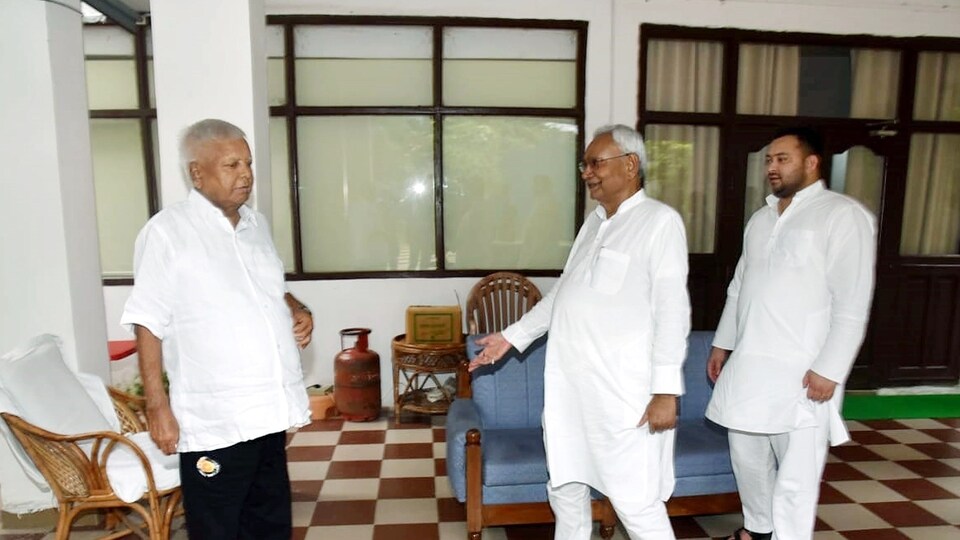
Lalu Prasad Yadav is one of the two poster boys of Mandal politics in north India, the other being Mulayam Singh Yadav from Uttar Pradesh who passed away in 2022. Unlike Mulayam, who never saw a full stint as a chief minister in Uttar Pradesh – his son and heir apparent Akhilesh had one after his victory in 2012 – Lalu controlled the reins of power in Bihar for 15 years of which seven years were under his chief ministership and another eight under his wife Rabri Devi who he nominated after his arrest as an accused in the fodder scam in 1997. These facts might suggest that Lalu and his party (Janata Dal/Rashtriya Janata Dal) had exceptional support in Bihar. However, a look at basic election statistics suggests that this is not the case.
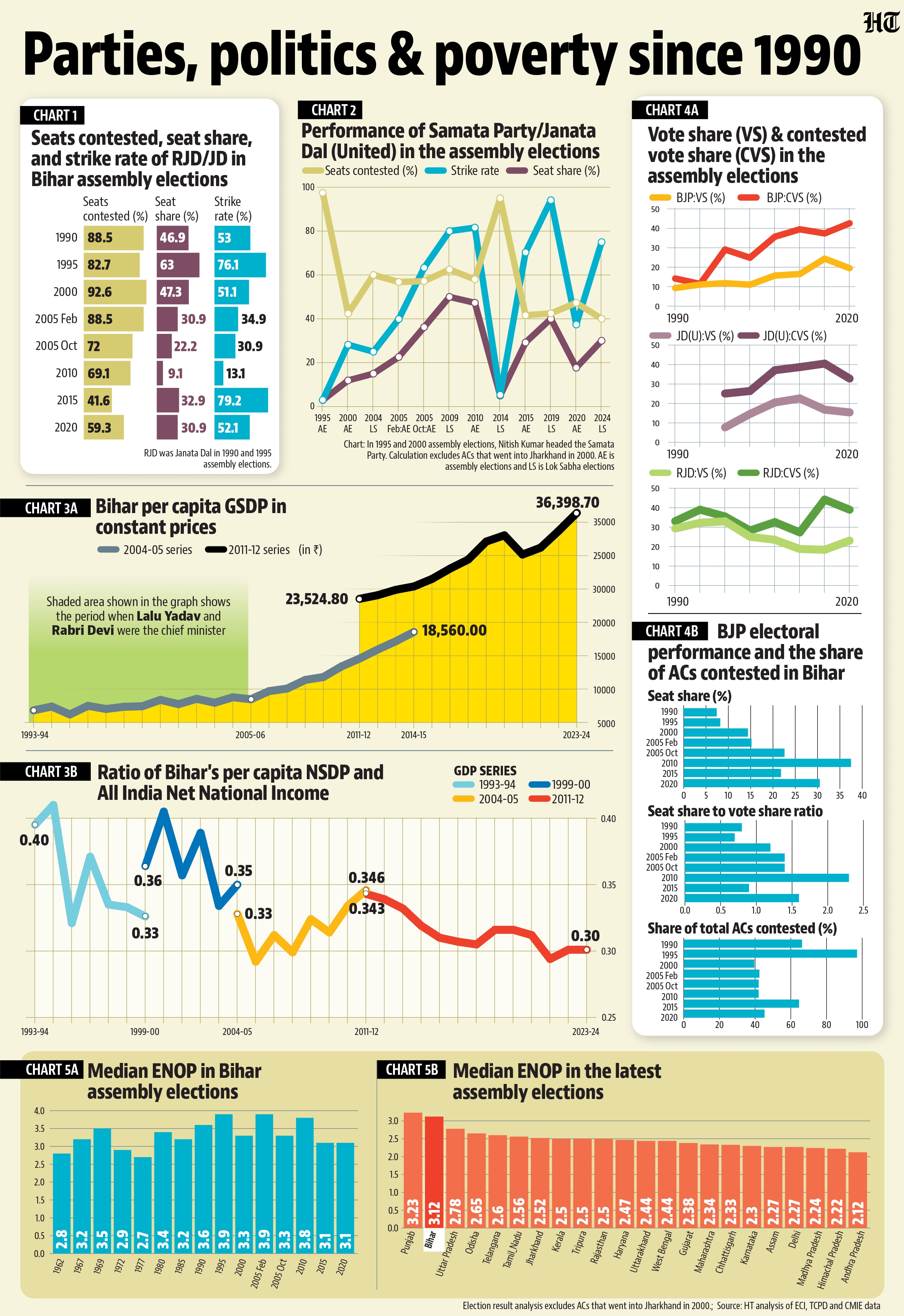
Lalu’s political fortunes peaked in 1995, the only election in which his party won a simple majority in Bihar. This analysis has considered only those 243 ACs that remained in Bihar after the state was bifurcated to create Jharkhand in 2000. By 2010, when the National Democratic Alliance (NDA) of the Janata Dal (United) and the Bharatiya Janata Party (BJP) won a massive 84.8% of the seats, RJD’s electoral footprint had shrunk massively in the state. Not only was its seat share a paltry 9.1%, the NDA had more Muslim MLAs (seven from JD(U) and one from BJP) than the RJD’s six. RJD’s decision to ally with the JD(U) in the 2015 assembly elections, and also accept Nitish Kumar’s leadership in the alliance – the latter was declared as the chief ministerial candidate – needs to be seen in the backdrop of the continuous slide the RJD suffered in Bihar between 2000 and 2010.
However, the RJD and the JD (U) have not been able to hold on to their alliance in the state despite two attempts – once as pre-poll allies in 2015 and another after the JD(U) jumped ship from the NDA to ally with the RJD in 2022 – and the JD(U) has gone back to the BJP. The RJD faces a big dilemma at the moment: its traditional allies, such as the Congress and the left parties, aren’t enough to take it past the threshold of power in Bihar, and the party that can help bring it to power does not stick to its alliance. (See Chart 1)
Nitish Kumar’s political somersaults are reaching their limits
Nitish Kumar’s first dissent was from the ranks of Janata Dal against the political dominance of Lalu Yadav and his politics in 1994. He first sought allies in the ultra-left, and contested with the Communist Party of India Marxist -Leninist Liberation or CPI ML in the 1995 assembly elections, faring extremely poorly. By the 1996 Lok Sabha election, Nitish had swung from the left to the right and entered an alliance with the BJP. Nitish’s alliance with the BJP would continue until 2013, when he walked out of the NDA opposing Narendra Modi’s prime ministerial candidature for the 2014 Lok Sabha elections. In the 2014 Lok Sabha election, Nitish Kumar contested with the Communist Party of India (CPI) and collapsed to just two Lok Sabha MPs.
The JD(U) jumped ship once again, allying with the RJD and the Congress in the 2015 assembly elections, and the alliance won a landslide victory. The JD(U)-RJD alliance gave way in 2017, and Nitish rejoined the NDA. The NDA swept the 2019 Lok Sabha elections, winning 39 out of the 40 parliamentary constituencies (PCs) in the state. However, the 2020 elections were a huge let-down for the JD(U), and it recorded its worst ever performance in the Bihar assembly since 2005. The biggest reason for the JD(U)’s collapse in the 2020 elections in Bihar was sabotage from within the NDA as the Lok Janshakti Party (LJP) which was a part of the NDA in the Centre contested the Bihar elections making a scathing attack on the JD(U) and Nitish Kumar but contesting only six assembly constituencies (ACs) against the BJP. In 2022, Nitish deserted the NDA again and allied with the RJD to stay in power, but he was back in the NDA before the 2024 Lok Sabha elections. Things improved for the JD(U) in the 2024 elections and it has managed to get a respectable seat sharing deal this time as well.
The 1995 assembly election and 2014 Lok Sabha elections were proof that the JD(U) cannot contest elections on its own. But, in the many elections in which the JD(U) has contested with the BJP and the RJD, it has proved to be an extremely valuable ally which is indispensable for winning Bihar. As Nitish Kumar himself seems to be fading given his indifferent health, the biggest question which the JD(U) faces today is who will take charge of it after him and whether the JD(U) can retain its value in Bihar’s electoral calculus. (See Chart 2)
Nitish Kumar is also facing anti-incumbency
With 20 years in office (barring some interruptions), Nitish Kumar is now among the longest-serving chief ministers in the country. Bihar is also among the poorest states in the country. This means that Nitish Kumar is also facing significant anti-incumbency headwinds. The best way to understand the objective basis of this anti-incumbency is to look at the long-term trend in Bihar’s absolute and relative per capita GSDP. While Bihar’s per capita GSDP was flat during the Lalu-Rabri years, signifying almost a lost decade and a half, it started rising sharply once Nitish Kumar took office. To be sure, some of the growth momentum could have been the pent-up growth from the pre-Nitish period as well. This impressive track record notwithstanding, Bihar’s relative economic position has only worsened during the Nitish era. This is best seen in the fall in Bihar’s per capita income as a share of all-India national income. The fact that the incumbent NDA government led by Nitish has opened the floodgates of welfare measures before this election only acknowledges the presence of a strong material precarity in the state. (See Chart 3A and 3B)
BJP is the only party with consistent growth in Bihar, but it still cannot win on its own
If one were to compare party-wise vote shares of the three major parties in Bihar – BJP, JD(U) and RJD – the BJP seems to be the only party which has seen its graph rising almost continuously. By 2020, the BJP’s contested vote share was at its all-time high and its vote share was its highest ever if one were to exclude 2015, when the BJP contested significantly more ACs than it has since it got the JD(U) into the NDA’s fold. This impressive historical performance notwithstanding, the BJP is still nowhere close to capturing power without a bigger ally in the state. The BJP realised it the hard way in both 2015 and 2020 assembly elections. In the first, the JD(U)-RJD-Congress alliance swept the polls, and in the second, the NDA just about crossed the halfway mark after the LJP sabotaged the JD(U) , likely with the blessings of the BJP. (See Chart 4A and 4B)
Despite the centrality of alliances, Bihar’s polity is among the most fragmented
Both Lalu and Nitish, the two central characters who have dominated Bihar’s politics for the past three decades, reached their peak of success when Bihar’s polity was at its most fragmented, if it were to be captured by looking at median Effective Number of Participants (ENOP) in the state assembly. ENOP is the reciprocal of the sum of squares of the vote share of each candidate in a constituency and increases with increasing degree of fragmentation. For example, if a constituency had three candidates with vote shares of 80%, 12% and 8% in election A; 50%, 40% and 10% in election B; and 35%, 33% and 32% in election C; then ENOP values for elections A, B and C will be 1.51, 2.38 and 3, respectively. Bihar’s median ENOP was the highest in 1995 when Lalu Yadav won his only majority in the state and almost the same in 2010 when Nitish Kumar led NDA won the largest mandate in the state since 1962. While Bihar’s median ENOP has fallen in the more recent elections, it is still the highest among major states, except Punjab, which is still locked in a multi-cornered contest. (See Chart 5A and 5B)
The 2025 Bihar elections will test each of its three major parties. The JD(U) is headed into the election with its biggest leader fading into oblivion. Even if the NDA were to win power, the leadership question -- something which has always been settled around Nitish Kumar --would remain up in the air. The BJP might have got the JD(U) to fall in line for the moment – Nitish has never been so accommodative of the BJP in the course of their three-decade alliance as he has been since his latest return to the NDA – but would also be vulnerable if JD(U)’s popularity was to sink with Nitish. The RJD can hope to make gains from the weakening of the JD(U) and the accumulated anti-incumbency against Nitish Kumar, but it has proved unable to resolve the contradiction between its social base and a larger political alliance. The RJD is also fighting the ghosts of its own past, which continues to animate politics in the state, as well as the rift between the Tejashwi Yadav and his siblings. Bihar’s political churn, given the dynamics described above, might well continue even after the results are declared on November 14as the larger contradictions facing the three key parties in the state are unlikely to be resolved with the elections, especially with Prashant Kishor’s Jan Suraaj likely to play spoiler in some seats.