E-Paper



When fog meets smog: Decoding Delhi-NCR’s low-visibility mornings
Fog does not discount the presence of pollutants or smog. This is what makes a distinction difficult on days such as November 16.

 Prefer HTon Google


A thick haze has enveloped Delhi-National Capital Region (NCR) in the early hours over a fortnight, with visibility dipping to as low as 50 metres on November 9, a day after Diwali. But is this fog or smog? What was it on the morning of November 16 (Monday)? Meteorologists say there are no universally accepted rules for separating fog from smog. It is likely to have been both on the morning of November 16.
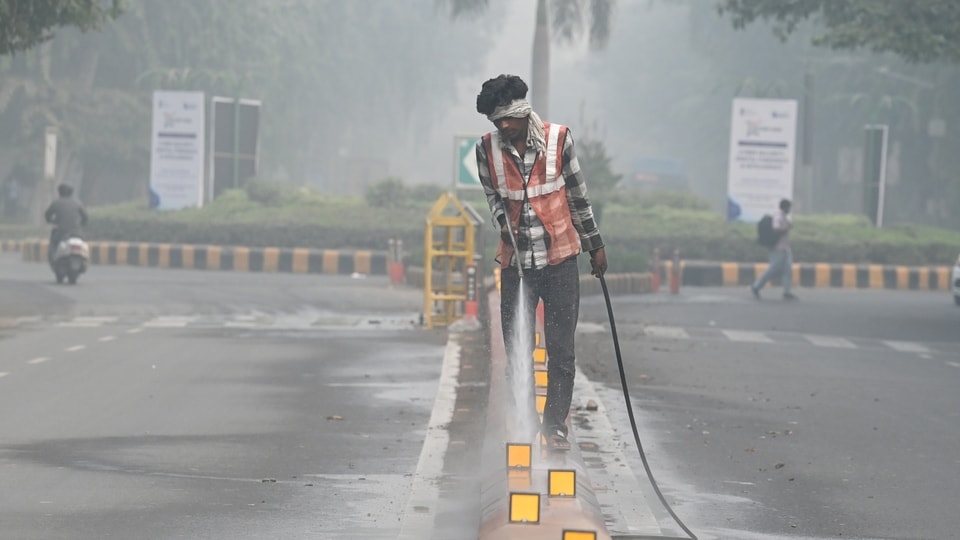
Meteorologists have looked at humidity and visibility in India to distinguish between fog and smog. If visibility is low in low humidity, it is almost certain it is smog. This is because fog, by definition, means water droplets suspended in the air close to the ground. There can be no fog in low humidity. For the same reason, low visibility combined with high humidity suggests fog. Fog does not discount the presence of pollutants or smog. This is what makes a distinction difficult on days such as November 16.
What is the threshold for deciding whether humidity is high or low? In practice, Indian meteorologists count visibility under 1,000 metres or 1 km as low visibility and relative humidity under 75% as low humidity.
Also Read | Delhi’s AQI remains ‘poor’, set to deteriorate further; shallow fog at many places
When fog meets smog
India Meteorological Department (IMD) director general M Mohapatra has previously said they have used both terms smog and fog in their forecasts for Delhi. “Visibility has to be lower than 1,000 metres for fog, but when moisture is lower than 75%, it can be called smog, as moisture is low."
IMD officials said that for record-keeping, they classify low visibility only as fog. “When we receive queries, we clarify whether [it] is fog or smog based on moisture content and the air quality. There is no fixed definition, though, for record-keeping,” said an official.
So what was the case on the morning of November 16? Experts said it was fog in the early hours until around 9:30am, with smog persisting after that till around 11:30 am.
"While humidity was high and pollution levels comparatively lower in the early hours of the day, one can call it fog, but after 9:30am, humidity was below 75%, and the visibility remained below 1,000 metres, with this period called smog. After 11:30am, visibility increased to over 1,000 metres, and so...post 11:30am is haze. What we are seeing in the air is pollutants now, as the moisture content has dropped drastically," said Mahesh Palawat, vice president at private forecaster Skymet Weather Services.
This was in contrast to the situation earlier. “For the past fortnight, on most mornings, we have been seeing smog rather than fog. Other than relative humidity, we also look at air quality, which on most days has been in the 'very poor' category. Such levels of particulate matter mix with the moisture in the air to make the haze denser, and so it is more smog than fog,” Palawat said.
Fog in the early hours of November 16 does not mean that there was no smog or air pollution. Particulate matter (PM) data analysed by HT shows this. The drop in visibility, from 6000 metres to what would be classified as haze and mist and finally fog, happened while both humidity and PM2.5 and PM10 concentrations were increasing.
Similarly, low visibility in the early hours on earlier occasions was also not only due to particulate pollution. Humidity has been above 75% on almost all days this November in the early hours. This means that low visibility late at night and early in the morning has been a combination of pollutants mixed with high moisture, which could be classified as haze, mist, or fog, along with smog. This is expected, as meteorological conditions that favour fog also favour smog. A clear distinction can generally only be made when humidity is low, or there is no air pollution.