
 E-Paper



When Indian forces get into rescue mode
‘Operation Kaveri’ is India’s second such humanitarian assistance mission this year itself


The evacuation of Indian nationals from strife-torn Sudan has, once again, turned the spotlight on the impressive humanitarian assistance and disaster relief (HADR) capabilities created by India’s armed forces in recent decades and its ability to reach out to citizens in distress in far corners of the world.
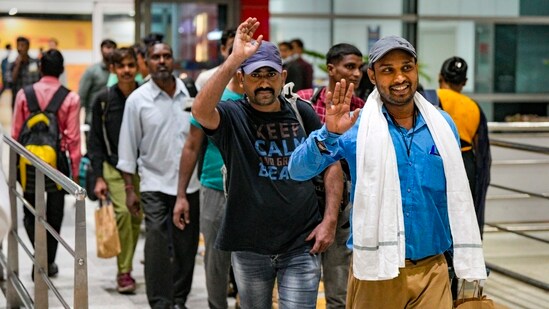
Operation Kaveri, the latest mission to rescue Indians stranded in the northeast African nation, comes on the back of India’s gruelling rescue and relief effort, codenamed Operation Dost, in earthquake-ravaged Turkey in February. India was one of the first responders to the natural disaster that hit parts of Turkey and Syria and killed tens of thousands of people.
A range of exercises conducted by India’s military with counterparts around the world and understandings on HADR and military cooperation with friendly countries in different regions have allowed the armed forces to mount complex evacuations in challenging conditions, officials familiar with the matter said on Wednesday.
The Sudan crisis is the result of an ongoing fight between the regular army and a rebel paramilitary force. In the most recent instance, evacuation of expatriates began on Tuesday after forces loyal to the Sudan Army chief, Gen Abdel Fattah al-Burhan, and his deputy-turned-rival, Gen Mohamed Hamdan Daglo, who heads the paramilitary Rapid Support Forces (RSF), agreed on a 72-hour nationwide ceasefire. At least 3,000 Indian citizens in Sudan, and thousands of expatriates of other nationalities, including diplomats and aid workers, were caught between the two warring forces when fighting erupted on April 15.
From rescuing Indians stuck in Ukraine after the invasion by Russia last year under Operation Ganga and bringing back citizens stranded in Afghanistan following its takeover by Taliban in August 2021 under Operation Devi Shakti, to launching HADR operations after the massive 2015 Nepal earthquake under Operation Maitri and helping the Maldives when it suffered a drinking water crisis under Operation Neer in 2014, India’s armed forces have been at the forefront of humanitarian relief activities in different parts of the world, the officials said.
While the three services — the Army, Navy and Air Force — have made key contributions to HADR operations depending on the geographies and tasks assigned to them, the role of the Indian Air Force (IAF) has been more pronounced because of its unmatched reach and speed.
The induction of long-range heavy and medium lift aircraft such as the C-17 Globemaster and C-130J Super Hercules have also bolstered India’s HADR capabilities. India stationed two C-130J aircraft in Jeddah, Saudi Arabia, over the weekend to help with the evacuation of some 3,000 Indians stranded in Sudan. By early Wednesday, the aircraft had flown more than 250 Indians from Port Sudan to Jeddah.
“India has an outstanding airlift capability that has grown manifold over the years with the induction of new platforms like the C-17 heavy-lifters and C-130J Super Hercules special operations aircraft,” said military affairs expert Air Marshal Ashok Goel (retd), who was the man behind the planning and successful execution of Operation Cactus.
In November 1988, the IAF airlifted the Indian Army contingent that took part in Operation Cactus, launched to help thwart a coup attempt by mercenaries to overthrow the democratically elected government in the Maldives. The operation was carried out at extremely short notice, and by night, to an unfamiliar airfield in a foreign country.
“From the airlift of Indians from Kuwait in 1990 to the current effort in Sudan — and the scores of operations in between — India has put its airlift capability to good use. We have the capability to rescue our stranded citizens from anywhere in the world. We have also never failed in rendering assistance to foreign countries whenever we have been called to do so,” Goel said.
The largest HADR operation was the airlift of 110,000 people from Kuwait in 1990, and these capabilities have only grown in importance as more than 11 million Indians now live across the globe.
Such exercises conducted by India’s armed forces with their counterparts in different regions such as West Asia and the Indo-Pacific help build interoperability and trust, both of which are invaluable for mounting relief and humanitarian missions at short notice. India has also forged agreements for reciprocal access to military logistics facilities such as ports with key partners like the US, France, Russia and Japan that can be crucial for mounting such operations.
It’s not just the smaller countries that India has rendered assistance to in times of need, the officials said.
In September 2005, when the US was hit by Hurricane Katrina, the IAF flew halfway around the world to deliver relief material at the Little Rock Air Force Base in Jacksonville. India also extended help to Pakistan when it was struck by a massive earthquake in October 2005. Between 2006-2011, the IAF undertook a raft of international relief missions, including in the Philippines and Indonesia in 2006, Bangladesh in 2007, Myanmar in 2008, China in 2008, Sri Lanka in 2009, Kyrgyzstan in 2010, and Thailand in 2011, the officials said. These missions ranged from earthquake and cyclone to flood relief.
The Indian Navy, which is also involved in Operation Kaveri, has also been at the centre of several past missions, including Operation Sukoon to evacuate Indians from Lebanon in 2006, when Israel invaded Lebanon to suppress the Hezbollah attacks, and Operation Raahat to bring back Indians stranded in Yemen in 2015, during intense fighting between Saudi-backed government forces and the Houthi rebels.
HADR missions are complex inter-agency operations that require detailed planning and efficient execution. India has continued to build on its reputation as a first responder and a responsible HADR provider ever since the Indian Navy was among the first forces to respond to nations affected by the 2004 Indian Ocean tsunami.
The external affairs ministry, mandated with the Covid-19- and HADR-related responses, has effectively liaised with other ministries, armed forces, state governments and state-run enterprises to facilitate the supplies of critical items to India’s neighbourhood, Indo-Pacific and even beyond. Over the past year itself, India’s HADR capabilities have also come in handy in the supply of disaster relief material and emergency use medicines to countries such as Ukraine, anti-TB drugs to 11 neighbouring countries and island nations, including Iran, Bhutan, the Maldives and Zimbabwe, and medical aid and disaster relief to the island states of Kiribati and Tonga.
Experts also acknowledged that capabilities such as the Quad’s Indo-Pacific Maritime Domain Awareness Initiative and Partnership on Humanitarian Assistance and Disaster Relief for the Indo-Pacific will help further bolster India's capacities to respond to HADR incidents.
 ABOUT THE AUTHORRezaul H Laskar
Rezaul H Laskar is the Foreign Affairs Editor at Hindustan Times. His interests include movies and music.


