
 E-Paper



When Manmohan Singh's 'People of India love you' remark to George Bush stirred a row
During a 2008 meeting, Manmohan Singh commended George Bush for enhancing Indo-US ties through the nuclear deal, but his comments faced backlash from critics.


"The people of India deeply love you."
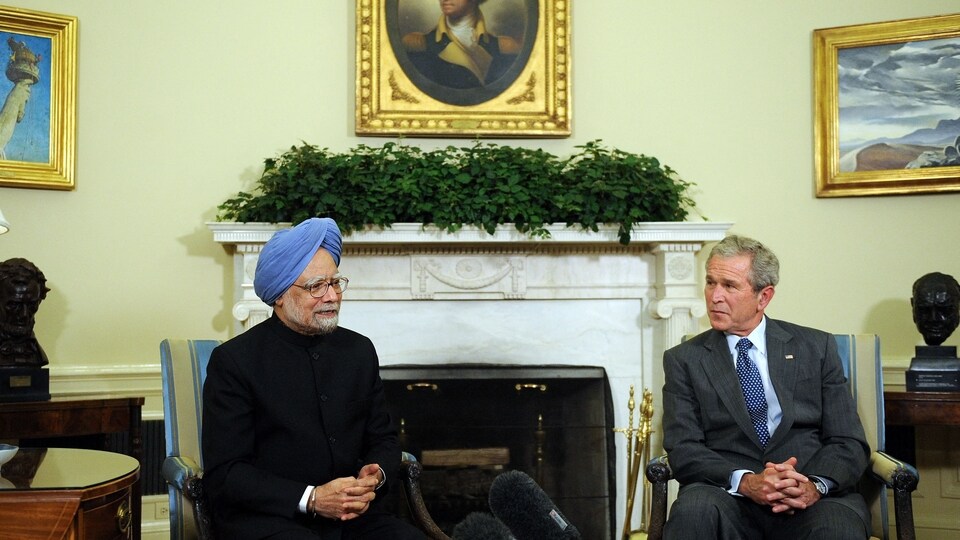
This was the sentiment expressed by Manmohan Singh about then US President George W Bush during their 40-minute meeting at the White House on September 25, 2008. Singh was praising Bush for his 'important and historic' role in initiating various bilateral efforts, particularly the landmark Indo-US civil nuclear deal.
While the weather outside in Washington was cloudy and rainy, the atmosphere inside the White House was warm during the eight-minute press interaction between the two leaders. Both exchanged compliments on several occasions, demonstrating a sense of camaraderie.
However, Singh's enthusiastic praise of Bush in what was seen as an all-encompassing statement caused some controversy. Manmohan Singh died on Thursday night at the age of 92.
The landmark civil nuclear agreement had brought an end to India's 34-year isolation in nuclear commerce.
Manmohan Singh under fire
Singh's praise of Bush faced criticism from both the Left, which had withdrawn support from the UPA-1 government over the nuclear deal, and the BJP. Meanwhile, the Congress, which celebrated the Indo-US nuclear deal as the "greatest" achievement for India in the 21st century, found itself in a defensive position.
"The people of India deeply love you, and all that you have done to bring our two countries closer to each other is something history will...," Singh remarked at the press conference, which this correspondent also attended.
Bush, who shared a close rapport with Singh, expressed his appreciation for the Prime Minister's friendship and leadership.
"I appreciate your friendship and I appreciate your leadership," Bush said.
The President then added, "You and I have worked hard to change the relationship between our countries. India is a great country with an incredibly bright future, and it's in the US's interest to have a good, strong strategic relationship with India. And we've worked hard to achieve that."
Regarding the civil nuclear deal initiated in July 2005, Bush acknowledged the effort, saying, "It has taken a lot of work on both our parts, a lot of courage on your part."
"All in all, ours is a very strong relationship at both the state level and the personal level, and I appreciate you coming," Bush concluded.
In his response, Singh remarked, "When history is written, I think it will be recorded that President George W. Bush played a historic role in bringing our two democracies closer to each other."
Singh, renowned for his steadfast commitment to securing the Indo-US nuclear deal, expressed to Bush that the President had played the "most important role in the massive transformation of India-United States relations."
Reflecting on the challenging journey of the Indo-US nuclear deal, Singh emphasized, "These are difficult issues, and at each stage it was your leadership, your personal intervention, which resolved all the difficulties that were affecting the progress of these negotiations."
Speaking about how the nuclear restrictive regime would come to an end after the Nuclear Suppliers Group waiver, Singh said, "For 34 years, India has suffered from a nuclear apartheid. We have not been able to trade in nuclear material, nuclear reactors, nuclear raw materials. And when this restrictive regime ends, I think a great deal of credit will go to President Bush. And for this, I am very grateful to you, Mr. President."
A year later, in 2009, after leaving office, Bush again praised Singh during his visit to India.
"I really like Prime Minister Manmohan Singh. The Prime Minister is a wise leader," Bush said at the HT Leadership summit in Delhi on October 31, 2009.
Bush, known for his humor, complimented Singh the day after the Indian leader described him as a "great friend of India."
Bush further praised Singh for his role in India's economic liberalization process in 1991, noting that it was one of the two key events that transformed Indo-US relations.
On his second visit to India since March 2006, when he visited as President, Bush expressed his honor in returning.
Reacting to Singh's remark, "The people of India deeply love you," CPI-M General Secretary Prakash Karat quipped, "We always knew that PM Manmohan Singh is in love with President Bush. Why is he getting the people of India in between (the relationship)?"
CPI National Secretary D Raja also criticized the statement, noting, "At a time when Bush's rating is so low in his own country, it does not augur well for the Indian PM to say such a thing."
The BJP echoed similar sentiments. "All I can say is that the personal adulation of PM Manmohan Singh cannot become India's adulation," BJP spokesperson Ravi Shankar Prasad stated.
Congress media cell chairperson Veerappa Moily struggled to defend the Prime Minister's remark. When asked how Singh could speak on behalf of the entire Indian population regarding their feelings for Bush, Moily explained that the statement was simply an expression of India's "tolerant and accommodating" attitude.
"India has never practiced a hate culture—there's nothing wrong with the PM saying that," he argued.


