
 E-Paper



Why farmers are fretting across the world
Farmers globally are protesting rising costs and falling incomes, with demands for better support and policies, echoing similar movements across nations.

 Prefer HTon Google


They come in long convoys of tractors, sometimes with months of food supplies with them, to stage protests. Their demands may differ, but concerns about rising costs and falling incomes are common. Farmer angst around the world has been intensifying since 2021, from Paris and London to Delhi. And increasingly, their protests have started looking similar.
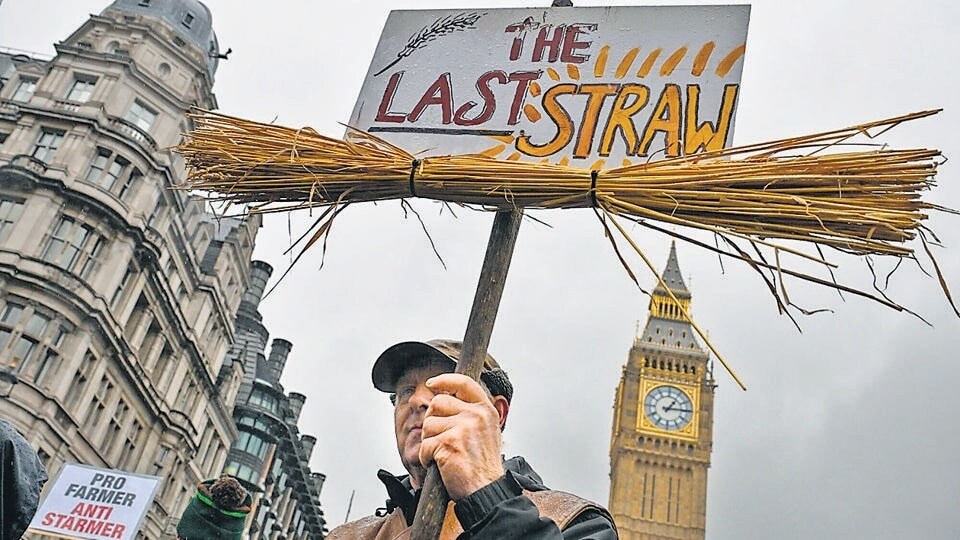
In London, hundreds of farmers stormed Britain’s heart of government, Whitehall, this week, protesting a proposed 20% inheritance tax they say will be a stab in their backs.
Their angst reflects broader dissatisfaction among many farming communities around the world, especially since the pandemic, including in India and mainland Europe. According to the Centre for International Policy Studies, dozens of farm groups in six continents have been protesting agricultural policies since 2021.
Read more: SC panel ready with list of issues affecting farm sector
The London scenes brought back memories of a standoff outside Delhi, where an uprising by farm unions during 2020-21 prompted the government to scrap three market-oriented agricultural laws.
There are other echoes of Delhi in London. “No farmers, no food,” said a protester on BBC. Another held a placard: “Small farmers will die. They’ll have to borrow to pay tax.” “Tax businesses not farms. A 20% inheritance tax? It’s ridiculous, if you ask me,” said Sarah Boulden, a farmer from Wiltshire, southwest England.
These concerns are similar to the core issues raised by farmers in food bowl states, such as Punjab. “The reasons vary. The demands differ. But what may be common (about the disenchantment) is the feeling that governments don’t realise the old ways are gone, and the new problems are new,” said Jeremy Clark, a London-based campaigner with the World Farmers’ Organisation (WFO), over phone on Wednesday.
The latest challenges all over the world, to a large extent, have emanated from changing markets, declining profits and climate change, resulting in a “unappreciated crises”, Clark said.
The protest in London was joined by celebrity TV presenter Jeremy Clarkson and James Dyson, a prominent business tycoon who supported Brexit.
Farm unions in India, the world’s second-biggest wheat and rice producer, are seeking guarantees, backed by law, for minimum purchase prices of crops.
In Europe, farmers in Netherlands, Poland, Spain, Italy and France etc. have driven tractors across their countries to protest curbs on how much fertilisers they can use and even how many acres they can sow. The new EU measures are part of concerted steps being taken to meet climate and emission goals. Subsidies for crop inputs are being slashed. In India, experts say subsidies alone haven’t been enough for producers to keep up with cultivation costs.
Farmers have also become politically savvy. “In Europe, the protests were held in the run-up to the EU parliamentary polls, while in India too farmers were seen intensifying protests ahead of major elections,” said Mukul Paranjape, a researcher with the Indian Institute of Technology Bombay.
While India doesn’t tax farm income, cultivators have long claimed they never get federally fixed floor prices for many commodities. Studies have shown that Indian farmers are “net taxed” or implicitly taxed due to the government’s efforts to keep food prices low.
India’s agriculture sector hasn’t been generating enough revenues to keep farmers profitable for nearly two decades, according to a landmark 2018 report by the Organisation of Economic Cooperation and Development (OECD), a grouping of 36 countries, and ICRIER, a think tank.
The study looked at, among others indices, gross receipts — or total assets without adjusting for expenses— to the farm sector. Agriculture in India suffers negative total revenues despite large subsidies because of missed income opportunities due to frequent export bans and prohibition on stockpiling. So, prices paid by farmers have outstripped prices earned by them.
Farm movements aren’t new. The Farmers’ Alliance, an American agrarian movement during the 1870s, sought to improve the economic conditions through collective bargaining through cooperatives and political advocacy.
Cultivators in the US then faced similar problems as those in developing economies, such as India, a country with excess farm labour and small landholdings. Small land parcels typically lack economies of scale, which refers to falling costs with rising production.
In January 1979, nearly 5000 farmers drove tractors to Washington, D.C., in a movement known as tractorcade to protest the Carter administration’s foreclosure of all loans, just as north Indian farmers had done in Delhi in January 2021, a protest that had turned violent.
The group that led the rebellion, Sanyukt Kisan Morcha, has planned a renewed phase of protests from next month with their old demand: guaranteed floor prices. The Union government announces minimum support prices for more than 20 crops to set a floor rate, so that farmers get a basic price assurance.
However, government agencies buy only rice and wheat at the assured rates in sufficiently large quantities, which means several other produce, such as soyabean, groundnut, mustard, millets, lentils and maize etc, are sold for any price depending on what the markets offer.
“These problems are not unique to India in the sense that European farmers think that regulations to make farming environment-friendly will hit their earnings. It’s ultimately an income issue,” Paranjape said.
The centre-left Kier Starmer government will levy, from April 2026, a 20% tax on inherited agricultural assets worth more than £1m, which were previously exempt. Still, this is half the non-farm inheritance tax rate.
The argument for inheritance tax has been influential, especially after radical French economist Thomas Picketty published his book “Capital in the Twenty-First Century”, which called for “confiscatory” tax on inherited wealth to cut down inequality.
Picketty, who marshalled centuries of data, argued that wages will always rise at a far slower pace than earnings from assets and profits, forever increasing the gap between rich and poor. His solution is a globally coordinated wealth tax, so that rich asset owners can’t relocate their assets to tax havens.
In a recent paper, Picketty suggested a similar tax for India. “Raise phenomenally large tax revenues while leaving 99.96 per cent of the adults unaffected by the tax. In a baseline scenario, a 2 per cent annual tax on net wealth exceeding ₹10 crore and a 33 per cent inheritance tax on estates exceeding ₹10 crore in valuation would generate a massive 2.73 per cent of Gross Domestic Product (GDP) in revenues,” his India paper suggested.
In the UK, the farm inheritance tax will similarly apply on big-ticket estates worth more £1 million. However, farmers say that while they are “asset rich” in terms of their land, many are cash poor. Clarks said that many farmers would be forced to sell their estates.
“Farmers don’t mind paying taxes. Bring them on provided farmers can earn profits that can match non-farm earnings,” Clarks said. Rising costs of cultivation are a common concern across farming communities.
According to Britain’s agriculture department, there are about 210,000 farm estates worth £1 million or more that could be subjected to the inheritance tax. Clarks says piggery costs have risen by 54%, cattle rearing by 44% and grain farming by 43% due to higher food, fuel and fertiliser prices because subsidies have been declining since Brexit.
An average farm last year made profits of about £45,300, according to government estimates. But farmers say this an exaggerated estimate because it excluded farms with lower earnings. In India too, farmers complain of rising costs and uncertainties from extreme weather.
India sets inflation-indexed minimum support prices such that they give one-and-a-half times profit over costs. However, cultivators want these prices to be legally enforceable. Moreover, they want the government to use a broader measure of cultivation costs.
The government uses the so-called “A2” formula, a narrower measure that includes all out-of-pocket expenses, plus the value of family labour. Farmers instead want the government to use the “C2 formula”, which includes the actual paid-out costs (on seeds, fertilisers, irrigation, etc) plus the notional value of family labour and rent, besides interest on owned land and capital.
“Agriculture worldwide is on its knees. Farmers have reached the end of the rope,” Clark said. This is what Indian farmers allege too. There’s a sense of a rupture in the “social contract” between farmers and governments.


