
 E-Paper



India grows, environment pays the cost
In the absence of a clear policy to balance development and environment, the Aravallis in Gurgaon, Western Ghats spread across five states, biodiversity of the Northeast and the forests in tribal districts have taken a hit.


India has driven the truck of development — loaded with tar, bricks, glass, concrete…the works — right through its most treasured and fragile green spaces in the last decade. While major cities like Delhi and Mumbai sacrificed green cover for real estate, the country's finest wildlife corridors have been ceded to indiscriminate industrialisation.

In the absence of a clear policy to balance development and environment, the Aravallis in Gurgaon, Western Ghats spread across five states, biodiversity of the Northeast and the forests in tribal districts (one-fifth of the country’s 640 districts) have taken a hit.
India lost 135 hectares of forest — think 190 full-sized football fields — daily to industrial projects in 2013 compared with about 80 hectare two decades ago, showed an RTI reply by the environment ministry.
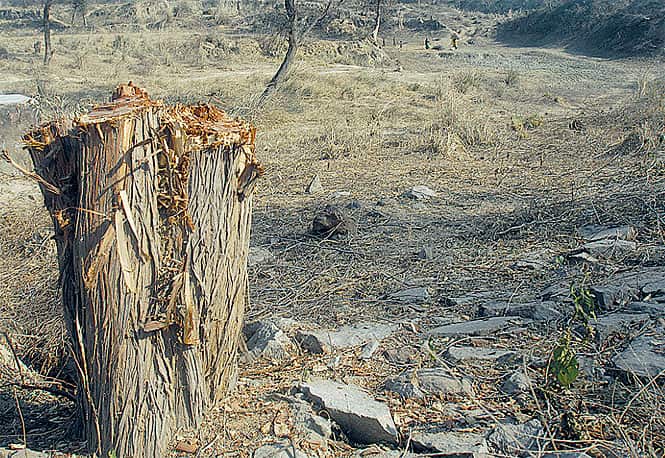
The government records, however, fail to depict the true degradation, thanks to Forest Survey of India (FSI) showing rubber plantations and apple orchards as green cover. “The trick is that the forest department manages to add compensatory afforestation programmes to the total green cover,” said Neeraj Vagholikar of environmental group Kalpavriksh.
Western Ghats’ forests — spread across Gujarat, Maharashtra, Karnataka, Andhra Pradesh and Kerala — shrunk by about 25% in two decades because of reckless mining and quarrying.
Stalin D of environmental group Vanashakti said the government had meekly surrendered to the “development lobby which sought a free hand to unleash destruction”. Madhav Gadgil, who headed an ecological expert panel on the Western Ghats, said if restrictions were not imposed, we would lose pristine ecology to “those who send bags of money to politicians”.
In spite of a 2005 Bombay high court order declaring mangroves as forests, rampant reclamation of mangrove-rich coasts is making way for housing projects and industries in Maharashtra.
In the Northeast, a probe panel set up by the Supreme Court in 2011 found that 39% land at nine cement plants in Meghalaya were forests. Around 10,000 hectares of forest has been encroached by tea estates in Assam.
About 80 hydel projects in Arunachal Pradesh approved in the last three years would wipe out hundreds of acres of forest including the habitat of the Black Neck Crane, considered the embodiment of the sixth Dalai Lama, and the Bengal Florican, a critically endangered species.
Northeast’s jewel, the Kaziranga National Park, home to tigers and the single-horn rhino, has been damaged by stone quarries, stone crushes, brick kilns and other industrial units within the notified ‘no development zone’.
“The environment ministry and the Assam government allowed the mushrooming of industrial units including private tea factories in this sensitive zone,” said Rohit Choudhury, an activist who lives near Kaziranga.
Elsewhere, it is the same story.
Odisha, Jharkhand, Chhattisgarh and Goa have all lost green cover to aggressive mining. The MB Shah Commission, which investigated illegal mining in these states, accused the environment ministry of allowing plunder at the cost of the exchequer.
In Odisha alone, the panel said, illegal mining worth Rs 59,000 crore was allowed. Around 16,000 hectare of forest — half of it in Keonjhar district — was lost to mining. Odisha principal chief conservator of forest JD Sharma, however, said there was no violation.
“When we find any discrepancy, we initiate action,” he said.
Among more than 100 projects cleared, environment minister Veerappa Moily this February allowed mining in the core area of an elephant reserve in Jharkhand. Earlier, the ministry approved mining in the green corridor used by elephants and tigers to move from one reserve to another in Maharashtra and Chhattisgarh.
Forest loss because of rampant mining had prompted Tribal Affairs minister V Kishore Chandra Deo to seek a ban on mining in tribal areas including in his home state Andhra Pradesh, where about 1,500 hectares in Visakhapatnam cleared for bauxite mining is under litigation.
“Mining clearances are being given without a thorough environmental and social impact assessment. This leads to rapid forest degradation and unrest among local tribals dependent on these forests for their livelihood,” said Srinivas Ganjivarapu, environmental activist based in Visakhapatnam.
Closer home in Delhi, green regulations are getting compromised within 40 km of the ministry’s headquarters at Paryavaran Bhawan.
The National Capital Region Planning Board plans to allow 0.5% of Aravallis for construction and tourism on the ground of land constraint, by leasing the capital’s green lungs to colonisers. The state had sought permission from courts to set up a Disneyland, a technology park and a film city. The courts refused permission.
In UP, sand mining and unauthorised construction on Yamuna banks goes on unabated, resulting in shrinking of wetlands from 19 in 2009 to 6 in 2011. “Ironic that a state, which is willing to spend Rs 2,000 crore on an artificial night zoo, is not protecting its natural gifts,” said Vikrant Tongad, a local environmentalist.
An officer like Durga Shakti Nagpal, who challenged the mining mafia, was suspended in 2013 for stopping illegal sand mining in Gautam Budh Nagar. A young IPS officer, Narendra Kumar Singh, was crushed under a tractor in MP’s Morena in 2012 when he tried stopping illegal sand mining.
“Nothing much will change unless environment protection is made independent of the government. There needs to be transparency in clearing projects and strict penalties for violation,” said Sunita Narian, director general of Delhi-based advocacy group Centre for Science and Environment.
(With inputs from Prasad Nichenametla, Rahul Karmakar, Priyaranjan Sahu, Vinod Rajput and Snehil Sinha)


