E-Paper



NTCA data puts tiger deaths at 69 last year, up from 2014
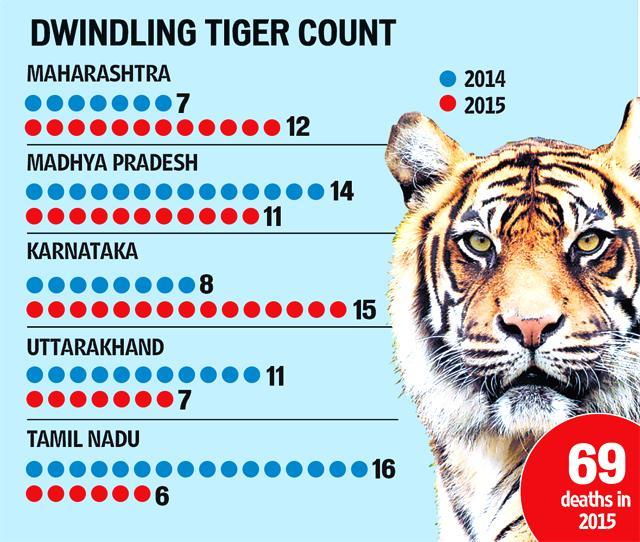
The National Tiger Conservation Authority (NTCA) revealed that 69 tigers died across the country in 2015, a marginal increase from the corresponding figures for 2014.

 Prefer HTon Google


The National Tiger Conservation Authority (NTCA) revealed that 69 tigers died across the country in 2015, a marginal increase from the corresponding figures for 2014.

According to tigernet, the official database on tiger mortality maintained by the NTCA, a total of 69 tiger deaths were reported in the country. The highest number of deaths was recorded in Karnataka with 15, followed by Maharashtra and Madhya Pradesh with 12 and 11 respectively.
The tigers died from various reasons, ranging from natural deaths and infighting to traps and snares normally used for poaching of tigers. Principal chief conservator of forests (PCCF) Narendra Kumar told HT that most of the tiger deaths were natural and in the rest of the cases, a detailed investigation is generally carried out to ascertain the exact cause of the death.
“We cannot stop natural deaths or deaths from territorial fights, but we can make efforts to stop deaths from poaching. In MP, we have decided to improve our intelligence network and use better forensic methods to keep a tab on what was happening in the forests. We will train more of our staff members in the forensic procedures,” he said.
This rising death tally comes in a year which saw the country’s tiger population increasing to 2,226, up from 1,706 in 2010. A wildlife biologist with the Dehradun based Wildlife Institute of India (WII) said the 2014 tiger census report showed that tigers in buffer zones and corridors linking one reserve with another were most vulnerable to killings. Man-animal conflict deaths have also risen in the recent past.
Wildlife expert and former chief conservator of forests PM Lad said tiger deaths due to natural reasons and infighting couldn’t be stopped. “But wildlife officials can make more efforts to stops deaths due to poaching and avoidable accidents, like from radio-collar infections,” he said.
However, 2016 has not started off on a good note, with seven tiger deaths already reported — five from Maharashtra and one each from MP and Uttar Pradesh. “These deaths are shocking and show that there is a need for strict protection to tigers and leopards outside tiger reserves, especially in the corridors”, said Kishor Rithe, president of the Satpuda Foundation, an NGO which works for the protection of tigers.