
 E-Paper



The life of Modi: checking the facts and 'fiction'
Family members, friends and ordinary people interviewed in Gujarat (Modi's native state) put his remarkable journey down to single-minded ambition, an eye for opponents' weaknesses and his grasp of economic management.


Bharatiya Janata Party's (BJP) prime ministerial candidate and Gujarat chief minister Narendra Modi spent his childhood in a modest three-room dwelling made of mud and brick nestled in a narrow, crowded lane in the town of Vadnagar.
The tea stall his father ran with the help of his sons is just as it was then, a small shed of patched blue-grey tin on the platform of the ramshackle railway station nearby.
Fast forward nearly 60 years and Modi stands on the cusp of leading the world's biggest democracy, after an election beginning on April 7 (Monday) that looks set to make his party BJP the country's biggest.
Family members, friends and ordinary people interviewed by Reuters in Gujarat (Modi's native state) put his remarkable journey down to single-minded ambition, an eye for opponents' weaknesses and his grasp of economic management.
Underlining how he divides opinion, critics also speak of an authoritarian who at times rides roughshod over the democratic process and espouses moderation while concealing an agenda less benign.
One of the defining moments of Modi's career was in 2002, shortly after he became Gujarat's chief minister, when more than 1,000 people, mostly Muslims, were killed in mob violence in the state.
Modi has always vehemently denied that he allowed, or even encouraged, the bloodshed, driven by a Hindu nationalist agenda, and a Supreme Court inquiry found no evidence to prosecute him.
Throughout the election campaign he has sought to project himself as moderate, not a champion of the Hindu majority.
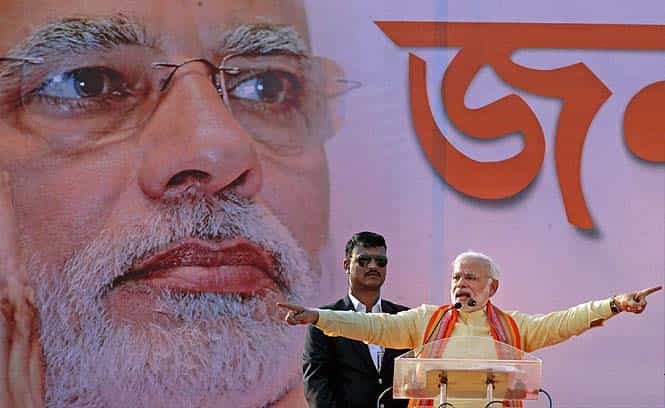
An analysis of 68 Modi speeches for the weekly magazine Outlook found that he did not utter the word "Hindu" once and "development" came up more than 500 times.
But suspicion lingers, particularly within India's sizeable Muslim minority, many of whom fear a rise in communal tensions.
"He talks in several tongues," said M Hasan Jowher, a rights activist in Gujarat. "He can be a rabid fundamentalist. I hope Indians make the right choice."
Modi's aides did not respond to a request for comment for this article. A spokeswoman for the BJP, Nirmala Sitharaman, said Modi had "nothing to be defensive about" over the 2002 slaughter in Gujarat, and she rejected as "fear mongering" attempts to brand him as a fundamentalist.
Man or myth?
Man and myth often collide when it comes to Modi. His presence is ubiquitous after a meticulously stage-managed election campaign that has electrified the country and dominated the media, yet little is known about his personal life.
Narendra Damodardas Modi, now 63, was born and brought up in Vadnagar, a town built on a hill in rural Gujarat.
The third child in a family of eight that struggled to make ends meet, he ended his education after school and abruptly left home, only returning years later for his father's funeral.
One of his brothers, Prahlad Modi, who sells car tyres in Gujarat's commercial capital Ahmedabad, said that as boys they would carry kettles up and down trains standing at the station, offering passengers cups of tea.
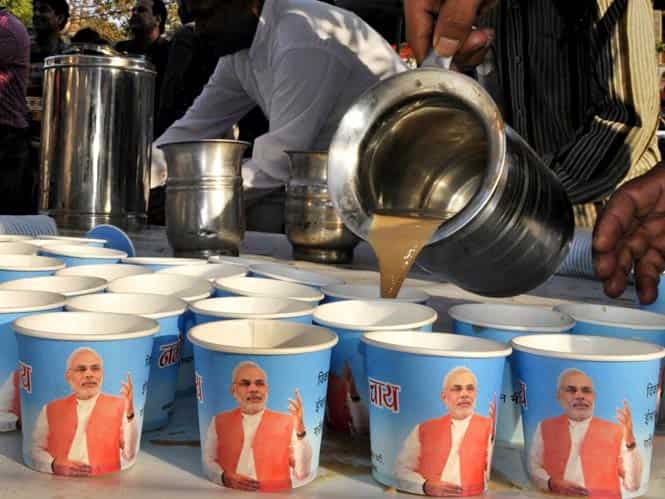
Several people at the station said the tea story had been embellished for Modi's election campaign to depict him as a man of the people, and in fact his father's main business was a salt-grinding shop at the entrance to the station.
"This whole thing about Modi and his brothers selling tea is wrong. I have been here all my life and I know it's false," said Bhagwaji Diwanji, a rickshaw driver.
But Prahlad Modi said his version of events was "100 percent true", and that the salt business came much later. The BJP's Sitharaman said doubts about the tea-boy narrative merely reflected a struggle by opponents to accept his humble birth.
Since he rose to fame, breathless stories about the heroic exploits of young Modi have become folklore in Gujarat.
One has it that, for a wager, he swam alone to reach a submerged temple in the middle of a lake - and some say the water was infested at the time with crocodiles.
But at the small Bhagavatacharya Narayanacharya school, principal AP Goswami said there was nothing exceptional in Modi's records: he was an average student, an all-rounder.
He did take a shine to drama, Goswami said, pulling a black-and-white photograph from a dog-eared 1966 album showing Modi with a spear in his hand as he performed in a school play about a bandit fighting rapacious landlords.
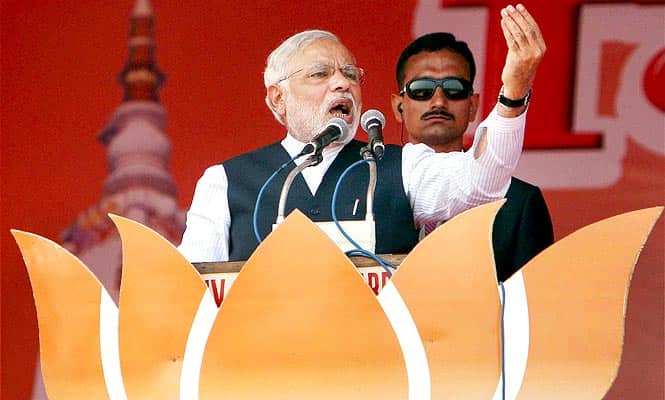
As a teenager, Modi joined the Rashtriya Swayamsevak Sangh (RSS), a voluntary right-wing group that serves both as the ideological incubator for "Hindutva", a brand of Hindu nationalism, and as the philosophical parent of the BJP.
A friend from those days, Chandubhai Rami, used to spar with Modi using rattan sticks at RSS self-defence classes. He recounted how Modi figured out early that his opponent was weak when attacked from the left side.
"He is good at picking up the weakness in an adversary and then he attacks it until he wins," said Rami.
After Modi left home, he adopted an ascetic lifestyle and dedicated himself to winning recruits to the RSS, virtually cutting ties with his family, they said. Today he still lives alone, and only occasionally sees his mother and siblings.
"We've come to accept it," Prahlad explained. "Narendrabhai believes family ties have to be kept at a distance once he went into public life."
Common touch
Modi's humble roots are key to his popularity.
Hundreds of millions of people live in poverty and there is anger at the ruling Congress party led by the Nehru-Gandhi dynasty, whose 10 years in power have coincided with a slump in economic growth and a spate of corruption scandals.
Across Gujarat, and India, people admire Modi's pursuit of industrial development in a state that, on a raft of measures, is an economic powerhouse relative to the rest of the country.
Business leaders, both Indian and foreign, flock to a biennial gathering called "Vibrant Gujarat" that Modi launched in 2003 to attract investment to his coastal state.

Anil Ambani, a prominent billionaire industrialist, told the throng at last year's event that their host was "a lord of men, a leader among leaders, and a king among kings".
A stocky but dapper figure who wears tailor-made traditional Indian clothes and sports a neatly trimmed white beard, Modi sat passively as accolades flew.
For Jentibhai Thacker, who farms land outside the Gujarati town of Bhuj, that glowing endorsement hits the mark.
Fifteen years ago his family worked on less than five acres: today, they grow fruit on 1,300 acres thanks to generous state subsidies, technical help with irrigation and reliable power supplies. Thacker is now selling his produce overseas as well as at home, he is building a helipad to spray his crops with pesticide from the air, and he is looking to buy more land.
Bhuj and the vast surrounding swamplands of Kutch were devastated by a magnitude 7.7 earthquake in January 2001 that killed more than 20,000 people and toppled some 400,000 homes.
Modi, who became chief minister of the state later that year, went all out to rebuild the region, introducing tax concessions to encourage development and lure entrepreneurs.
"For us, Modi has created a revolution," said Thacker, who campaigns for a BJP victory when he isn't tending to his bananas, strawberries and papayas.
On a new four-lane expressway connecting Ahmedabad to Kutch signs of change are everywhere. The toll road is being widened, wind turbines dot the countryside and factories belch out smoke.
Fierce critics
For all his popularity, Modi has critics.
Ajitsinh Jadeja, a village chief near Bhuj, bemoans the onslaught of heavy industry in a region whose farmlands and traditional handicrafts he says are now under threat.
"We wanted development, but not like this. This is like a bull in a china shop," Jadeja sighed.
He said a proposed steel plant in the area would further deplete water and land available for families to pursue the centuries-old craft of block printing on fabric.
The BJP's spokeswoman rejected the criticism, saying the party always seeks to balance growth and environmental impact.
Detractors also pick holes in Gujarat's economic report card and Modi's reputation as an efficient administrator, arguing that the state was already doing well before he came to power.
Opposing political parties have used different statistics to make their cases, although the consensus among independent experts is that Gujarat's growth did accelerate under Modi.
Claiming that he cares little for democracy, Modi critics quote research showing Gujarat's assembly has one of the lowest number of sittings among India's state legislatures since 2005 and tends to rush through new laws.
Gujarat's minister of parliamentary affairs, Bhupendrasinh Chudasma, said the assembly meets for as long as is needed. "There is no question of subverting democracy," he said.
Modi himself says he is first and foremost a team player.
"I listen to everyone, that is the reason for my success," he told the ETV channel. "Once we have consulted and taken a decision, then I make sure it is implemented. That has been my training in the RSS. They used to teach us to forget all the gods. Just think of Mother India."


