Sign in

Unseasonal rains, hail damage rabi crops in key food-bowl states

A good yield was expected this year but heavy rains induced by westerly disturbances flattened the wheat crop less than a month before harvest in Punjab, Haryana, Uttar Pradesh, Rajasthan and Madhya Pradesh.

Updated on: Mar 15, 2016, 09:15:29 IST
Hindustan Times | By , New Delhi
Share
Share via
  • facebook
  • twitter
  • linkedin
  • whatsapp
Copy link
  • copy link

Heavy rainfall accompanied by hail over the weekend damaged crops in key food-producing states across north and central India, triggering fears of higher food prices amid a deepening nationwide agrarian crisis.

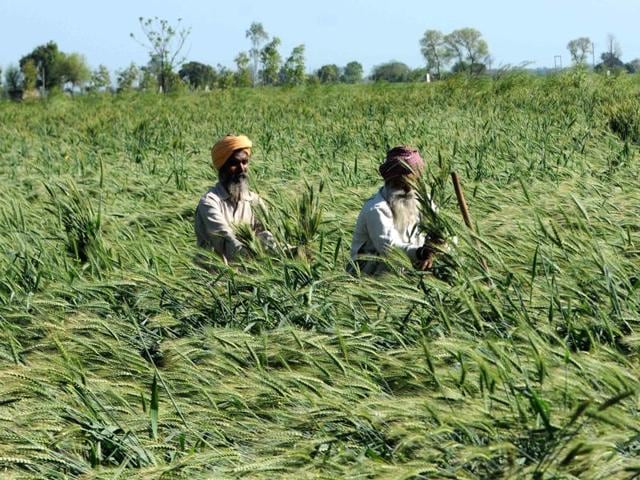
Farmers in Patiala tend to flattened wheat crops. Heavy rains induced by westerly disturbances flattened the wheat crop less than a month before harvest in key food-producing states. (Bharat Bhushan/HT Photo)

A good crop was a must this season for the sustenance of farmers who suffered because of unseasonal rainfall in March-April last year followed by a drought that reduced output of summer crops. A good yield was expected this year but heavy rains induced by westerly disturbances flattened the wheat crop less than a month before harvest in Punjab, Haryana, Uttar Pradesh, Rajasthan and Madhya Pradesh.

“The damage can be up to 50% in several districts of Haryana, Punjab, northern Rajasthan and Uttar Pradesh,” an agriculture ministry official said, adding that state governments had been asked to submit reports.

Delhi chief minister Arvind Kejriwal ordered divisional commissioner A Anbarasu to assess the damage to crops in the Capital. “Have asked Div Commissioner to assess damage to crops of farmers in Delhi due to unseasonal rains (sic),” Kejriwal tweeted.

The governments of Madhya Pradesh, Haryana and Rajasthan also instructed officials to assess the loss.

In 2015, the Centre gave states about Rs 8,000 crore for crop losses due to unseasonal rains.

In Madhya Pradesh, protesting farmers took a tractor trolley full of hailstones to the office of the SDM, Banda in Sagar district and a chakka jam protest was held on NH-86 near Banda on the Sagar-Chatarpur road to draw the administration’s attention towards damage to crops.

In Rohtak, Ram Chander, a Dalit farmer who had taken two acres of land on contract for Rs 25,000, said rain and thunderstorm had almost completely destroyed his wheat crop. “There is not much left,” he said, crying for government help.

Farmer Kundan Lal Jatav of Ghatla village in Rajasthan’s Alwar district said with tears in his eyes that rain and hail ruined his entire mustard crop on seven bighas of land.

The government needs about 62 million tonnes of grains, including wheat and rice, to ensure steady supply of food items under the national food security law. Good crops in 2014 had ensured adequate stocks but crop damage in two consecutive years can exert a burden on the buffer maintained by the Food Corporation of India.

Experts say the government might not have enough buffer stocks to sell in the market to keep wheat prices under check.

Apart from wheat, officials admit, there has been extensive damage to mustard, potato and peas in these states. The showers have withered the flowering of mangoes in Uttar Pradesh and apple, pears and apricots in Himachal Pradesh.

Congress vice-president Rahul Gandhi raised the issue in the Lok Sabha and asked the government to assess the crop damage and provide adequate compensation to the affected farmers.

“After the hailstorm and heavy rains, farmers of northern India are in distress. The government must act to give relief to farmers affected by crop damage,” Gandhi said in the Lok Sabha.

(With inputs from Jaipur, Chandigarh, Bhopal and Meerut)

  • Chetan Chauhan
    ABOUT THE AUTHOR
    Chetan Chauhan

    Chetan Chauhan is the National Affairs Editor looking into all aspects of news and features from across India. A Chevening scholar with over three decades of experience in reporting and news management, Chetan has extensively covered all important aspects of the social sector, political economy, environment and climate change nationally and internationally. He did a journalism course at the Reuters Institute of Journalism in Oxford and Digital Media training at Nanyang Technological University in Singapore. He started as a reporter with The Statesman in 1996 and joined the Hindustan Times in 2000 in the metro bureau covering environment, crime and Delhi politics. He covered hot local news, from the Jessica Lal murder case to the rebellion of Delhi Congress MLAs against then Chief Minister Sheila Dikshit, to the replacement of toxic vehicle fuel with cleaner compressed natural gas (CNG) in the national capital. Some of his stories on air pollution became part of the Supreme Court’s landmark MC Mehta versus Government of India case in the National Capital Region (NCR), forcing the government to take corrective measures. As part of the national political bureau since 2004, he covered important central sectors such as environment, education, social justice, labour, rural development, water resources, renewable energy, agriculture, broadcasting and the Planning Commission for more than a decade producing several exclusive and investigative breaking stories. His specialisation is the environment, having covered at least a dozen United Nations global conferences on climate change, biodiversity and wildlife including climate summits in Paris, Copenhagen and Bali. He also covered India’s two five-year plans ---11th and 12th and reported on drafting and execution of right based laws such as Right to Education, Right to Information and rural job guarantee law, MG-NREGA, now being introduced in new format as VG-RAM-G Act. He has in-depth knowledge of social sector issues. He was one of the first to report on tigers vanishing from Sariska and Panna wildlife reserves in 2004 and 2008, respectively, leading to the setting up of the National Tiger Conservation Authority (NTCA) and the introduction of stringent penal provisions for poaching. He has written extensively on the rising human-animal conflict in India and the degradation of India’s biodiversity hotspots because of mining and other activities. Since 2004, Chetan has covered Parliament comprehensively and participated in training on the nuanced coverage of Parliament proceedings. He has travelled extensively across India to cover national and provincial elections since 1998, especially in the Hindi heartland states, considered India’s road to power. He writes a regular column for Hindustan Times, Ecostani, on important national politics, economy, Himalayan ecology and environmental issues. His other responsibilities include providing inputs for edits and edit page articles for the publication, apart from managing news flow from across India.Read More

Check India news real-time updates, latest news on Hindustan Times and more across India.