
 E-Paper



Lack of food, change in weather make vultures leave Jodhpur
Jodhpur has witnessed a rapid decline in the number of vultures in the last decade.


Jodhpur has witnessed a rapid decline in the number of vultures in the last decade. Nine years of research has revealed that a number species of vultures are migrating to other areas because of the shortage of food.
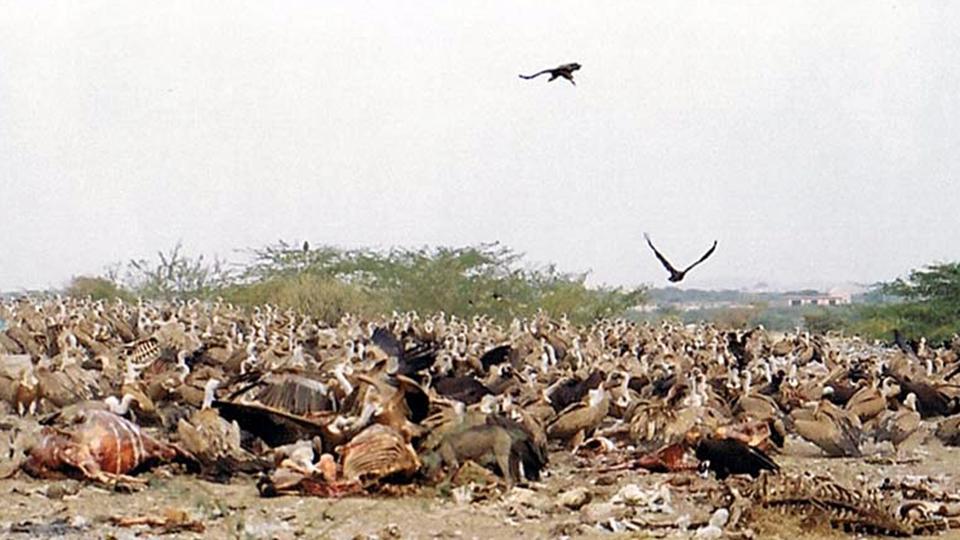
“Vultures are important scavengers who play a vital role in clearing animal carcases and municipal dumps. We have observed a sharp decline in the vulture population in and around Jodhpur city in the last decade,” said AK Purohit, a professor at the zoology department at Jai Narayan Vyas University.
An intensive survey of the natural habitat of resident and migratory vultures was carried out between 2007 and 2015 to know the annual population fluctuations in various species of vultures in and around Jodhpur, Purohit added.
Experts said that India has nine species of vultures in the wild, out of which four species — Gyps bengalensis, Gyps indicus, Sercogyps calvus and Gyps tenuirostris — are listed as critically endangered by the International Union for Conservation of Nature (IUCN) red list of threatened species. In Jodhpur, sites such as Keru, Badli pond and Arna Jharna are major vulture habitats due to the availability of lake water and animal carcases (it’s a site for dumping dead animal).
“The population of six species of vultures — Gyps himalayensis, Gyps fulvus, Aegepus monachus, Gyps indicus, Gyps bengalensis and Neophron pernopterus — are being monitored in Jodhpur,” Ramprakash Saran, assistant professor of zoology said. “Comparative analysis of population dynamics of various species of vultures in the area has suggested that there has been a drastic decline in the population of migratory as well as resident species of vultures,” said Saran.
A comparative study suggests that the population of migratory species has reached very low relative abundance is 2015 as compared to 2007.
Egyptian vulture (Neophron percnopterus) has the highest and White-rumped vulture (Gyps bengalensis) has the lowest population account in the nine-year-long study.
According to the study, climate change and temperature fluctuations over the period of time, particularly in the breeding season, can be attributed to the population changes.
Saran said a municipal carcass waste treatment plant was set up in Jodhpur city in 2006. Animal carcases are used for further treatment. “Only skull, hooves and rumen is left,” he said, adding that it led to the shortage of food for vultures and led to a decline in the population of migratory and local vulture species in Jodhpur.
Feral dogs and electrocution are some other reasons of decline vulture population. Another important reason is renal failure among vultures linked to use of diclofenac in livestock.


