
 E-Paper



A time to reckon with the gods of our making: A year-end essay by R Sukumar

 Prefer HTon Google


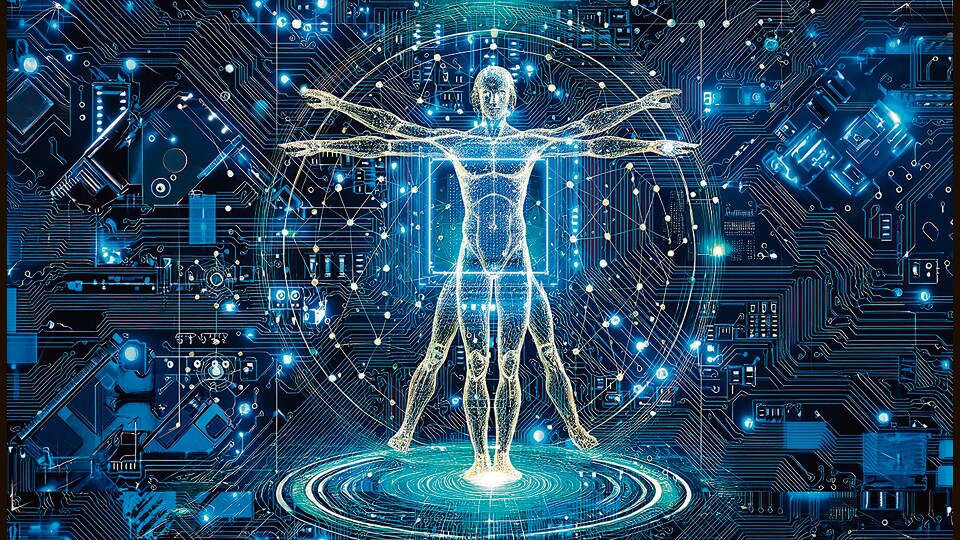
We know where this road leads. We live in a world of filter bubbles and alternative facts. The big question now is: How can we build on what makes us special?
A quarter of a century ago we started forgetting phone numbers. This wasn’t necessarily a bad thing; a good memory may be a sign of high cognitive abilities, but intelligence, it is not. As Sherlock Holmes says in A Study in Scarlet: “A fool takes in all the lumber of every sort that he comes across, so that the knowledge which might be useful to him gets crowded out, or at best is jumbled up with a lot of other things, so that he has a difficulty in laying his hands upon it.”
The reason we forgot phone numbers was because all the important (and unimportant) ones were in our mobile phones, which, over the past 25 years, have only become smarter. The phone has also become the easiest way to stay connected to the internet — and, by extension, to shop, search, consume and create content, interact with people and, with the arrival of mass-scale artificial intelligence, analyse and code (though this was possible to some extent even before the advent of AI).
No man is now an island; though every man and woman now is just their mobile phone. (Want to lose yourself? Just lose your phone).
So, for all these years, we have been living a life explained by the two sentences that precede Marshall McLuhan’s most famous quote: “All media work us over completely. They are so pervasive in their personal, political, economic, aesthetic, psychological, moral, ethical, and social consequences that they leave no part of us untouched, unaffected, unaltered.”
History will likely recognise 2025 as the year when AI went mainstream. There are many ways to quantify this. I have simply taken the benchmark of at least 50% of the adult population in the US adopting and using a technology; and considered the US instead of any other country because it is still where most popular and pervasive consumer technologies emerge.
Roughly seven (or eight) years after we started forgetting phone numbers, Nicholas Carr wrote about what the internet was doing to us in an article titled Is Google Making Us Stupid?, in The Atlantic. “... what the Net seems to be doing is chipping away my capacity for concentration and contemplation. My mind now expects to take in information the way the Net distributes it: in a swiftly moving stream of particles. Once I was a scuba diver in the sea of words. Now I zip along the surface like a guy on a Jet Ski.” That was 2008 and it was just the internet (although it was capitalised back then).
Back then, social media was still in its infancy, and Eli Pariser was yet to coin the term filter bubble (he would do this sometime in 2010; and his book with the same name would be published in 2012).
Back then, Kellyanne Conway was still running The Polling Company, and was still about a decade away from coining the term “alternative facts”. But over the past decade-and-a-half (perhaps a bit more), most people have spent more time on virtual connections than on real ones — and usually with people who think just like them (“This is what most people believe; I have not encountered anyone in my circle who thinks otherwise”). And at least over the past eight years, most people have discovered the allure and magic of alternative facts — never mind that they are lies.
Then, along came AI, with its ready summaries (the veritable death of Search) and know-it-all responses checking all the boxes for the attention-span-challenged and the easily distracted (which is most of us, thanks to the internet), and its ability to turbocharge the fake news industry complex (with its path made easier by social media, which, over the years, has trained people to permanently suspend their disbelief). The right prompts can now churn out a sequel to The Maltese Falcon with the original cast (AI tells me the principal cast are all dead).
Lest I sound like a Luddite, I will clarify that I do understand the staggering utility of AI (as beautifully explained by our columnist Kashyap Kompella later in this section), its ability to solve complex problems, and perhaps make the right decision all the time, but the quantum of money being bet on it, and the interconnectedness of the major players in the space, worries me. I also fear that Big Capital will leverage it (at least in the first wave) to replace people, creating an unemployment pandemic. And I am concerned that it will make humanity dependent on it for tasks that were once easily accomplished by us.
For when we start treating AI as a black box that is infallible, we are trading our cognitive abilities — the result of the biology of our brains, education, and years of experience, all layered with emotional intelligence — for its computing abilities built on Big Data and algorithms (and, as the evidence shows, a dash of hallucinatory hubris). There are enough examples in science-fiction of where this can lead, and how it may end.
So, as we end 2025, it is a good time to understand and appreciate what makes us human — and realise that the Singularity may be closer than we think because, even as machines are growing smarter, we are allowing ourselves to become dumber.
Maybe our new year resolution should be to practise more first-principles thinking in 2026.
Or maybe AI can write the next year-ender essay.
(Send in your bouquets and brickbats to sukumar.ranganathan@hindustantimes.com)


