
 E-Paper



Contested Will: What is Shakespeare’s true linguistic legacy?

 Prefer HTon Google


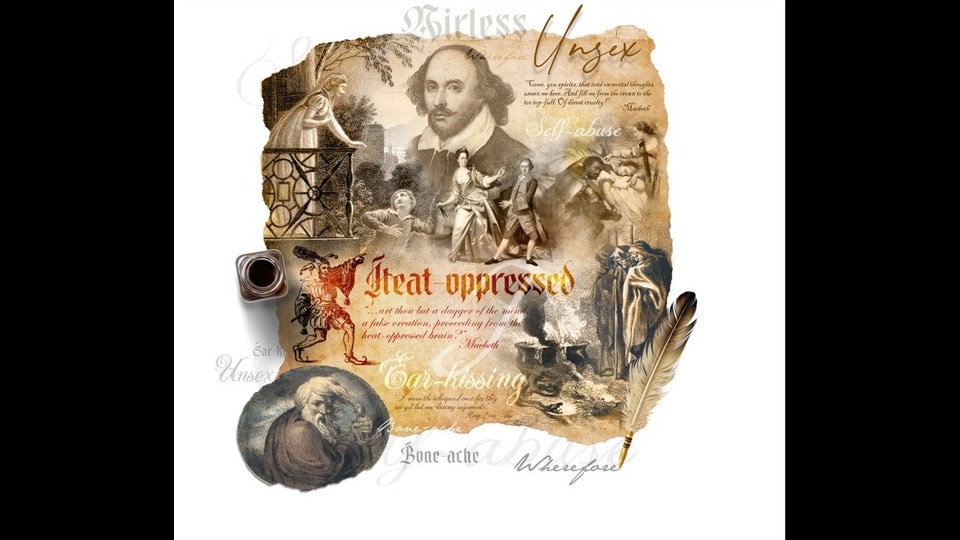
A new encyclopedia of his language addresses questions of meaning and structure in the playwright’s work. How many words did he coin? Which ones? Take a look.
Orders for beer, courtroom arguments and refugees from France have helped a team of scholars begin to answer questions that have drifted, suspended, around the world for over 400 years: What is Shakespeare’s true linguistic contribution? Which words did he really coin?
Jonathan Culpeper, 57, a professor of English language and linguistics at Lancaster University, first began work on what is now an evolving encyclopaedia of Shakespeare’s language, 27 years ago.
He found it rather odd, he says, that a trip to the average university library yielded vast amounts of literary criticism, but very little on the linguistics of the Bard. So he began trying to understand what Shakespeare’s language might have meant to his contemporaries.
Culpeper started by studying plays by other Early-Modern English writers, then sourced transcripts from courtroom trials and referenced spoken-English self-help books of the time. “This was the easiest way to discover what mundane everyday dialogue looked like,” he says. “There were several books written for French refugees fleeing religious oppression at that time, for instance, to help them learn conversational English. Those were a goldmine of information.”
As Culpeper immersed himself in the project, it got bigger and bigger, becoming the first comprehensive account of Shakespeare’s language to use a corpus linguistics software program – where computers analyse large-scale collections of texts (or corpora) to address questions of meaning and structure. Eventually working with a team of 25, and a 2016 grant of 1 million pounds from the Arts and Humanities Research Council (funded by the UK government), he has now had Volumes 1 and 2 of The Arden Encyclopedia of Shakespeare’s Language published by Bloomsbury in August.
It has 20,000 dictionary-style entries, featuring words that were likely coined by the Bard; words that were used unusually in his plays; given new meaning by him; or were commonly used in his time, in ways that would be unfamiliar today.
These words were identified with the help of the software program, which was fed the million-odd words from Shakespeare’s acknowledged corpus of 38 plays (written between c. 1590 and 1613), as well as a similar million-word corpus drawn from contemporary plays by other writers, and 320 million words gathered from various writings of the period (such as the courtroom transcripts and self-help books).
What emerges is perhaps less dramatic than Shakespeare-lovers would like. The playwright certainly did not invent the 1,000-odd words often attributed to him, Culpeper says.
But what the encyclopaedia offers in place of such legend is more interesting: a scientific account of a towering intellect, and a contribution unlike most others.
***
As things stand, Shakespeare can be said to have coined “about 400 words that have endured”, Culpeper says. For perspective, he offers a reminder that writers, even from the classical literary cannon, do not generally invent any; and might count themselves unique if they coin a single word that gains a life outside their writing.
Shakespeare entered several words from spoken usage into the literary canon, of course, which is why so many are attributed to him incorrectly.
He also used words so differently as to twist them into new meanings that carried far greater weight. He used “bone-ache” for syphilis in Troilus and Cressida, for instance. “This term for the medical condition was a far more vivid way of describing the horrible agonies of this disease eating away at the bones,” Culpeper says.
The Bard married words with remarkable effect; as in “ear-kissing”, also not found elsewhere in the corpus, but then sadly dropped by the Bard too. The delicious metaphor for a whisper occurs just once, in King Lear.
***
As he worked to untangle myth from legacy, Culpeper came up against some distinct challenges. A key one was the lack of standardised spelling.
He and his team realised that they were missing instances of the use of “sweet”, for instance, because it was sometimes spelt “sweete”, “swete” or “svveet”. Similarly, “very” was sometimes “ferry”, “vary” or “vara”, to represent Welsh, Scottish or rustic English accents, respectively. Along with linguists Andrew Hardie and Jane Demmen of Lancaster University, Culpeper worked to reconcile such differences through the software program.
“Robert Cawdrey’s Table Alphabeticall, first printed in 1604, is generally regarded as the first dictionary, but it was essentially only a selection of tricky words. It’s one of the reasons why spellings weren’t standardised during Shakespeare’s time: they didn’t have a dictionary to fall back on,” Culpeper says.
It is important to acknowledge that Shakespeare’s language is not an island of its own, he adds. It was designed, in fact, to be all-encompassing, playing to the people in the one-penny seats and the nobility in their boxes.
The approach worked. The Bard wasn’t raised wealthy (his father was a glove-maker; his mother a farmer’s daughter, though they did earn gentility status over time). But his work certainly made him so. He was well-respected; his theatre company, King’s Men, was often invited to perform at the court of Queen Elizabeth I.
After he died in 1616, his comedies, tragedies and dramas — with their sonnets and soliloquies, universal themes, roots in timeless folk tales, and profound psychological insight — continued to be staged, retold, reinterpreted. They remained popular.
By the 18th century, the British began to use this as a tool of soft power, the ultimate literary challenge. And so, amid imperialism, Bardolatry, or veneration of the Bard, intensified. “By the late-19th century, the more the British Empire began to decline, the more the British tried to pump up their ‘national poet’. It was during this period that many of the myths about Shakespeare were cemented,” Culpeper says.
As it grew in status, and as the language itself changed, the Bard’s work came to be viewed as inaccessible. “But unlocking his language is what I am aiming to do with all five volumes of the encyclopaedia,” Culpeper says.
***
The two-volume dictionary is the first building block in this plan.
Future volumes, set to be published over the next three years, focus on larger concepts such as what the language used can unlock about characters and themes in these works.
Such study will examine, for instance, how Juliet uses words that are statistically unusual in Shakespeare’s work. How some of the words most frequently used by Romeo are love, beauty, and lips; while those used by Juliet are laden with doubt — if, yet, and or.
“Words like alas and ah were also heavily used by Shakespeare’s female characters, who did all the emotional work of lamentation in his plays,” Culpeper says.
Another interesting theme set to be explored is the poet’s use of colour to create metaphorical patterns. The green-eyed monster of jealousy in Othello, however, much against popular notion, was far from original, in use by at least three other writers before Shakespeare, says Culpeper.
“We must remember that he had an added advantage over the other writers at the time, being someone who produced a lot of words that actually survived. Only about 6,000 words of his contemporary, the English playwright and poet George Peele, have survived, for instance, compared to Shakespeare’s million-word corpus.”
Culpeper likes to compare the Bard, in this respect, to The Beatles. “He wasn’t a one-hit wonder but was consistent with his hits,” he says. “Though there is also a sense among scholarship today that he has possibly caused other Early-Modern writers to be overlooked, especially female playwrights such as Aphra Behn.”
.
Fresh of the Folio: Words likely coined by Shakespeare
Unearthly (adj.): Shakespeare had a love of words beginning with un-. This word neatly captures the sense of something beyond or above the ordinary world. It’s still used to describe something that is strange, not natural and therefore frightening.
It’s first known usage is in The Winter’s Tale.
Unsex (v.): To lose the traits traditionally associated with one’s given sex and / or gain traits of a different sex. The term was first used and made famous by Lady Macbeth.
“Come, you spirits, that tend on mortal thoughts, unsex me here. And fill me from the crown to the toe top-full. Of direst cruelty!” she says, as she tries to summon the supposed courage of a man, to commit the murder of King Duncan.
The word illustrates Shakespeare’s ability to create surprise meanings. It is rarely used today.
Self-abuse (n.): Self-deception. Today it is more likely to be used in the context of an action or practice of physically or verbally maltreating oneself. The term illustrates Shakespeare’s affinity for creating compound words through the use of the addition of “self”.
Self-harming, self-loving and self-neglecting were all first used in his plays.
Champion (v.): To challenge.
The playwright created a fair number of verbs, from nouns. “Champion” is still in use, to describe someone who has defeated an opponent, or, figuratively, someone who advocates or defends a cause.
Unvarnished (adj.): Something plain, straightforward, not adorned. It also invokes a metaphor, with the sense of a shiny surface distinguishing something beneath it.
First known usage: “Yet, by your gracious patience, I will a round unvarnished tale deliver. Of my whole course of love.” (Othello).
Many of Shakespeare’s un- words were created to generate an element of shock, and associated with conditions that could not typically be reversed. These included: unpregnant, undeaf, unseduced and unpay.
Airless (adj.): Shakespeare created a number of words that ended with -less. This word captures the sense of being stuffy, unventilated. The word is in common use.
It first known use was in Julius Caesar: “Nor stony tower, nor walls of beaten brass, nor airless dungeon, nor strong links of iron. Can be retentive to the strength of spirit.”
Heat-oppressed (adj.): Affected negatively by heat; metaphorically, a person who may not be thinking clearly. It’s a simple, evocative term first used in Macbeth: “...art thou but a dagger of the mind, a false creation, proceeding from the heat-oppressed brain?” But it never took off.
Words to which he gave new meaning
Beef (n.): The meat of cattle (as opposed to fowl and venison) was seen as food for the lower ranks, and thought to reduce intelligence. In Shakespeare’s work, it was often used as a reference to the penis, or to a woman prostitute, as in Measure for Measure:
Lucio: How doth my dear morsel, thy mistress? Procures she still? Ha?
Pompey: Troth, sir, she hath eaten up all her beef, and she is herself in the tub.
Lucio: Why, ’tis good; it is the right of it; it must be so...
Bone-ache (n.): Used for syphilis, in Troilus and Cressida. “This term for the medical condition was a far more vivid way of describing the horrible agonies of this disease eating away at the bones,” says Jonathan Culpeper.
Ear-kissing (v.): A delicious substitute for “whisper”, sadly dropped by the Bard. It occurs just once, in King Lear. “I mean the whispered ones, for they are yet but ear-kissing arguments.”
Wherefore (adv.): It simply means why, and is in little use today. But the word remains instantly recognisable, mainly from one line it was used in: “O Romeo, Romeo, wherefore art thou Romeo?” (Romeo and Juliet).
Phrases he coined
These are among Culpeper’s favourites, for the ways in which they have endured, he says. He is currently studying them as part of his research for the three remaining volumes of the encyclopaedia.
Band of Brothers: First used in Henry V. Nearly two centuries later, by 1798, it was being used in newspaper reports on the Battle of the Nile (fought by the British and the French). It remained popular through the Crimean War of the 1850s. It was recently re-popularised by a 2001 American war drama miniseries of the same name.
Brave new world: First used in The Tempest and then, of course, as the title of a dystopian novel by Aldous Huxley, published in 1932. A wonderstruck Miranda, seeing shipwrecked men from a world beyond her little island in The Tempest, introduces it to the world: “How beauteous mankind is! O brave new world, that has such people in’t.”
Sea change: A major change or transformation, as could be brought about by the action of the sea. It was used in The Tempest to inform Ferdinand that his father has died in a shipwreck. By the 1980s, it was becoming popular again, as a way to describe the fluctuations of financial markets.


