
 E-Paper



Faith has a role in climate action: Mridula Ramesh, in this month’s Trade-Offs

 Prefer HTon Google


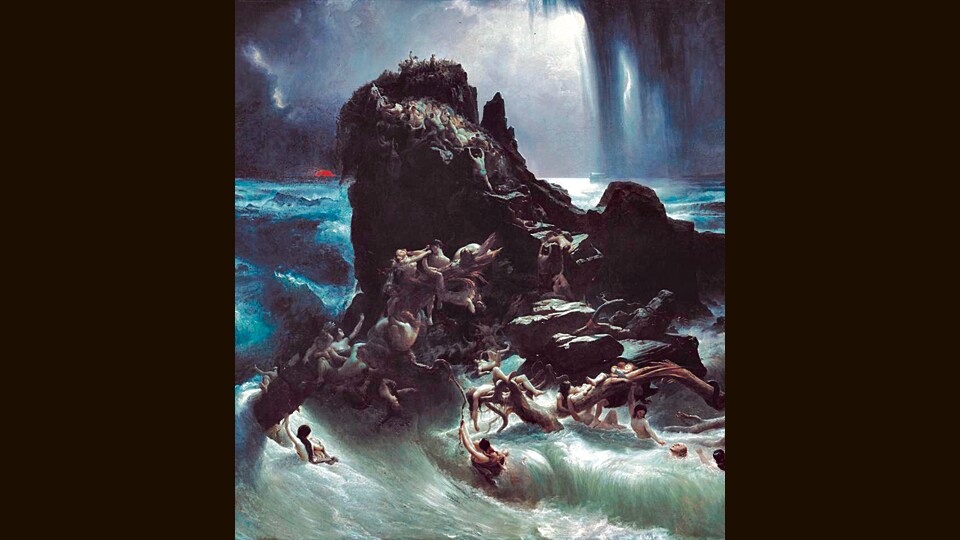
Some aspects of climate action ask us to consume less. Economics can be an awkward envoy for this message. Faith asks us to step lightly, see divinity in all.
Faith has reshaped the world time and time again. Yet, in arguably the greatest fight confronting humankind, it has remained a backbencher at best. Climate change battles have been fought over complicated science, through geopolitical wrangling, with some economics and a lot of bureaucratese. And where has that got us?
2023 was the hottest year in recorded history. Indeed, the secretary-general of the World Meteorological Organization, Petteri Taalas, put it eloquently when he said, “Greenhouse gas levels are record high. Global temperatures are record high. Sea level rise is record high. Antarctic sea ice is record low. It’s a deafening cacophony of broken records”.
In the many, many actions required to stave off the worst effects of the climate crisis, only one — increasing the share of electric vehicles — remains on track as per the State of Climate Action 2023 report published by a group of organisations including the World Resources Institute, Climate Action Tracker and Climate Analytics.
Most other indicators remained well off track. Deforestation rates, for one, must come down four times faster than they are currently, asking us to eat differently (as we explored in an earlier piece). Some indicators — reducing food loss and protecting mangroves to name two — are headed in the wrong direction entirely. Despite decades of gold-standard, near-consensus science on the need for strong climate action, and meetings of world leaders and luminaries, here we are. Fractious political realities and unappetising economic incentives retard action in the laggard sectors.
Something’s gotta give. At the moment, the planet is the one giving way, which isn’t a good thing. If science, politics and economics can’t help, what can? A Pew Research survey from a year ago, titled How Religion Intersects with Americans’ Views on the Environment, found that 82% of respondents who identified as Christian believed that “God gave humans a duty to protect and care for the Earth, including the plants and animals”. Christians also trusted scientists and preachers more than the media or politicians on climate change. And yet, just 12% of those who attended sermons monthly, heard “support for actions to limit the effects of climate change” in those sermons. That’s a squandered opportunity.
This is especially pertinent for Evangelical Protestants, who account for a quarter of all Americans, and white Evangelicals, who accounted for 46% of Republican voters in 2016, as cited in a 2020 paper titled Who are American Evangelical Protestants and Why Do They Matter for US Climate Policy? This group, the paper explained, is highly sceptical of climate change, but were not always so. Indeed, the 1970s and ‘80s saw the Evangelical concern over the environment coalesce into an advocacy movement under an organisation called the Evangelical Environment Network. In the early 2000s, this manifested as highly visible climate campaigns such as “What would Jesus drive?”, and the Evangelical Climate Initiative, which launched the report Climate Change: Evangelical Call to Action. Then came the backlash: After 2008, many media ministries began portraying climate change scepticism as the biblical position on the issue, per Robin Veldman, an associate professor of religious studies at Texas A&M University studying the relationship between climate change and religion.
Republican acceptance of climate science fell by 27 points between 2007 and 2009, per a Pew survey in 2009. Veldman and her co-authors raise the intriguing possibility of linking the origins of climate scepticism among American Christians with the oil industry. One takeaway from their research is that faith evolves and can be co-opted into the battle against climate change, something younger Evangelicals are beginning to do.
It’s not just the young. In 2015, the Pope issued an encyclical, Laudato Si (Latin for Praised Be), stating that “the use of highly polluting fossil fuels – especially coal, but also oil and, to a lesser degree, gas – needs to be progressively replaced without delay”. Since then, more than 300 Catholic institutions globally have reduced their investments in fossil fuel related assets. (Interestingly, American dioceses have been more reticent to follow his call.) The Pope weighed in again at last month’s COP28 climate summit: “May we be attentive to the cry of the Earth… The climate, run amok, is crying out to us to halt this illusion of omnipotence. Let us once more recognise our limits, with humility and courage, as the sole path to a life of authentic fulfilment”.
***
Here at home, India is doing reasonably well on carbon action, bringing down the carbon intensity of its economic activity. But as a country highly vulnerable to a warmer climate – just look at Chennai’s brush with intense rainfall this past week — can we perhaps do better on adaptation?
My own understanding of faith and climate is grounded in my institute’s research into traditional tank (or lake) systems. The most effective tanks, we found, were those with strong community ties. These ties, we found, were grounded in faith (almost all tanks were associated with a temple), with water seen as sacred. In one tiny tank in a crowded neighbourhood, our researchers were asked to remove footwear while approaching the tank, and the tank remained garbage free while less fortunate ones without the community connect were replete with garbage and sewage.
Ask any writer what makes a message stick, they reply that it’s a good story. Time and again in our research, we found evidence to show that faith and compelling storytelling reinforced the community-connect needed to maintain tank systems. Consider the story about the Madurantakam Tank, which lies a little over 70 km south of Chennai as the crow flies. The story begins in 1798, just as a huge cyclone hits the little town.
Much like the Chennai lakes over the past week, the bunds of the enormous Madurantakam Tank threaten to breach. Earlier that year, the local collector, Colonel Lionel Blaze, had found one part of the temple, a shrine to Sita, incomplete. That evening, he made a vow saying he would build the Sita shrine with his own funds if the bunds held.
Later that night, when Blaze was inspecting the lake, he saw two young men armed with bows and arrows guarding the bund (no prizes for guessing who they were; the temple is also called the Eri Katha Ramar, or Rama who Protected the Lake). He knelt and prayed. The bund held, and, in thanks, he built a shrine for Sita. An inscription commemorating this event reminds visitors that if the gods can respect water and maintain bunds, so can they.
***
In addressing the climate crisis, while economics will need to play a larger role in scaling action, the starkly unequal progress made across the different spheres of climate action point to the limits of economic incentives.
Some aspects of climate action ask us to consume less, step more lightly on our planet and treat other species with greater respect. Economics can be an awkward envoy to carry this message. Faith, on the other hand, asks one to look within for fulfilment, for after all, “The kingdom of God is within you” (Luke 21:17) and Aham Brahmasmi (I am Brahman, the Supreme Reality, as the Upanishads say).
Faith asks us to step lightly: Prophet Muhammad said “I am in this world like a rider who halts in the shade of a tree for a short time, and after taking some rest, resumes his journey leaving the tree behind”, reminding us that we merely travel through this world and must leave it for others to enjoy after we are gone.
Faith asks us to see divinity in all. In the story of Narasimha (Vishnu’s avatar as half lion and half man), the rakshasa Hiranyakashipu is about to attack his own son, the young Prahalad. He taunts the boy about his faith, asking him where his beloved Vishnu is. To which the boy replies (in the Tamil version of the epic tale), “Thoonilum irrupan, Thurimbilum irrupaan” (meaning, He is in the pillar, He is also in the dust). Hiranyakashipu kicks a nearby pillar in disbelief, causing Narasimha to emerge and kill him.
Fast forward to today. Would we treat the Himalayas with such impunity if we truly believed they were sacred? This last point was brought home on a recent walk in the rolling grasslands near Ootacamund. Our Toda guide told us that because his tribe believed Nature was divine and that farming the land hurt Nature, they sustained themselves on tubers, leaves and honey that they gathered and the milk and butter from their sacred buffaloes. He recounted an incident when as a boy, he and his friends had become almost drunk on a largesse of honey because they could not store it and did not want to waste it. He said this nostalgically and a little sadly, as we walked past a fenced-off farm growing cabbage on what used to be expansive grassland.
The rain was different earlier, he told us, falling in a gentle drizzle that stretched over months, sustaining grassland. Now it falls in a torrential downpour that rolls off quickly, leaving the grass parched. Was this change in faith and lifestyle connected to the changing rains, he seemed to ask. Are we better off for it?
I am not advocating a return to a hunter-gatherer lifestyle, nor indeed to a sanyasin’s frugality. My point is to ask if faith can play a greater role in climate action, and if so, how? Let’s further acknowledge that faith can be a risky card to play, especially in recent times when religion can be divisive. But not including faith in the process at all maybe riskier still – especially if that elimination retards climate action.
The climate movement began as an elitist movement. Over time, the messaging became less elitist and the adherents expanded to include the youth and investors, and as it did, climate action scaled. Maybe, the next step is to appeal to the faithful, but that might mean crafting the message appropriately. But any good preacher will tell you that.
(Mridula Ramesh is a climate-tech investor and author of The Climate Solution and Watershed)


