
 E-Paper



History on the rocks: Tour the ancient marvels lurking in our midst

 Prefer HTon Google


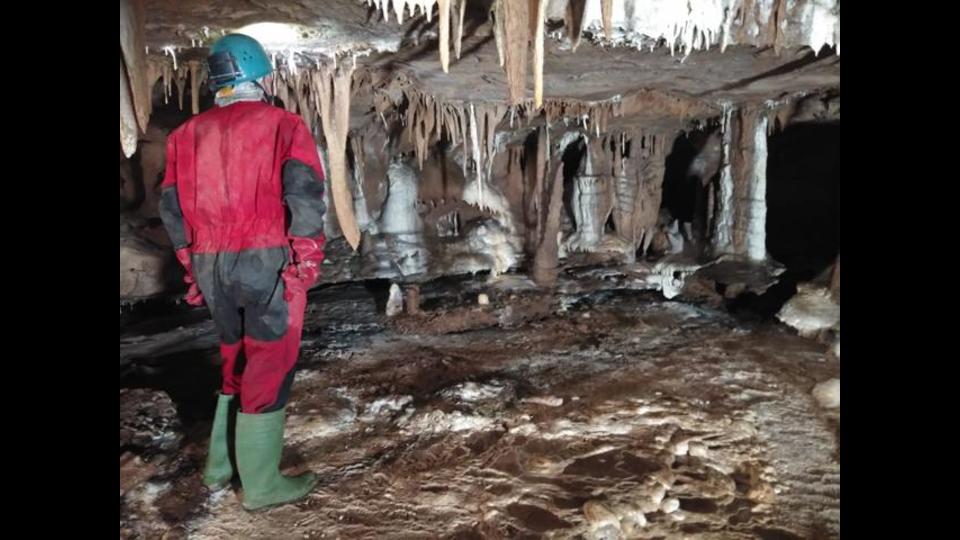
The mysteries of the earth’s fantastic past are hidden all around us — in rocks and caves, in stalagmites, even in plain sight. Travel back in time, as far back as 4.2 billion years, through ancient remnants still visible in and around some of India’s biggest cities.
The earth’s been through a lot in its 4.54 billion years. How much evidence of that early tumult is still visible? What can traces of that time tell us about how we got here, and what next? It turns out, there’s evidence of prehistory hiding in plain sight, even within and around our largest cities.
A peculiar stump rising out of the earth in the suburb of Andheri in Mumbai, now flanked by residential buildings and topped by two temples, dates back to a time when all of India was an island, floating towards Asia. That’s the soaring, 66-million-year-old Gilbert Hill.
In Meghalaya, a stalagmite was extracted from a cave, split open and studied, to reveal signs of a 200-year global megadrought that may have contributed to the decline of the Indus Valley Civilisation. The clear evidence of the megadrought observed in this stalagmite prompted the International Commission for Stratigraphy to name the period that began then, 4,200 years ago, the Meghalayan Age.
In Odisha, hair-thin zircon filaments found embedded in rocks date back to when the earth was an ocean of lava and was still being bombarded by asteroids, 4.2 billion years ago. The filaments also hold new clues to how (and when) the earliest rocks formed.
Not far from Bhopal, 550-million-year-old Dickinsonia fossils have been found at Bhimbetka. The fossils of a mysterious, soft-bodied organism believed to have been a kind of flatworm or lichen are the first Dickinsonia ever found in India.
Meanwhile, recently discovered rock paintings on the fringes of Delhi reveal that habitation in the Aravallis goes back a lot further than the Indus Valley Civilisation.
As dating technology improves, “India is now busy pushing its history back in time,” says SB Ota, retired joint director general of the Archaeological Survey of India.
Areas that need desperately to catch up are preservation, legislation and funding. Geologists Rajat Mazumder and Trisrota Chaudhuri, who discovered the zircon fragments in Odisha, had to beg labs around the world to test their samples, before a lab in China agreed to help. Mazumder is now struggling to secure funding to study the site further, and to preserve it.
Scientists across the country, meanwhile, have been pushing for a geo-heritage preservation law. “The wait is getting longer and geo-heritage sites are being vandalized unabated in many parts of the country in the name of development,” Dhiraj Mohan Banerjee, INSA emeritus scientist and former professor of geology at the University of Delhi, wrote in an editorial in the journal Current Science, in July 2021.
“India’s unique geological features are made by natural processes and cannot be repaired or replaced,” he added. “Once destroyed, they will be gone for ever.”
Gone with them would be clues to what the planet was like in its earliest years, the creatures that lived before us, the life and times of early man, even the causes, progressions and effects of previous phases of climate change. Wouldn’t that be a shame, to lose vital signs tucked away in the earth, of what a long strange trip it has been?
.
A stalagmite from Meghalaya gives our Age its name
In the long history of the earth’s 4.6 billion years, the sliver of time in which we currently exist is called the Meghalayan Age. It’s an age that is said to have begun about 4,200 years ago, with the early years marked by a global megadrought that lasted 200 years and devastated ancient civilisations in Greece, Egypt, Syria, Mesopotamia, China and our Indus Valley.
Evidence of the megadrought is most clearly observed in a stalagmite formation found at the Mawmluh cave in Cherrapunji, Meghalaya. It is this state that gives this Age its name.
Meghalaya is home to some of the longest and deepest caves in the world. Mineral deposits accumulated in the form of stalactites and stalagmites have sat undisturbed inside the caves for thousands of years, and preserved in their layers, are clues to the mysteries of the earth’s past.
The Mawmluh stalagmite first began to be studied in 2003. Shillong-based cave explorer Brian Daly led Ashish Sinha, a paeleoclimate researcher and a geologist at California State University, about 2.5 km into the Mawmluh cave, and they pried one of the bigger active stalagmites from its base and carried it out. “We took it to a marble slab cutter in Shillong and sliced it to reveal the layers that had formed within, not dissimilar to the rings on a tree,” says Daly, 74.
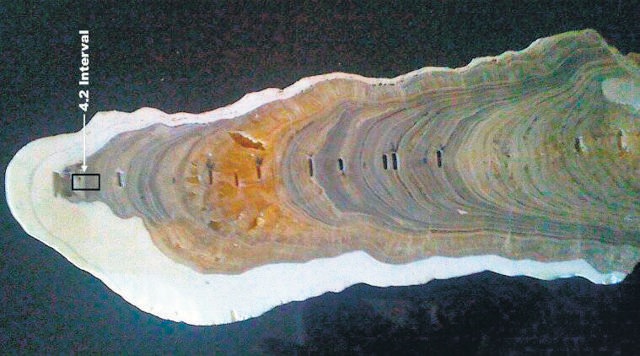
This stalagmite, estimated to be 40,000 years old, became an important subject of study in the field of stratigraphy, the branch of geology that correlates rock layers with geological timescale. A 2012 paper first proposed the idea of the Meghalayan Age based on evidence found in the stalagmite of how a particular oxygen atom changed, indicating, essentially, changes in precipitation.
In 2018, after widespread deliberation, the International Commission for Stratigraphy (ICS) named the period the Meghalayan Age.
The history-making stalagmite is housed at the Birbal Sahni Institute of Palaeosciences, Lucknow. But there are plenty more like it in the caves of Meghalaya, some of which, incredibly, are open to the public. The best time to visit is between November and April, but go with an experienced guide. You don’t want to be lost and wandering in 7 km of identical-looking passageways.
.
A fossil at Bhimbetka shifts a timeline for India
Speaking of ancient wonders lurking near us, the rock shelters at Bhimbetka have recently had a whole new chapter added to their story. The story was riveting enough. The petroglyphs (typically, rough outlines of people and animals scratched onto stone) and paintings on the cave walls here date back to a period from 290,000 to 10,000 years ago, and constitute some of the oldest known art in India. Scrawled over 700 caves spread across more than 10 km, this is also among the largest sites of ancient cave art in the world.
This cave art was accidentally discovered in 1957 by an archaeologist Vishnu Wakankar, while he was on his way to Nagpur by train (legend has it he looked out of the moving locomotive, saw the clear tier of stone running along a hilltop, and thought, there’s got to have been ancient habitation there; he uncovered numerous sites in this manner).
But it was only early last year that an even older sign of life was found here: 550-million-year-old fossils, from one of the earliest known multicellular organisms on earth, hidden in a wall of what is called the Auditorium Cave.
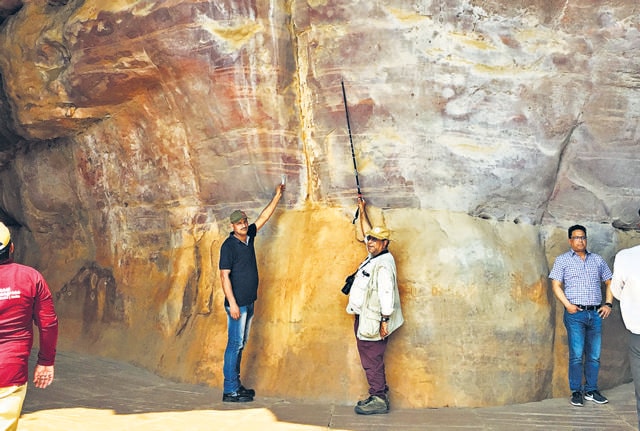
A group of geologists from the US and South Africa, in India for the International Geological Congress (which was cancelled because of the pandemic), was touring the Unesco World Heritage site when they made the discovery.
Sharad Master, a researcher at the School of Geosciences at the University of Witwatersrand in South Africa, was the first to spot the fossils. Soon the whole group, which was led by Ranjit Khangar and Merajuddin Khan of the Geological Survey of India, got involved, and they couldn’t believe what they were looking at.
“I was at first incredulous, but then agreed after seeing several diagnostic details,” says Gregory Retallack, a palaeontologist and geologist from the department of earth sciences at the University of Oregon in the US, and lead author of the paper that was later published in journal Science Direct.
The group knew, as they stood in the Auditorium Cave, that they would probably never get this close to the fossils again, so they pointed all available cameras, DSLRs and phones, at them and shot them from various angles. Retallack would later use photogrammetry, a digital manipulation of multiple images, to create a 3D model.
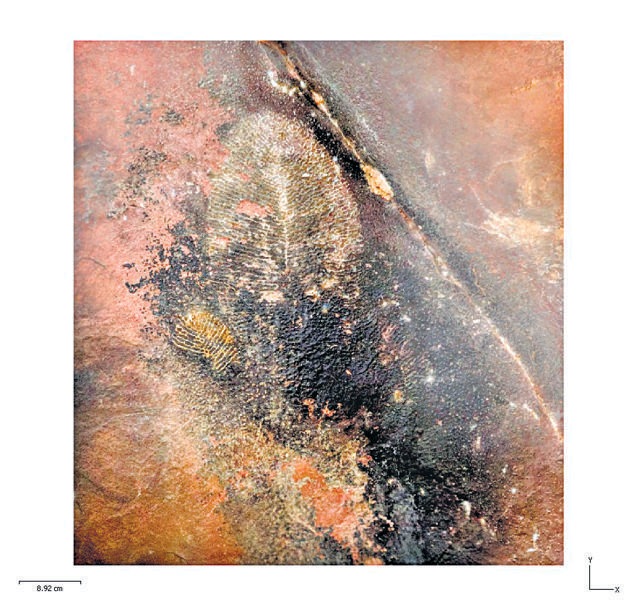
It helped that he had written several papers on the fossil they were staring at, the Dickinsonia, thus proving the adage that fortune favours the prepared mind, he said via email.
There were three specimens visible that day, the largest of which was about 50 cm long. When the Dickinsonia was first discovered in the 1940s in Australia, it was hard to tell that they were even animals. (They have since been found in the Ukraine, Russia, China and now India). They are oval shaped and symmetrically ribbed, and looked nothing like the animal life that followed. They are the remains of a group of mysterious, soft-bodied organisms that existed between 541 and 635 million years ago.
Though recent consensus in the community has moved toward calling the Dickinsonia an animal, Retallack doesn’t agree. “Some of my colleagues think it was a large marine flatworm that absorbed nutrients,” says Retallack. “I think Dickinsonia was a lichen.”
Whatever it was, this was an astonishing find.
.
Ancient rock art shows early Man lived just outside Delhi
Sunil Harsana still can’t believe the rock paintings he grew up around may be several thousand years old. What are now being considered some of the earliest signs of human habitation in the National Capital Region were on his daily route, as he grazed his family’s cattle when he was a child, deep within the forests of Mangar Bani in Faridabad, the only patch of primary forest in the national capital region.
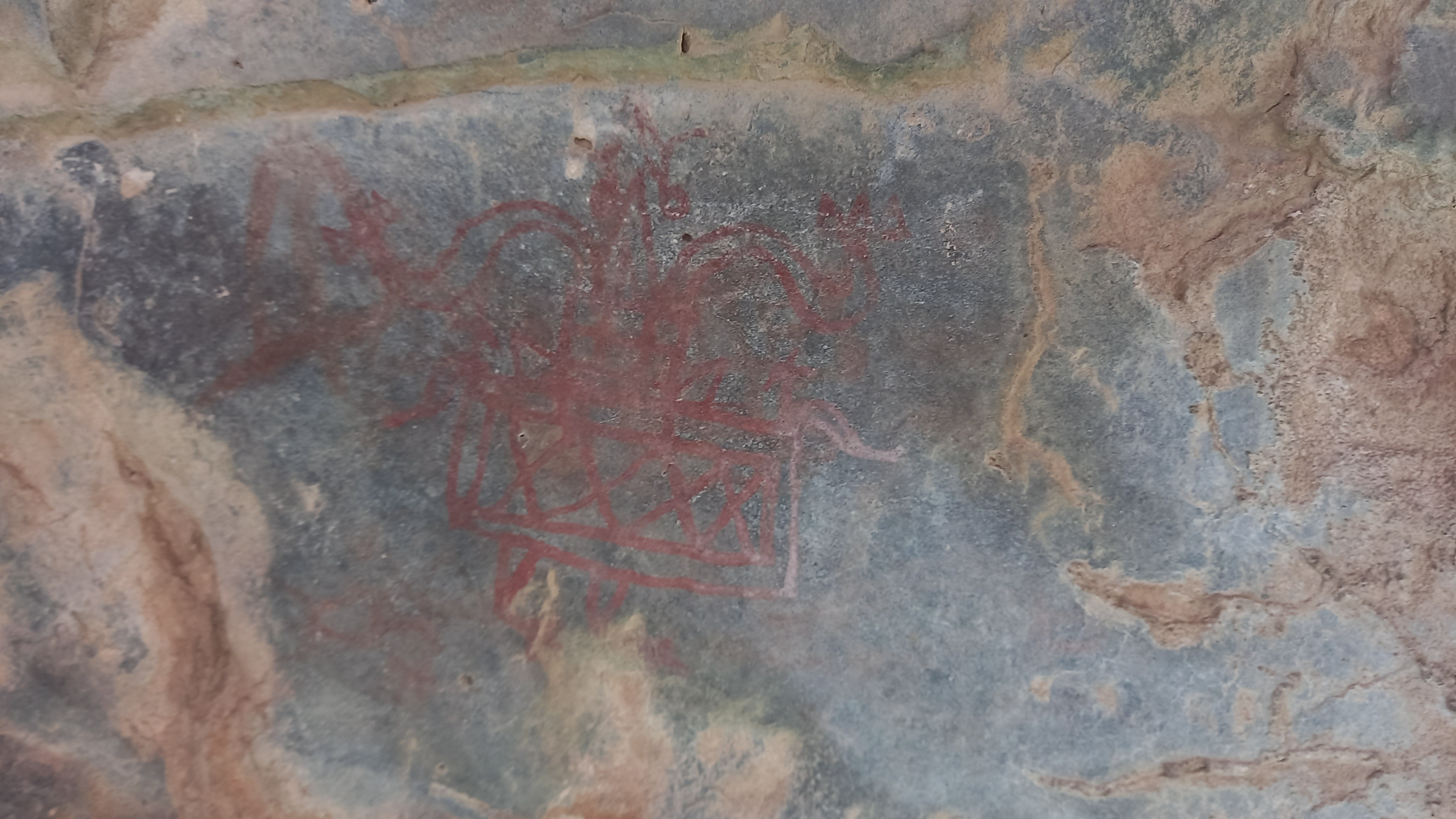
Harsana, now 32 and a conservationist and environmental consultant with the non-profit Centre for Ecology Development and Research (CEDAR), came upon the markings again recently, when he was documenting the flora and fauna of the forest. He posted photographs and videos on Facebook in May, and in June the Haryana Department of Archaeology and Museums took notice and decided to pay them a visit.
It turns out the “paintings” aren’t just prehistoric, they are the first of their kind found in the Aravallis.
Dating these finds will take some time. “All this needs to be studied in context to figure out when exactly they were made,” says SB Ota, retired joint director general of the Archaeological Survey of India. “At this point there are different clusters of paintings, petroglyphs, tools and implements. Was it all made at one time? Were they made by different groups? Are there different styles?”
Whatever the findings, the art is evidence that early man did camp on the Delhi Ridge. “Before these findings, Haryana was only identified with Harappan-era archaeology,” says Banani Bhattacharya, deputy director of the Haryana state department of archaeology and museums. “Now there is evidence of continuous habitation from the Stone Age to the historical period, around Delhi.”
(With inputs from Madhusree Ghosh)
.
Hyderabad’s giant rocks: Older than the dinosaurs
Palaces and empires have glittered and gone; an IT hub has now taken hold of Hyderabad. Through it all, silent sentinels have watched, dwarfing the rest of the city’s rich history.
Huge granite rocks in precarious positions sit stacked like a godly game of Jenga across the region. There are big rocks resting on small ones; round rocks wedged between wide ones; flat ones sandwiching higgledy-piggledy collections of boulders, any one of which could flatten a crowd.
There are rocks that resemble faces, elephants, rabbits’ ears, a human skull; some have been incorporated into the urban plan and turned into roundabouts’ others are preserved in public parks.
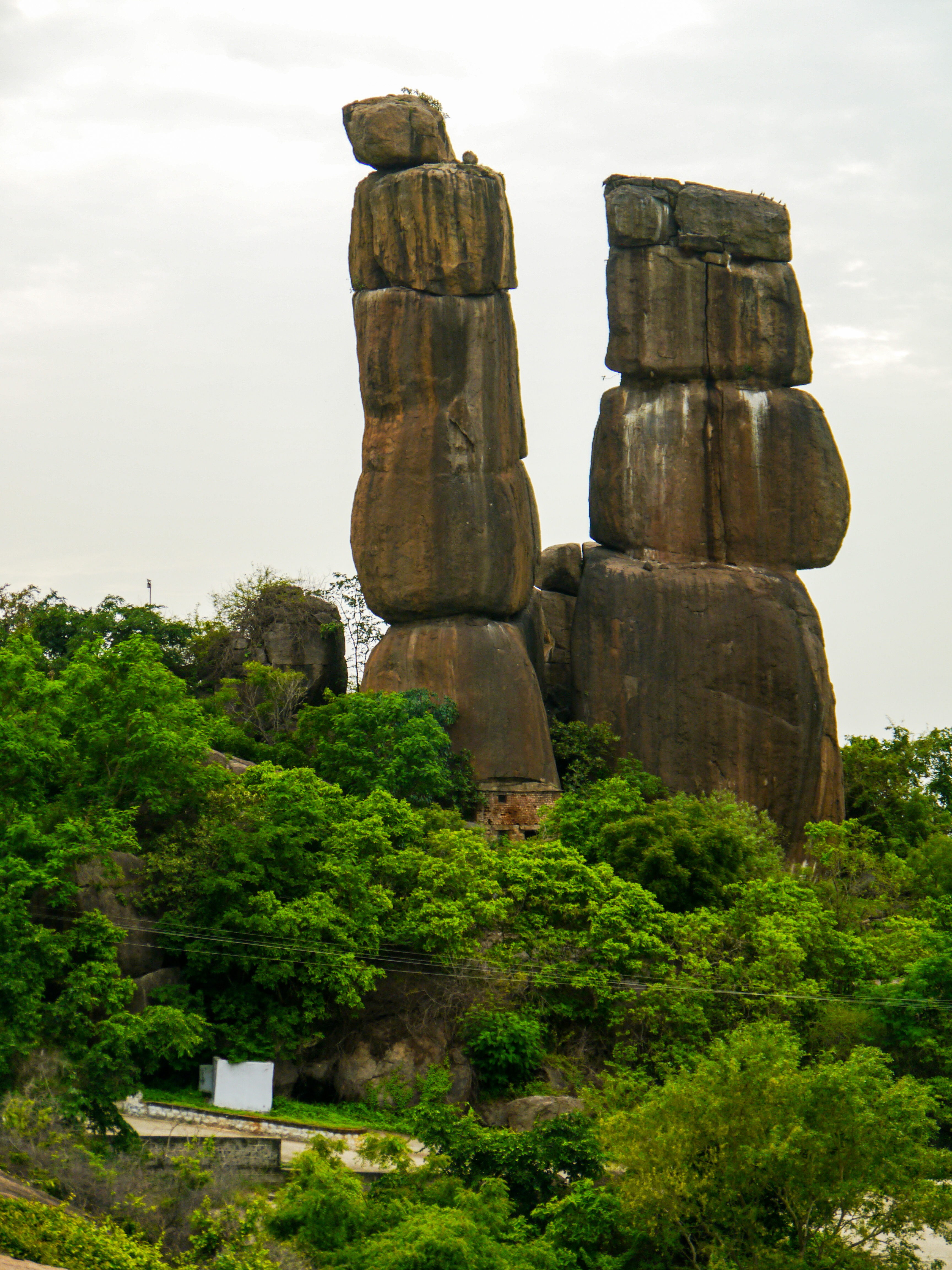
“These kinds of balancing and piled-up formations are all over the Deccan plateau,” says Frauke Quader, secretary of the Society to Save Rocks (SSR), a citizens group formed 25 years ago to save the rocks from being destroyed amid unmindful construction. “Some of them look like they are about to tip over. But, of course, they won’t.”
Some of these rocks have even been incorporated into homes in the luxury residences at Jubilee Hills. “They form parts of walls inside homes, some houses have been built on top of the rocks, and in some places they divide two properties, forming a natural boundary,” Quader says.
The rocks have been here for 2.5 billion years, since before the dinosaurs, before the Himalayas, when the earth was still a hot mess. Like much of the Deccan Plateau, this landscape was formed as a result of widespread volcanic activity, which cooled down over time, and weathered into the fascinating shapes we now see.
“Two billion years of wind, water and fluctuating temperatures can do that,” says R Pavanaguru, a retired geology professor at Osmania University. “What we have found is that apart from being a geological marvel, these rocks support rich biodiversity, including plants that have medicinal value.”
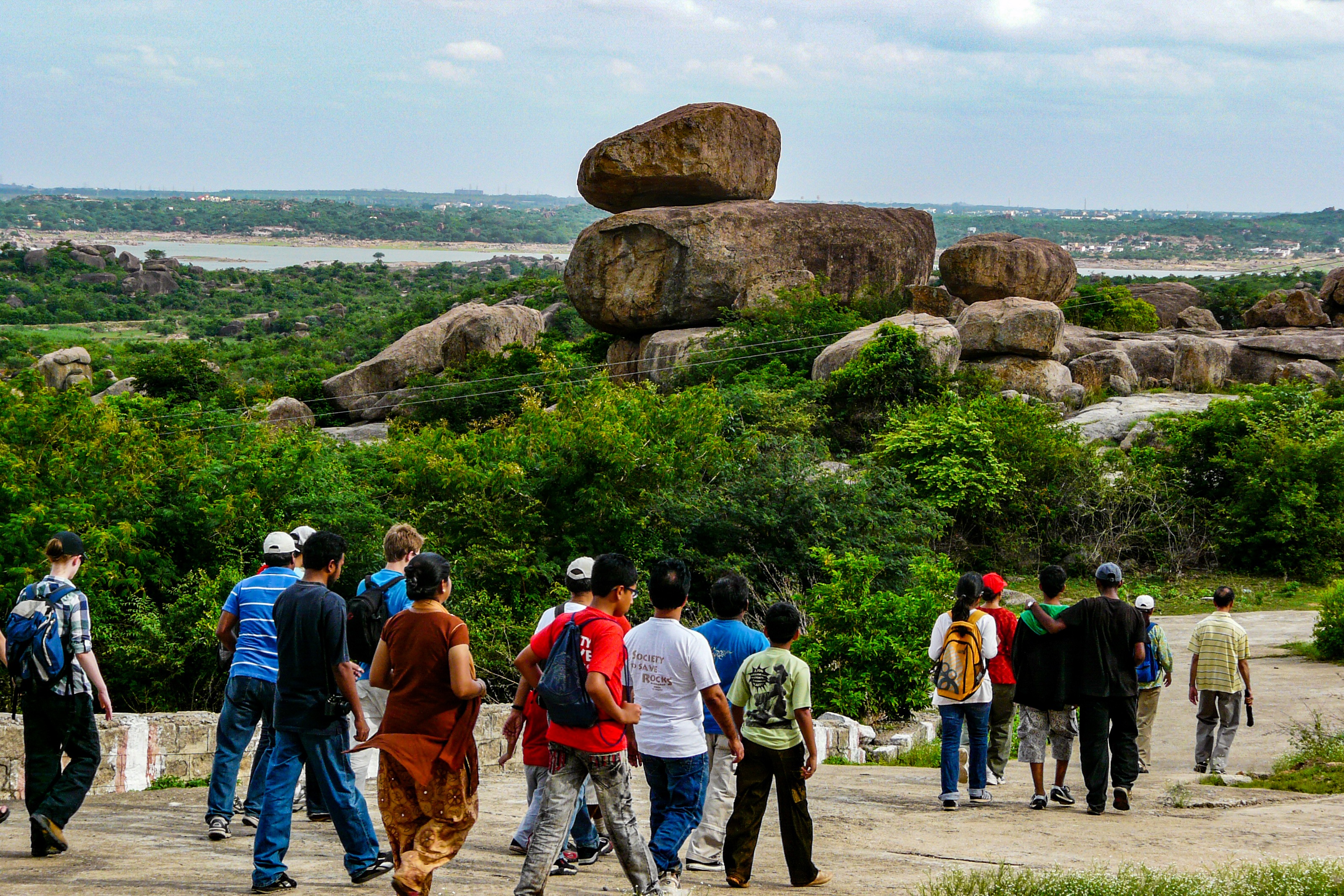
As Hyderabad grows and expands (it is now the fourth most populous city in India, with its population number rising from 6.9 million to 10.2 million over the last 10 years), though, the rocks and the ecosystems they support are under threat. “Incorporating them into construction is difficult and expensive,” says Quader. “So for the most part, they are just blasted away.”
SSR continues to campaign to save them. In 1998, they managed to get nine formations in the heart of the city to be listed as protected natural heritage. The society fought to expand that list and, in 2009, it grew to 25 protected rock precincts. While the new state of Telangana, created in 2014, recognises rocks as heritage, none of the 25 is listed as protected.
As a result, some of the bigger precincts have been nibbled at, Quader says. “Water tanks have been built on two. We’ve fought hard, raised our voices and gone to court,” he adds. “What we really need is for the city to collectively make a noise with us.”
.
Gilbert Hill in Mumbai, from a time when India was an island
It is one of Mumbai’s best-kept secrets. In the western suburb of Andheri, flanked by residential buildings, stands a 225-ft column of ancient rock that once dwarfed everything for miles.
It is a stump of earth that oozed out of the crust as molten lava over thousands of years, and has stood for millions (66 million years, to be sort of exact).
It formed when India was still a floating island that had broken off from Africa and was making its way to where we are now. “Around the time when she was cruising over where Mauritius and the Reunion islands currently are, which happens to be a hotspot in the earth’s crust, a very large body from space came smack and hit the earth at Chicxulub in Mexico,” says archaeologist and historian Kurush Dalal.
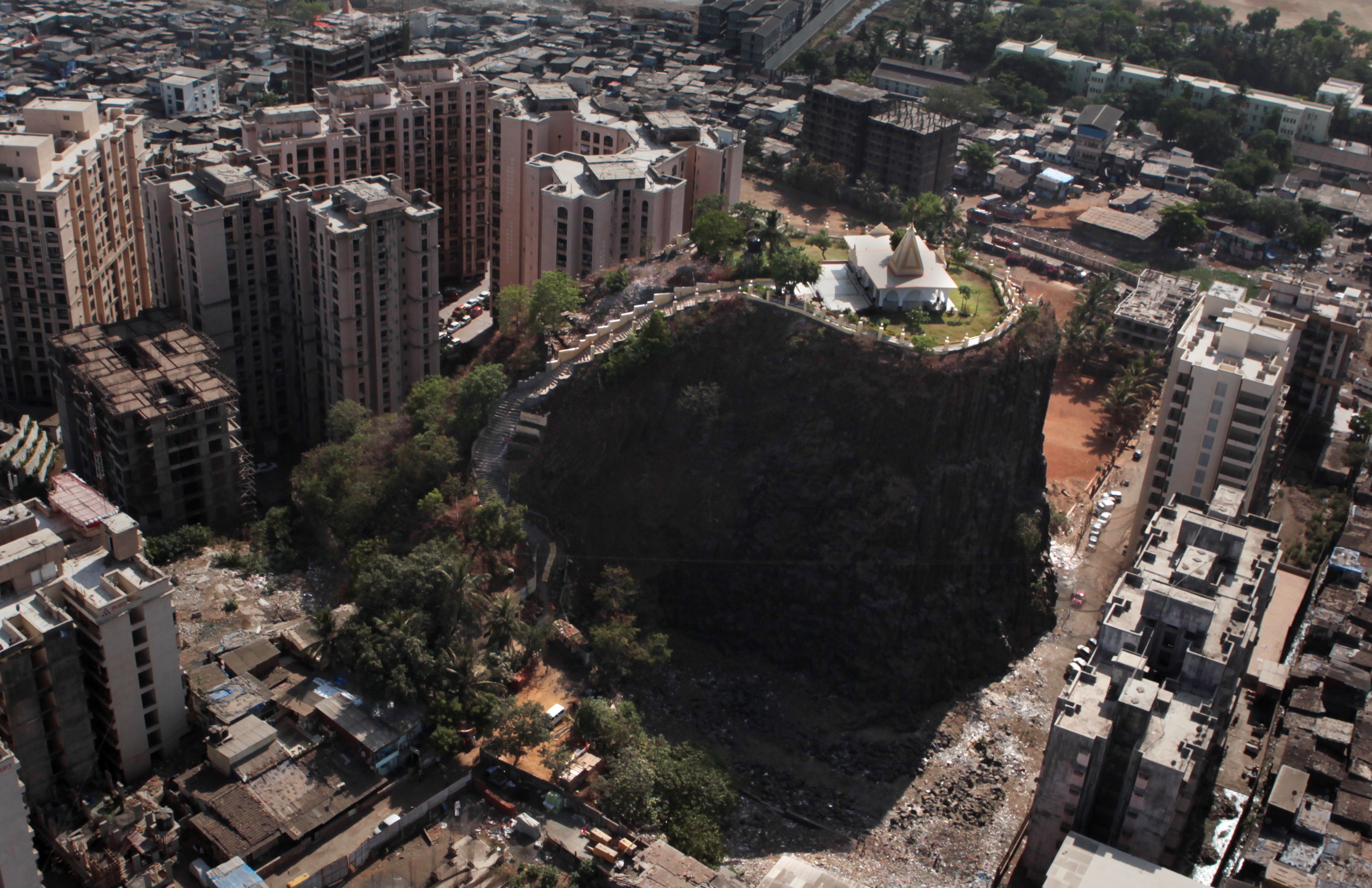
That impact delivered shockwaves across the planet, creating a global winter. On the floating island that was India at the time, it is theorised that the battering of the earth fuelled a series of volcanoes. “Some of the lava flows cooled quickly and some, like Gilbert Hill, which was squeezed out of the earth’s crust, cooled much slower and crystallised into these massive stumps of black basalt,” says Dalal.
The basalt column was originally part of a larger hill that has since been blasted and built over.
“The original expanse of Gilbert Hill can now only be viewed in a survey map of 1924. The present ‘Gilbert Hill’ is about one-tenth of that hill,” says Dr Kalpana Swaminathan, one half of the writing duo Kalpish Ratna. For their 2012 book Once Upon a Hill, Dr Swaminathan and her writing partner Dr Ishrat Syed went in search of the history of Gilbert Hill. “This columnar basalt was exposed when the true hill was blasted in 1939.”
Recent construction activity nearby has broken chunks of basalt off the column too. Before the city does more damage, visit and gaze up at one of the oldest geological formations in the country.


