
 E-Paper



Kochi-Muziris Biennale: Alang Ship Breaking Yard sails into annals of Indian art

 Prefer HTon Google


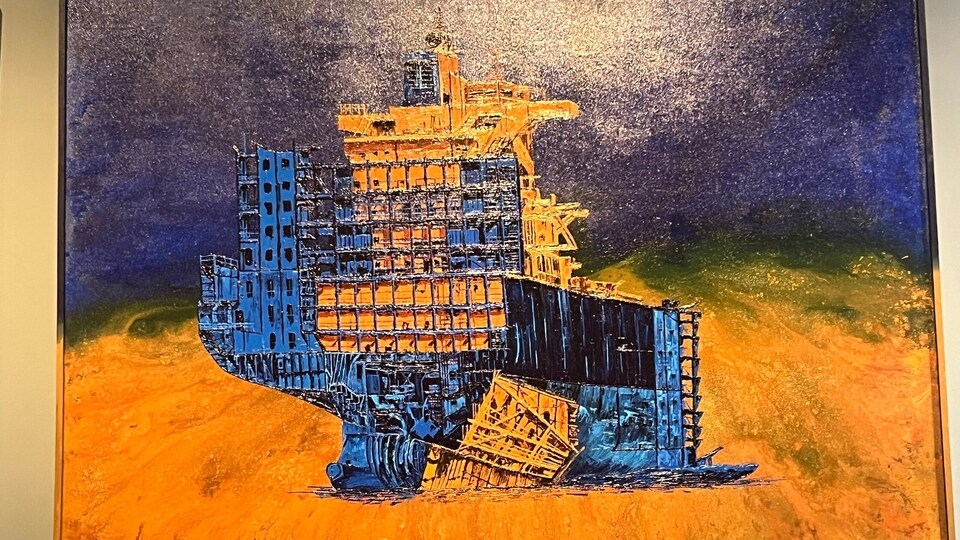
A highlight of Kochi-Muziris Biennale is Himanshu Jamod's deconstruction of the myth and infamy about the world's largest ship-dismantling hub in Gujarat.
"Every ship has an expiry date," declares Himanshu Jamod explaining the working of the world's largest ship dismantling yard in Alang, Gujarat. Jamod should know. The 32-year-old visual artist born in the port town of Bhavnagar has been watching ships arrive in Alang, only an hour's drive from his home, ever since he was a little boy. Also read | Kochi-Muziris Biennale 2025: Galaxy of young and emerging artists to present work from the grassroots
As a child curious about ships, Jamod would often accompany his father, a dockyard worker in Bhavnagar, and an uncle who worked in the Alang Ship Breaking Yard, to their workplaces.
"The Bhavnagar port is an old port built in the 18th century. The Alang Ship Breaking Yard came up in 1983. Ports and ships were part of my childhood. Many members of my family worked on ships and at sea," says Jamod, who amassed remarkable maritime knowledge before he passed out of secondary school.
It was, therefore, not surprising Jamod started sketching ships in the corridors of Gujarat's famed art school at the Maharaja Sayajirao University of Baroda in Vadodara, where he enrolled as a Bachelor of Fine Arts (BFA) student in 2013.
More than a decade later, Jamod's sketches have grown into large paintings that are part of the sixth edition of the Kochi-Muziris Biennale in Kerala, which began on December 12.

Art for Alang
"I would like people to know about Alang. The outside world doesn't know about the ship breaking yard because photography is prohibited on the site. Art probably can fill in the gap that exists," says Jamod, who is based in Vadodara.
Jamod, one of the 66 participating artists at the Kochi-Muziris Biennale, has 12 paintings on Alang at the sprawling Island Warehouse, a newly-added venue of the event this year.
"Alang is my backyard," says Jamod, who painted two large works, one measuring 14 feet in width and 10 feet in height displaying the anatomy of a ship ready for dismantling and the other 12 X 9 feet symbolising a dying vessel as a home full of life.

It is only fitting that the Kochi-Muziris Biennale has chosen to bring Jamod's works to its seaside venue visited by people from around the world. Alang is the only work that Jamod has ever done in his life as an artist, except a brief interest in sea trade routes to India when he was an under-graduate art student.
"All my work from the start as an artist until now has been about the Alang yard. There have been many artists who have done works on Alang, but nobody has worked on the yard for a longer period focused only on it," says Jamod, whose work on Alang spans a decade. “I think that is the reason I was selected for the Kochi-Muziris Biennale.”

Graveyard or paradise?
Founded in 1983, Alang Ship Breaking Yard has long been a subject of constant criticism by environmental activists at home and abroad who have dubbed it the world's "dumping ground" for old cargo ships. The activists cite hazards from toxic parts of ships for workers and the ecology.
"Alang is called the world's largest graveyard of ships, a description I don't agree with," says Jamod. "I grew up in the surroundings of Alang. If my father hadn't worked there, I would not have become an artist," he adds. "For me it is a different kind of world, it is a paradise."
"There have been generations of workers in the yard who come from states like Uttar Pradesh and Bihar. While they break the vessels, they are also witnessing the growth of their families. I have heard workers saying 'my house wouldn't have been built if I hadn't worked in Alang' or 'my daughter wouldn't have become a lawyer 'or 'my son wouldn't have become a doctor'," says Jamod, who pays tribute to the site through his paintings.

Alang is the only ship breaking yard where the dismantling is done on the coastal sand while others across the world break the vessels in deep water. A ship that is earmarked for dismantling arrives in Alang in the last year of its service. "It is the vessel's final voyage," says Jamod.
"I am not focusing on environmental impact or the struggle of workers," says the artist. "My focus is on how a ship is broken into bits and the different processes of cutting," he adds.
An ordinary container ship is cut starting from its sides while an oil cargo vessel is first cut at the bottom. "A ship is a big structure, but the cuts create small forms. That is what my first series on Alang is about," says Jamod, who began recollecting memories of his various visits to the ship breaking yard soon after his BFA in Vadodara.

Solo with ships
The Retrieve series, which Jamod began in 2015, his first year at the Master of Fine Arts programme in Vadodara, is about the "untold story" of Alang, the brush strokes outlining the interiors of a ship, such as "how much electrical wiring is there and how many compartments a ship has".
Ten paintings, including the two large ones, from the Retrieve series, are part of the biennale. Two more surreal paintings from his new Seedbed series complete the biennale collection, which Jamod considers his "first solo exhibition".
Goa-based artist Nikhil Chopra, the curator of the current edition of the biennale, visited Jamod's studio in Vadodara during the selection process for participating artists early this year. "The curator was impressed by the fact that I had been working only on one subject in the last one decade," says Jamod. "I think people can know more about Alang from my paintings."
The ship breaking and recycling hub, which witnessed decline in number of ships arrivals in the past decade, has been limping back to normalcy in the last two years. "The broken metal from an old ship is of high quality, which is melted for making rods, iron sheets, machinery and iron bearings. There is a flourishing second-hand market in Alang for material from discarded ships," says Jamod.
The Kochi-Muziris Biennale runs up to March 31 next year.


