
 E-Paper



Paperback alleys: A new platform lists beloved tales starring cities of the subcontinent

 Prefer HTon Google


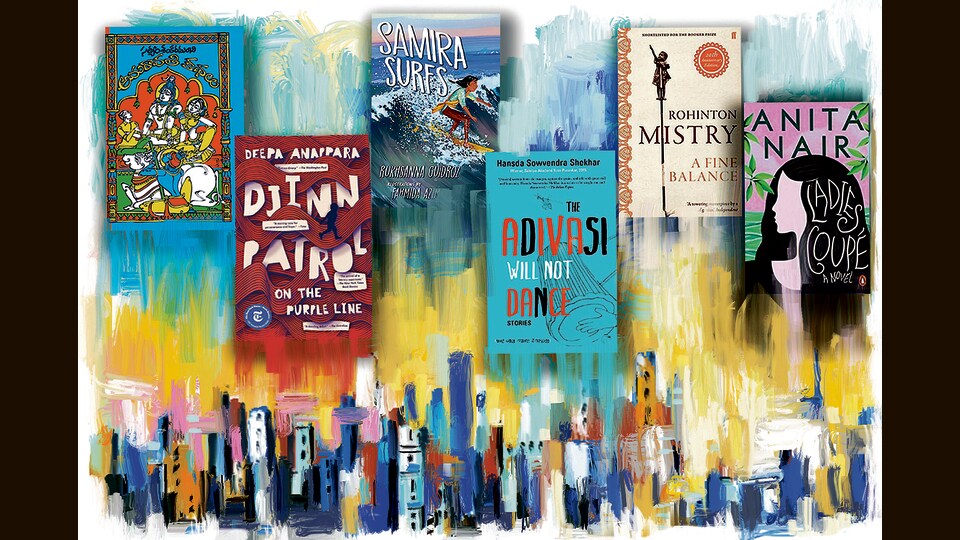
Could fiction be used as a teaching tool, to help explain cultures and peoples, demystify the periodic table? A web project’s crowdsourced list is a first step.
What is your favourite depiction of an Indian city in literature?
That’s the question Divya Ravindranath, a researcher and faculty member with the Indian Institute for Human Settlements (IIHS) in Bengaluru, posed on X in 2022.
In a year, she had gathered enough responses to build a rudimentary database; it has since grown from those original 100 titles to 400, and is now the ongoing crowdsourced platform Cities in Fiction (citiesinfiction.com), co-founded in September by Ravindranath, 39, and Apoorva Saini, 30, a fellow with the IIHS Urban Fellows Programme.
“When we started, the list was meant to focus on Indian cities, but before we knew it, people were entering mentions of cities in Nepal, Bangladesh, Pakistan,” Ravindranath says, so it is now a subcontinental repository.
Eventually, the plan is to use the repository as a reference point for lovers of literature and of India; as a record of how cities have been transformed (more on that in a bit); but also as a teaching tool.
“For instance, the short story They Eat Meat, from The Adivasi Will Not Dance by Hansda Sowvendra Shekhar, is an excellent device for talking about housing and migration,” Ravindranath says.
They Eat Meat is about a Santhal family that moves to Vadodara from the outskirts of Ranchi. Their new landlord tells them that “people believe in purity” in this city, and suggests that they give up their non-vegetarian food and not reveal their tribal identity. The tribal family does so, and is quietly lauded for “adapting” to their new surroundings. But this glorification shifts gradually into humiliation, as they are pushed to shed more and more of their true identity.
“The story can be a good starting point for conversations about how migration and marginalised identities are viewed by dominant groups, and how this informs our very definitions of discrimination, prejudice and segregation. “One can use data to explore such themes, and one must,” Ravindranath says, “but fiction brings affect and can have an incredible impact on young students.”
Similarly, themes such as poverty, corruption, marginalisation and life in a slum can be explored with children, through some of the children’s books listed, such as Djinn Patrol on the Purple Line by Deepa Anappara; Jwala Kumar and the Gift of Fire: Adventures in Champakbagh by Hansda Sowvendra Shekhar; and Samira Surfs, about a Rohingya girl’s journey from isolation to friendship, written by the Persian-Indian-Chinese-American Rukhsanna Guidroz.
The larger idea is to encourage learners and educators to see fiction as method. “For example, can a chemistry teacher think of teaching her students about the chemical properties of elements, through a story? There is a section in Anita Nair’s novel, Ladies Coupe, where the characters are described, according to their nature or behaviour, as elements from the periodic table. It would make for excellent secondary reading. This mode of learning can be used by any discipline,” Saini says. “Researchers could eventually look to build such titles into curricula.”
Aside from the larger missions, one of the joys of running Cities in Fiction, the women say, has been encountering places they once loved, that are long-gone.
Saini was surprised to discover an entry on Amaravathi Kathalu (1979), a collection of short stories by Telugu writer Satyam Sankaramanchi. His stories merge elements from folk tales with events occurring in this erstwhile town on the banks of Krishna river, in Andhra Pradesh.
Amaravati is a large city now, and the capital of Andhra Pradesh. It is currently in the process of being reimagined yet again. In the listing, Saini was able to revisit a place she had first encountered as a child. “In school, I used to watch the serial Amaravati ki Kathayein, by Shyam Benegal (1995; Doordarshan) and the stories left such an impression on me that my dollhouse was always in Amaravati, next to an imaginary river,” she says.
Ravindranath and Saini have added their favourite titles to the repository too. These include Rohinton Mistry’s A Fine Balance (1995), the story of four people who meet, live and work in an overcrowded metropolis (believed to be based on Bombay / Mumbai), in the 1970s and ’80s, in a rapidly changing India. For Ravindranath, this is a particularly evocative work since she grew up in the city he describes, and now lives away from it, in Bengaluru.
Saini’s favourites include a short story by visual artist Bhupen Khakhar titled Wadki (Gujarati for Bowl), which doesn’t explicitly mention a city but draws vivid pictures of life in a residential building in Gujarat. It’s a quiet tale, of the kind currently playing out in numerous such cities in India, and the kind she knows so well from her childhood in Alwar, and her current life in Bhopal. “In a lot of its details, it is very hyperlocal, and yet it is universal,” she says.


